A complete guide to visiting Gelati and Motsameta Monasteries from Kutaisi – including transport options, hiking directions, and where to stop for a traditional Imeretian lunch.
In the forested hills of Imereti outside Kutaisi you can find two of Georgia’s most important monasteries: The UNESCO-listed Gelati Monastery, and the smaller Motsameta Monastery.
Founded in the 12th century, hilltop Gelati offers a glimpse into Georgia’s Golden Age and its extraordinary intellectual and religious heritage. Perched above the Tskaltsitela River gorge, Motsameta is known for its dramatic setting.
Located around 20 minutes’ drive northeast of the city, the monasteries are just 5 kilometres apart and can easily be combined into a rewarding side trip from Kutaisi.
There are several ways to reach the monasteries. You can take a local marshrutka minivan, hire a private driver, or join a guided half-day tour. Alternatively, there is a walking route connecting the two, passing through woodland and along quiet village streets. If you have more time, I recommend making a half-day of it by combining the monasteries with a traditional Imeretian lunch.
In this guide, I’ll cover what to see at Gelati and Motsameta, the latest information about restoration works and closures, how to get there independently or with a driver, and how to hike between the two monasteries.
Please note: This post contains affiliate links, meaning I may earn a commission if you make a purchase by clicking a link (at no extra cost to you). Learn more.


Gelati & Motsameta Monasteries: Quick overview
- Distance from Kutaisi: 6-11 kilometres
- Opening hours: 9am-6pm (Gelati – Saturdays, Sundays & religious holidays only; Motsameta – daily)
- Admission: Free
- Recommended visiting time: 2-3 hours by car, 3-4 hours with the hike, or 5-6 hours with hiking and lunch at Korena
- Guided tour: Bagrati, Gelati & Motsameta Tour with Budget Georgia (mention Wander-Lush for 10% off)
- Accommodation/meals nearby: Agro Guesthouse Korena
Gelati restorations: Is Gelati Monastery open?
Important: Gelati Monastery is partially closed for restorations and visitor access is currently restricted to Saturdays, Sundays and religious holidays.

Gelati has been undergoing extensive conservation work for several years now following serious issues with its new roof (water was coming into the building, causing damage to the frescoes and mosaics).
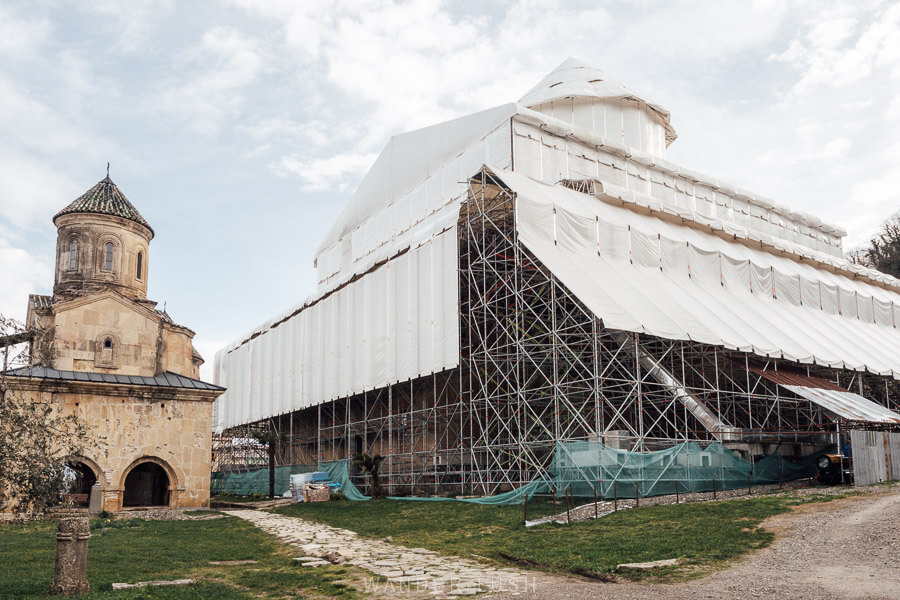
At the time of writing, these works are ongoing, and the main Cathedral of the Virgin is now completely covered by a white protective structure – as shown in some of my photos.
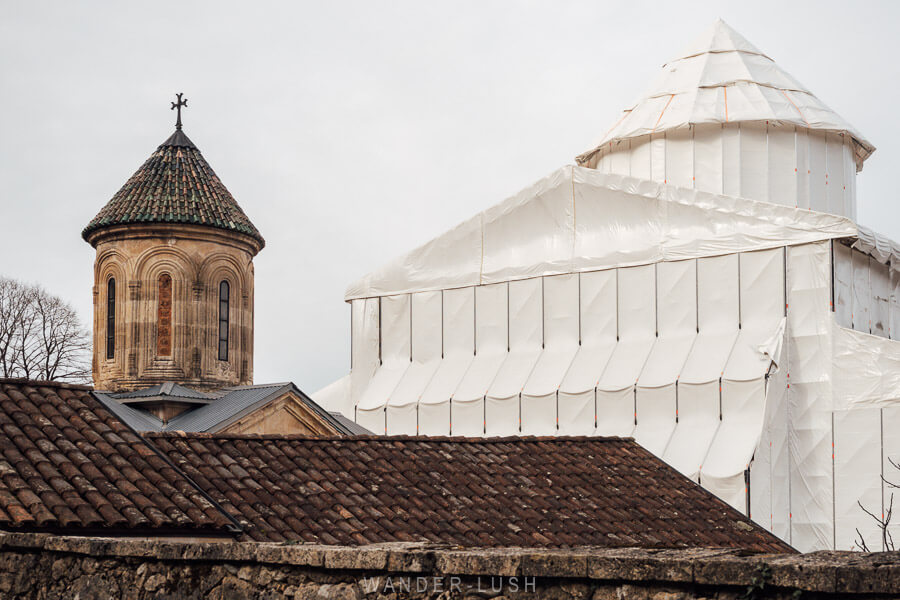
Gelati Monastery is only open to visitors on Saturdays, Sundays and religious holidays. On other days, the main gate is locked and the entire complex is off-limits. This means you cannot enter the grounds at all.
Even when the gate is open, access to the main cathedral is not guaranteed. The cathedral may be locked if work is happening, as it was when I last visited. If it’s unlocked, you will be able to get a partial view of the frescoes and mosaics through the scaffolding. Either way, when open, you can still explore the wider monastery complex – including the smaller churches, the historic Academy building, and the tomb of King David the Builder.
There has been some positive progress with the conservation project, but the restoration is a long-term undertaking with no firm finish date. For the latest, refer to the official Gelati Rehabilitation website.
Motsameta Monastery is not affected by Gelati’s restoration works and is normally open daily.
Gelati Monastery: Kutaisi’s UNESCO World Heritage Site
Founded in 1106 by King David IV – better known as David the Builder – Gelati Monastery is one of Georgia’s most important medieval monuments and a masterpiece of the country’s Golden Age.
At the time of its establishment, Kutaisi was the first capital of a powerful, unified Georgian kingdom. David envisaged Gelati not only as a religious centre, but also as a place of learning to rival the other great intellectual institutions of the Byzantine world – eventually earning it a reputation as a ‘New Athens‘ and a ‘Second Jerusalem’.
The prestigious Gelati Academy attracted the period’s leading scholars, philosophers and theologians who studied astronomy, geometry and other subjects while also translating important texts into Georgian. You can visit the long, open Academy building (it honestly looks a bit like a wine cellar!) on the western side of the monastery complex. There are a few museum cases inside with displays in Georgian.

Gelati’s centrepiece is the Cathedral of the Virgin, completed in 1130 during the reign of David’s son, King Demetre I. It is famous for its extraordinary 12th-century mosaic depicting the Virgin and Child flanked by the archangels Michael and Gabriel against a gold background.
The cathedral also contains an extensive collection of medieval frescoes, including portraits of Georgian royalty. Access is currently restricted by conservation works, although you might be lucky enough to catch a partial glimpse through the scaffolding if the cathedral is open.


Another interesting feature of Gelati is the southern gateway, where David the Builder is buried. According to tradition, the king requested that his tomb be placed beneath the entrance so that everyone entering the monastery would have to walk over his grave – a gesture of humility from one of Georgia’s most celebrated figures.
The gateway features an extraordinarily beautiful iron door from Ganja in present-day Azerbaijan, brought to Gelati by King Demetre I in 1139. Its original Arabic inscription dates to 1062.
The complex also includes the smaller churches of St George and St Nicholas, and a freestanding bell tower.

In 1994, Gelati was one of the first two sites in the Caucasus to receive UNESCO World Heritage status. Originally it was inscribed together with Bagrati Cathedral in Kutaisi, but following the controversial renovations at Bagrati in 2017, it has been listed independently.
Motsameta Monastery: The Place of the Martyrs
While Gelati is the more historically significant monastery, Motsameta wins out when it comes to location.
This little monastery is perched on a rocky promontory high above the Tskaltsitela River, almost completely surrounded by a deep, forested gorge. Its stone churches, red-tiled roofs and narrow walkways blend seamlessly into the surrounding landscape.

Motsameta translates to ‘Place of the Martyrs’, a reference to brothers David and Constantine Mkheidze, local rulers of the Argveti duchy who resisted an Arab invasion in the 8th century. According to tradition, the brothers were captured and executed after refusing to renounce Christianity. Their bodies were thrown into the ‘Red Water’ River, and their remains were later recovered and interred at the site of the monastery.
From the carpark, you need to walk a short way via a paved path to reach the monastery. Inside the church, a raised reliquary contains the brothers’ sacred remains. Local custom has it that passing beneath the reliquary three times while making a wish brings blessings.
Unlike Gelati, Motsameta is normally open daily – although it might be closed if there is a wedding taking place.
How to get to Gelati & Motsameta from Kutaisi
The two monasteries are located in the hills northeast of Kutaisi, approximately 15-20 minutes from the city centre by road. Gelati is furthest away, so if you plan to visit both, I recommend starting there and working your way back towards town.
Allow approximately 2-3 hours to visit both monasteries by car, including travel time from Kutaisi. If you want to hike between the monasteries, allow 3-4 hours in total, or 5-6 hours if you also stop for lunch at Agro Guesthouse Korena.
By taxi or with a private driver
You can use Bolt to travel from Kutaisi to Gelati (~15-20 GEL), but the app does not work in the village so you won’t be able to call a car from Gelati.
A better option is to book a private round-trip transfer through GoTrip. Prices start from around 15 USD for the whole car, and the driver will wait for you while you explore both monasteries. You can also add Agro Guesthouse Korena as an extra stop if you want to arrange lunch (more below).
By marshrutka
There is a direct marshrutka service between Kutaisi and Gelati Monastery. Vans depart from the centre of the city behind the Meskhishvili Theatre, close to the Colchis Fountain. Look for a van displaying ‘Gelati Monastery’ in English on the windscreen – some have a picture of the monastery.

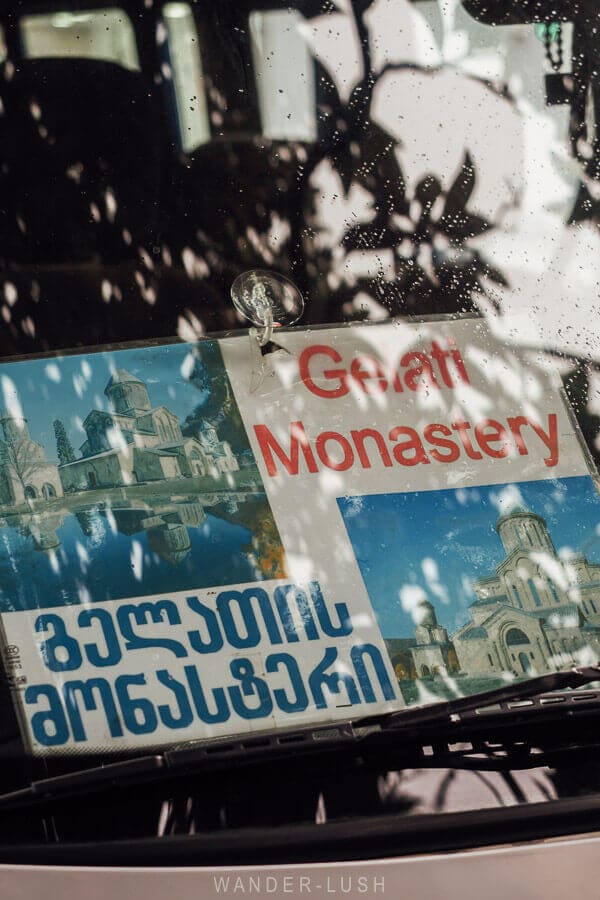
There are four or five departures daily from Kutaisi in either direction:
Kutaisi to Gelati Monastery:
- 7.30am
- 11am
- 2pm
- 4pm
- 6pm
Gelati Monastery to Kutaisi:
- 8am
- 11.30am
- 2.30pm
- 4.30pm
It’s always a good idea to verify the times in person before you travel – the Kutaisi Tourist Information office can help with that.
The fare is 4 GEL cash, paid directly to the driver. The journey takes approximately 20 minutes. Before you board, make sure the van is going all the way to Gelati Monastery rather than terminating in the village.
If you want to visit both monasteries by public transport, you can take the marshrutka up to Gelati then walk downhill towards Motsameta (as described below). When you’re done, it’s a 2-kilometre walk back to the highway, where you can flag down a minivan travelling to Kutaisi. Vans from Orpiri village come down this road fairly frequently, but you might have to wait a while depending on the time of day.
Guided tours to Gelati & Motsameta
There is virtually no signage at either monastery, no audio guides, and no guides to hire on site. So if you’d like to learn more about the history, it’s best to go with a local guide from Kutaisi.
Budget Georgia runs a small group trip to the monasteries year-round, departing from their office on the Colchis Fountain every day at 9am and returning at 12pm. The three-hour excursion costs 50 GEL per person, and includes an English-speaking guide. We did this tour on our second visit to Kutaisi way back in 2019.
The itinerary normally covers Bagrati Cathedral, Gelati and Motsameta – but due to the ongoing restoration works at Gelati, it currently substitutes Holy Annunciation Church and Mtsvanekvavila Church in town.
Bookings are essential – reserve a place in person at the office or book online, and mention me for 10% off.

Hiking between Gelati & Motsameta
If you have extra time and want to turn this into a longer day trip, there is an option to walk between Gelati and Motsameta. The route follows a mix of woodland paths, village streets and quiet rural roads, with beautiful views of the surrounding hills and the Tskaltsitela River valley.
Starting at Gelati makes the most sense, as the route is predominantly downhill. You’ll need around 60-90 minutes to cover the 4-5 kilometre trail from Motsameta from Gelati.
Walking from Gelati to Motsameta
The walking trail starts immediately outside Gelati Monastery. As you exit the main gates, turn right and follow the monastery wall past the cemetery and look for a pathway branching downhill into the trees.
The first section follows a fairly steep descent through the forest. The first half has been upgraded with concrete, lighting and bench seats, but there are still uneven sections, so it’s best to have proper shoes.
At the first major fork, take the left-hand path and continue descending. Eventually, the woodland gives way to houses and village streets. Follow the road downhill until you reach the main Kutaisi-Gelati road, then turn left and cross the bridge over the Tskaltsitela River. From here, you can continue along the main road towards the signposted turn-off for Motsameta Monastery, then follow the access road up towards the monastery.
There are several GPS tracks available on Wikiloc, including an alternative route that follows the railway line towards Motsameta. After crossing the river, continue along the main road for approximately 400 metres until you reach a bakery and small market on your left. Take the path immediately after the market and follow it uphill for around 600 metres to the tracks. From here, the route turns left and follows the tracks for approximately one kilometre, with lovely views of Motsameta on your left as you approach.
Freight trains still use this line, though, so I do not recommend walking on the tracks.
Continuing from Motsameta to Kutaisi
After visiting Motsameta, you can then walk all the way back to Kutaisi, bringing the total distance to around 8-10 kilometres. Several published routes follow the old railway line through the Tskaltsitela valley, emerging in Sapichkhia. But again, you need to follow the train tracks, which is not necessarily safe.
I recommend you walk back from Motsameta to the main highway – approximately 1.8 kilometres – and flag down a passing Kutaisi-bound marshrutka from there. Alternatively you could pre-schedule a Bolt taxi to meet you in the Motsameta car park.
Where to eat near Gelati: Agro Guesthouse Korena
There are several excellent restaurants in the hills near the monasteries, so you can also grab lunch while you’re up there. My top recommendation is Agro Guesthouse Korena, located near Gelati. You might recognise the family matriarch, Bebia Dali, from Sasha Korban’s famous With Love mural in Kutaisi.
Lunches are laid out inside a beautiful old wooden oda house, which has a fireplace for winter and a veranda for summer dining. This involves a huge spread of local Imeretian dishes – Imeruli khachapuri, pkhali, beans, mushrooms – many prepared using traditional clay ketsi pans.

This is a family home rather than a walk-in restaurant, so reservations via the website are essential. Cooking masterclasses and overnight accommodation are also available.
From Korena, it’s approximately a 20-minute walk downhill to Gelati Monastery – so it makes the most sense to eat lunch first before continuing by foot.
Practical tips for visiting the monasteries
Dress appropriately. Both monasteries are active Orthodox religious sites, and modest dress is required. Women are expected to cover their shoulders, knees and heads, and may be asked to wear a skirt. Men should wear long trousers and an uncovered head. Scarves and skirts are available to borrow at both entrances.
Admission fees & donations: Like all monasteries and churches in Georgia, Gelati and Motsameta are both free to visit. Bring cash (small notes or coins) if you want to leave a donation in the box or purchase candles etc from the church shop.
Photography and drones: There is no outright ban on camera photography at either monastery, but some areas might prohibit flash photography, so keep an eye out for any signage. You will often see groups flying drones for wedding parties, particularly at Motsameta.
Pick a clear day: Both complexes are very outdoor-orientated, so you want to avoid visiting in bad weather when possible.
Plan your return transport. If you’re visiting independently, remember that Bolt does not work in Gelati/Motsameta. Arrange a private driver through GoTrip to wait for you, schedule a pickup in advance, or give yourself enough time to get back to the main road for a marshrutka.
If you’re hiking: Wear sensible shoes, consider poles if it’s been raining, and bring water and snacks. There are a few small shops in the villages, but facilities are limited.
All comments are moderated and may take a little while to appear. If you’ve submitted your comment, I’ve got it!