Looking for something a bit different (and local) to do in Hanoi, Vietnam?
Here’s everything you’ll need to plan a visit to Quang Ba Flower Market and Long Bien Market – with sunrise over Long Bien Bridge, Dong Xuan Market, and breakfast in Hanoi Old Quarter thrown in.
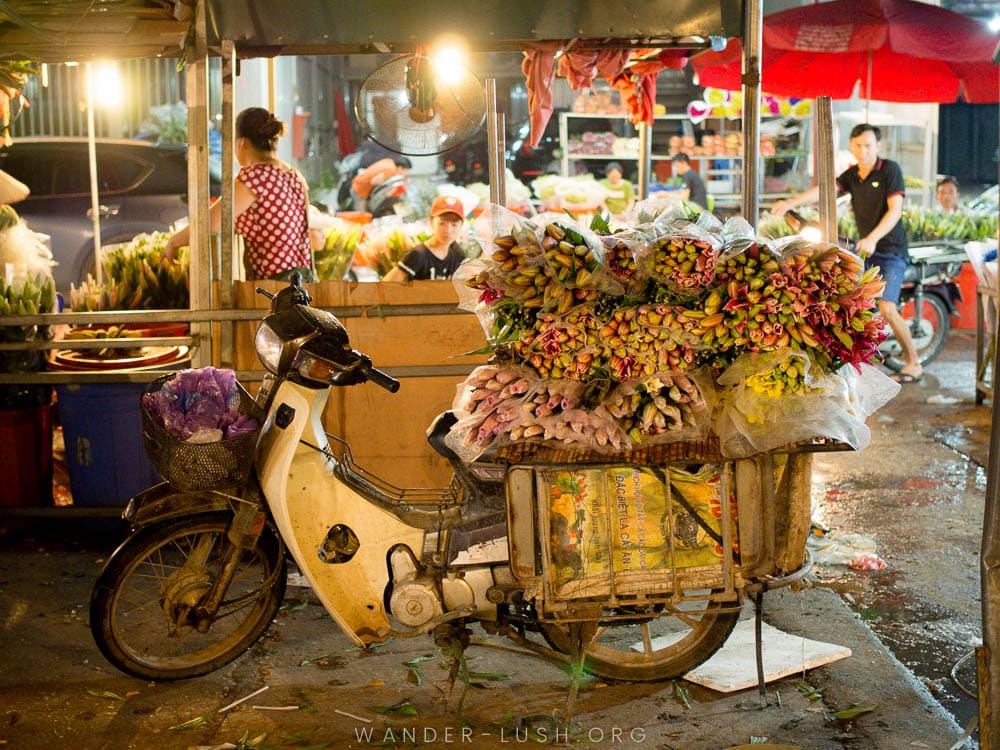
There are two things I’ll always associate with Hanoi: Street food, and ladies wheeling bicycles laden with fresh-cut flowers. These two vibrant industries are part of the city’s character – without them, Hanoi just wouldn’t be the same.
Street vendors are some of Hanoi’s hardest-working residents, and they start their days long before the rest of the city has woken up. One of the best things you can do when visiting Hanoi is check out the morning markets, where it all begins.

More from Vietnam
Discover the best city guides, itineraries, travel tips & hidden gems in my Vietnam Travel Guide.
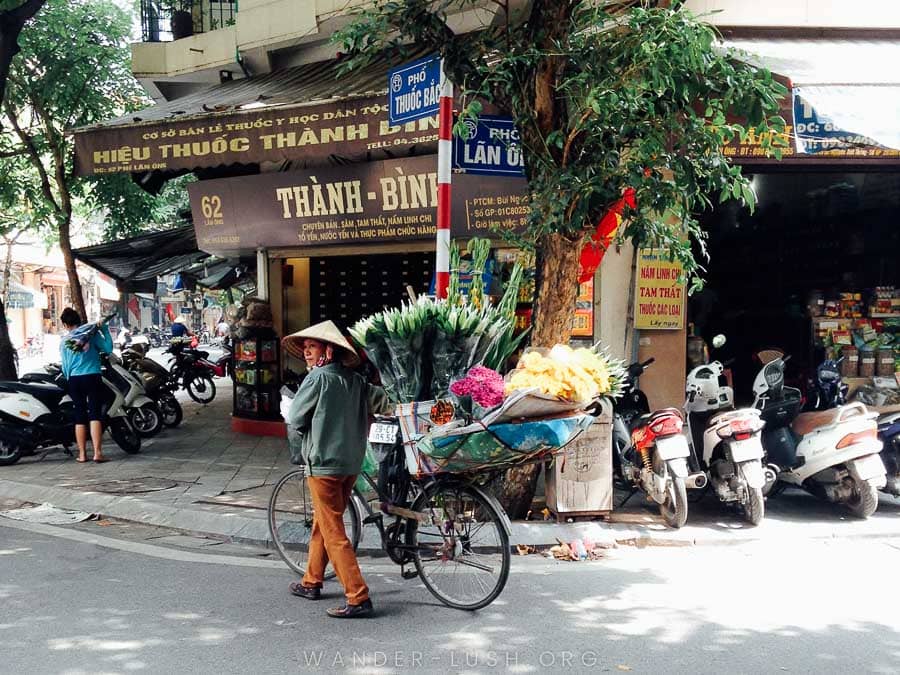
Quang Ba Flower Market (Hanoi’s main marketplace for fresh-cut flowers) and Long Bien Market (Northern Vietnam’s biggest wet market) are two of the best, most atmospheric markets in Southeast Asia.
If you want an authentic, local experience in Hanoi, I can’t think of a better place to go.
Unfortunately, most tourists miss out on the morning markets because of the early hours. Quang Ba Flower Market is most lively between 2am and 4am, while Long Bien Market peaks even earlier (around 1am) and peters out by sunrise.


These markets are not the place you go to do your souvenir shopping. Both are wholesale markets frequented by locals (street vendors, restaurateurs) and see relatively few tourists. (When we visited in July, we were the only obvious tourists around.)
Both markets are grungy and gritty – quite frankly, it’s a bit of a sensory assault. But hey, this is Asia and that should be part of the appeal!
The main reason to visit Quang Ba Flower Market and Long Bien Market is to take photos and soak up the atmosphere.
Here is your complete guide to visiting the best local markets in Hanoi.
Please note: This post contains affiliate links, meaning I may earn a commission if you make a purchase by clicking a link (at no extra cost to you). Learn more.
Top-rated Hanoi market tours
This private Hanoi Dawn Market Food Tour designed by a chef starts at 4am and visits the best morning markets in Hanoi, with lots of taste tests included!
Life in Hanoi’s markets
As an advocate of responsible tourism, I’d be remiss if I didn’t touch on the ‘dark side’ of Quang Ba Flower Market and Long Bien Market.
This is by no means limited to these two marketplaces either, and should be something you keep in mind whenever you visit a big market in Vietnam or elsewhere in Southeast Asia.

Huge markets like these employ hundreds of people, from stallholders to truck drivers, labourers to cleaners. In the case of Long Bien Market, many of the porters have emigrated to Hanoi from rural areas in a bid to earn money to send back home.
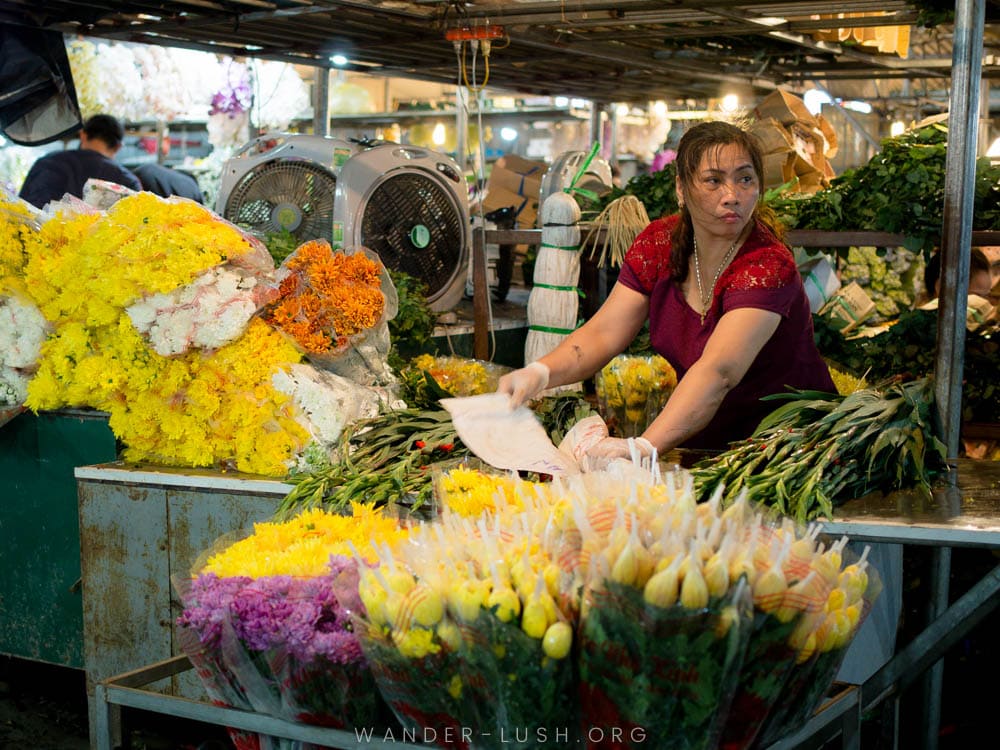
Pay is, unsurprisingly, very low; the hours and long and the labour back-breaking. Workers are vulnerable to abuse and often live in terrible conditions in dormitories.
The street vendors (mostly women) who go on to sell flowers and vegetables on the streets of Hanoi have a similarly difficult life – lots of manual labour and very little in return.
This isn’t meant to ruin your experience of the markets – but as you make your way around, do keep in mind that there’s often more to these markets than meets the eye.

How to visit Quang Ba Flower Market & Long Bien Market
Here is your complete guide to visiting Quang Ba Flower Market and Long Bien Market, from transport info, to opening hours, to marketplace etiquette.


Opening hours & best time to visit
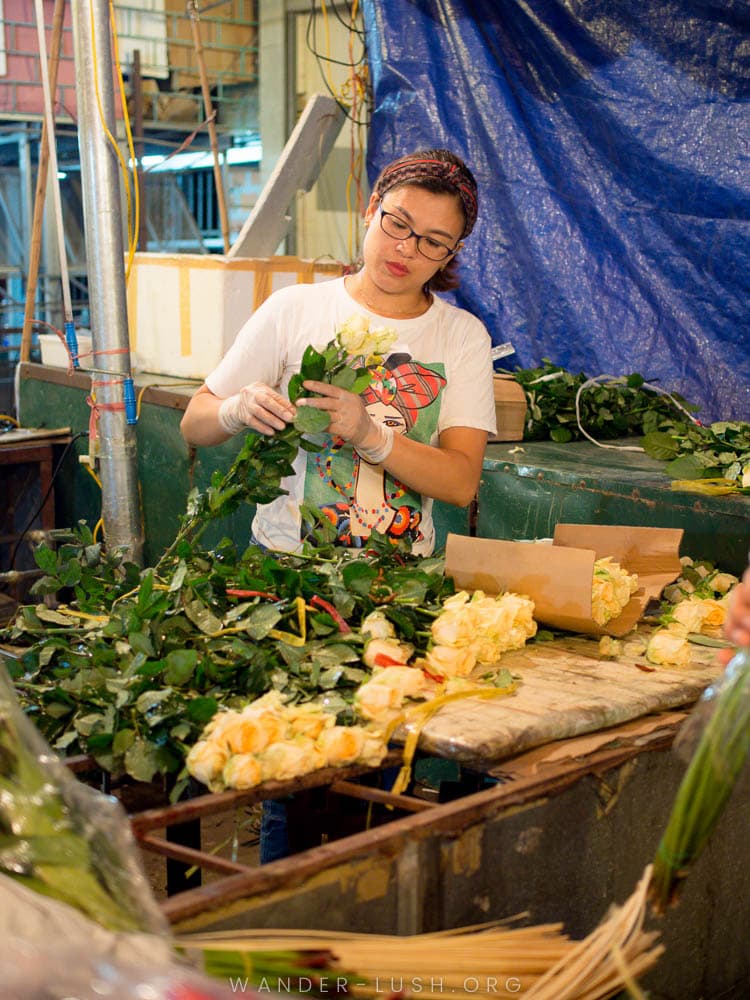
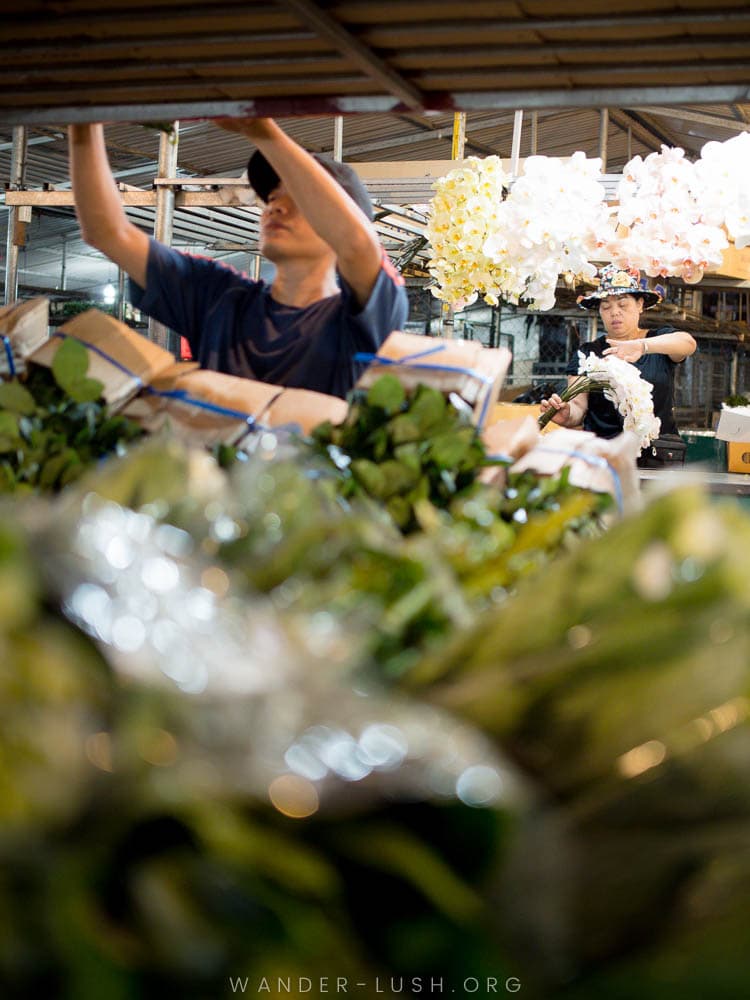
Quang Ba Flower Market is open daily and has two sessions: 2am until 4am (for wholesalers) and 4am until midday (for retailers). The market is at its most vibrant and interesting in the wee hours, so I recommend visiting for the first session.
Generally, it gets quieter and less ‘pretty’ as time wears on and all the lushest blooms get snapped up. Quang Ba is extremely lively in the lead up to Tet (Vietnamese New Year) and other holidays, but it’s good to visit any time of year.
I recommend spending at least 90 minutes at Quang Ba Flower Market.

Long Bien Market operates 24/7 but really gets going after dark. At around 1am, the produce trucks start arriving from as far away as China.
It’s good fun to watch them being unloaded. The market peaks at around 3am; then the later it gets, the hotter and the smellier it becomes. Vendors are supposed to stop selling at 5am. Police start patrolling the area in vans, warning people to close up (they usually pop back up once the trucks are out of sight).
Things have well and truly wrapped up for the morning by sunrise, and at 6am, the street cleaners move in. The market does continue though, and it can still be nice to wander around in the light of day.
I recommend setting aside 2 hours for Long Bien Market. You could easily stay for longer if you’re really into street photography.
Location & getting there
Quang Ba Flower Market (Chợ Hoa Quảng Bá) is located in Hanoi’s Tay Ho (West Lake) district, about 7km (or a 25-minute drive) north of the Old Quarter. The main entrance to the market is off Au Co Street (the same dyke road you take from the airport to reach the city).
There is also a listing for ‘Quang An Flower Market’ on Google, but they both pinpoint the same location. A Grab car to Quang Ba Flower Market will cost you around 100K VND (yes, it’s possible to order a Grab at this hour!).
Expect to pay slightly less for a Grab bike, and slightly more for a taxi.
📍 View the exact location of Quang Ba Flower Market on Google Maps.
Long Bien Market (Chợ Long Biên) is located roughly 3km (or a 10-minute drive) north of the Old Quarter and 4km (or a 15-minute drive) south of Quang Ba Flower Market. It sits at the foot of Hanoi’s iconic Long Bien Bridge, which spans the width of the Red River.
A Grab car from Quang Ba Flower Market to Long Bien Market to will cost you around 70K VND.
📍 View the exact location of Long Bien Market on Google Maps.
Suggested itinerary for Quang Ba Flower Market & Long Bien Market
Here’s my recommended itinerary for visiting Quang Ba Flower Market, Long Bien Market and Bridge, plus Dong Xuan Market and the Old Quarter. I recommend heading to Quang Ba first before taking a taxi to Long Bien for sunrise.
- 2am | Wake up call! Take a car/moto to Quang Ba Flower Market (about 20 to 25 minutes from the Old Quarter).
- 2.40am-4am | Quang Ba Flower Market.
- 4am | Depart for Long Bien Market (about 15 minutes’ drive south).
- 4.15am-5.30am | Long Bien Market.
- 5.30am (summer) | Watch the sun rise over Long Bien Bridge before returning to the market.
- 6am | Have a quick look at Long Bien Train Station before continuing a few hundred metres south to Dong Xuan Market.
- 6.30am | Time for breakfast and a well-deserved cà phê sữa!
We stuck to this exact itinerary on our visit to Hanoi’s morning markets. When we arrived at Quang Ba, we were worried we were too early – but the timing turned out to be perfect.
Navigating the Hanoi morning markets
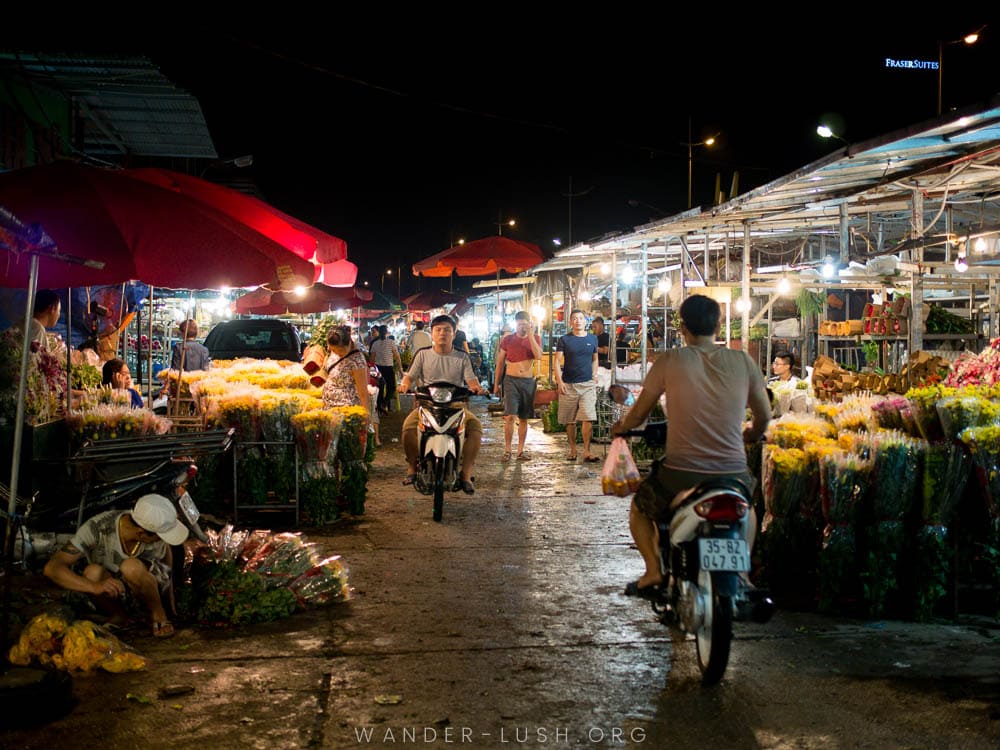
Quang Ba Flower Market is compact and easy to navigate. The main entrance is via a marked archway, sunken down off the Au Co Street. There are two main corridors through the market, each lined with stalls on both sides.
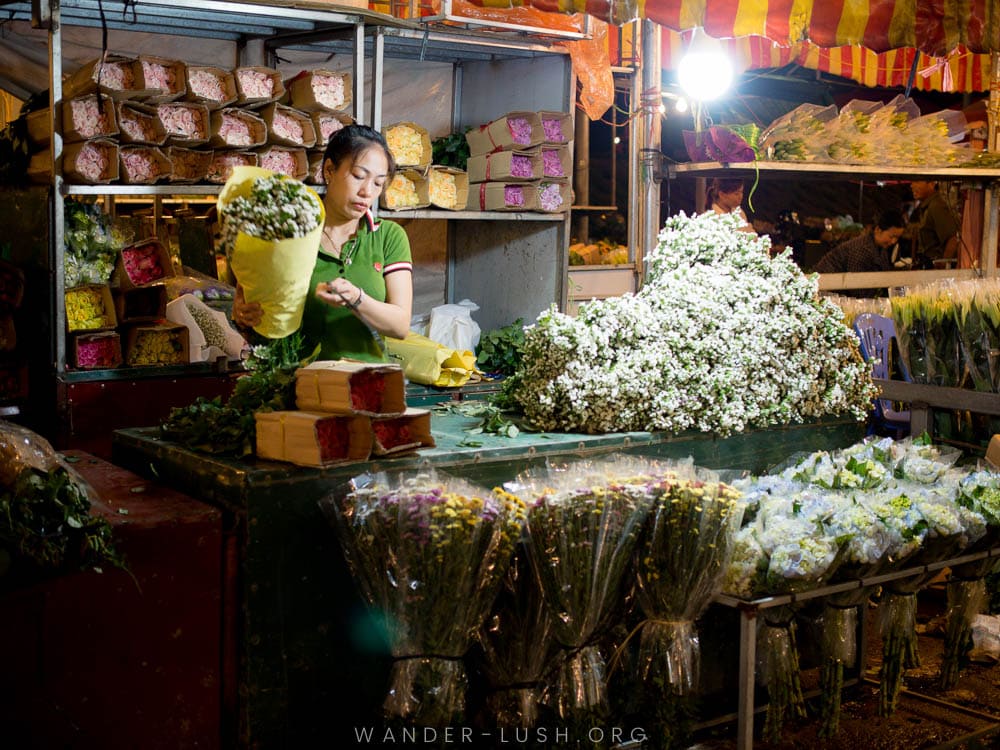
On the right, you’ll see a big undercover shed where some covered shops are housed. Along the outer left-hand side of the market there are half a dozen street food stalls. Majority of the flower shops are makeshift and lit by bare light bulbs, which gives the market a great atmosphere but makes for challenging photography conditions!
Towards the back, Quang Ba Flower Market opens up into a small car park where lorries congregate to offload their blooms. Motorbikes speed up and down the corridors, loading and unloading flatbed trolleys full of flowers. Be extremely cautious of traffic!

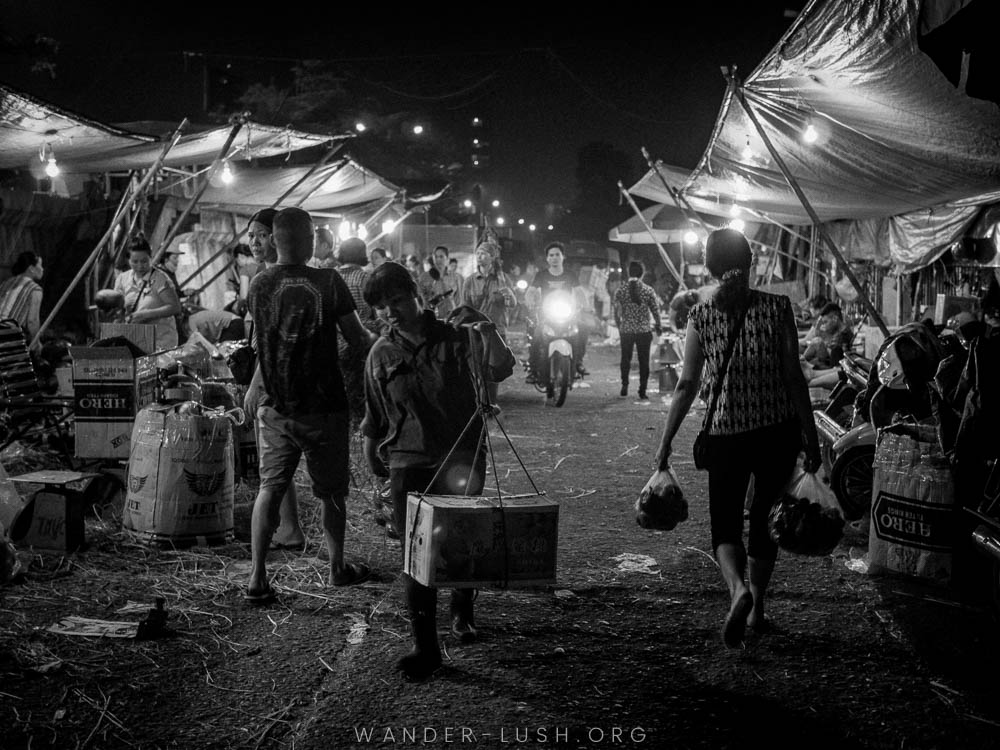
Long Bien Market is less contained than Quang Ba Flower Market. Stalls and sellers stretch out far beyond the boundaries of the market proper onto the surrounding roads and sidewalks. The main entrance to the main market is off Street, right underneath Long Bien Bridge.
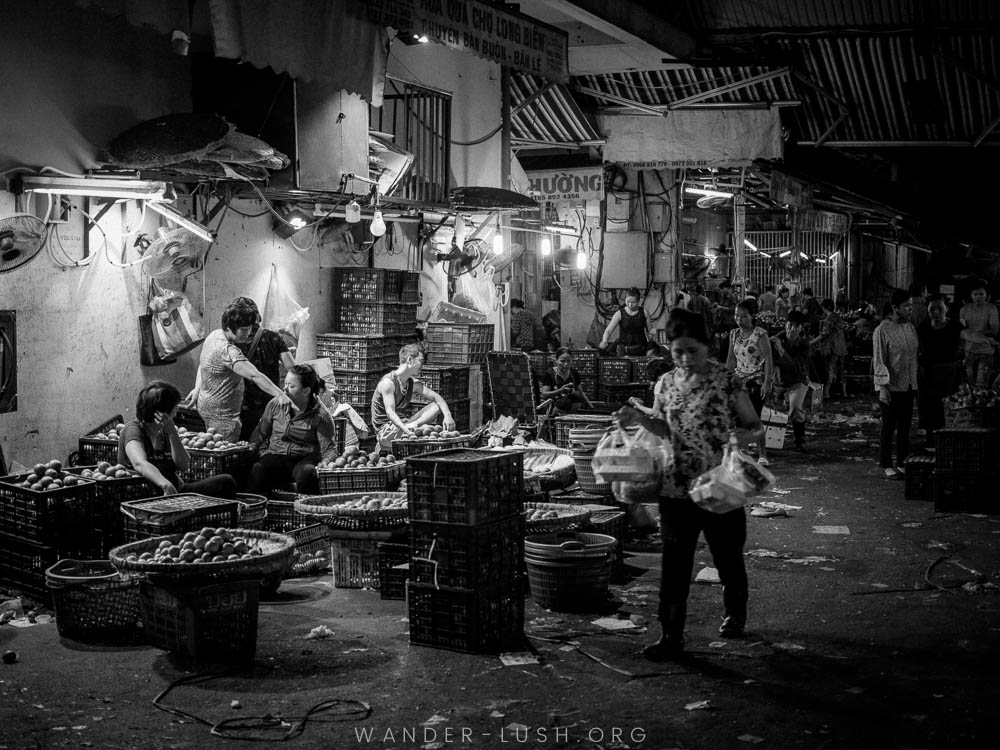
Once you’re inside, the market breaks off into a number of roads and alleyways. At first, we stuck to the right, following the cement wall (the other side of Hanoi’s mosaic), which goes on for blocks and blocks. People sit in the bottoms of shop houses, peeling, slicing and dicing all kinds of fruit and veg.
Huge stacks of pineapples and potatoes are piled up against the concrete wall opposite.

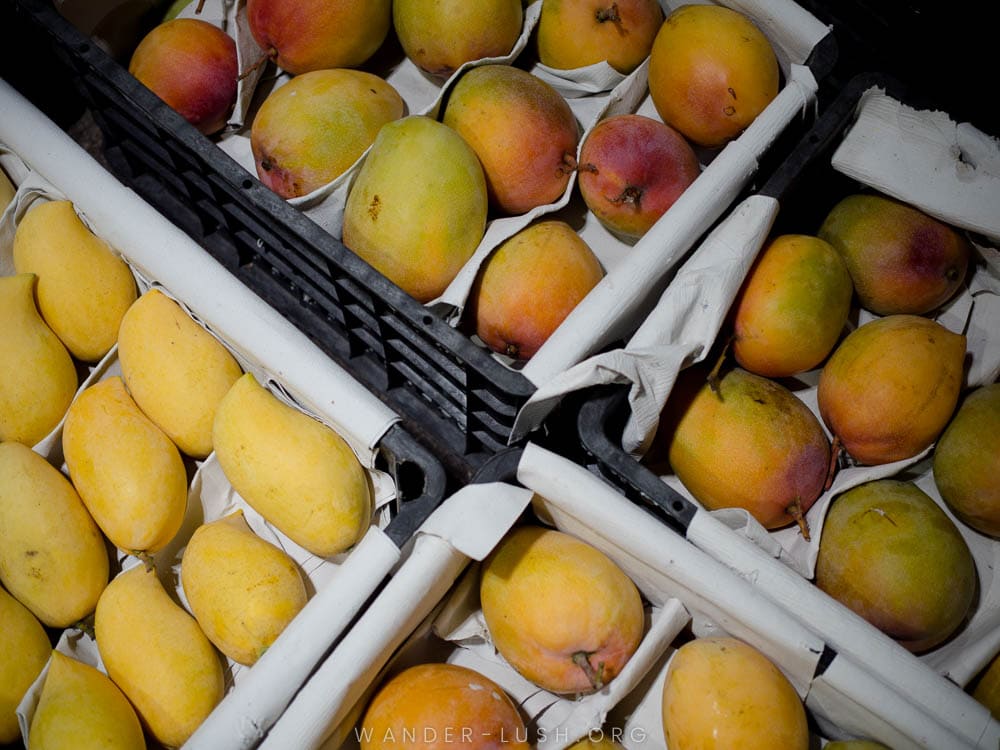
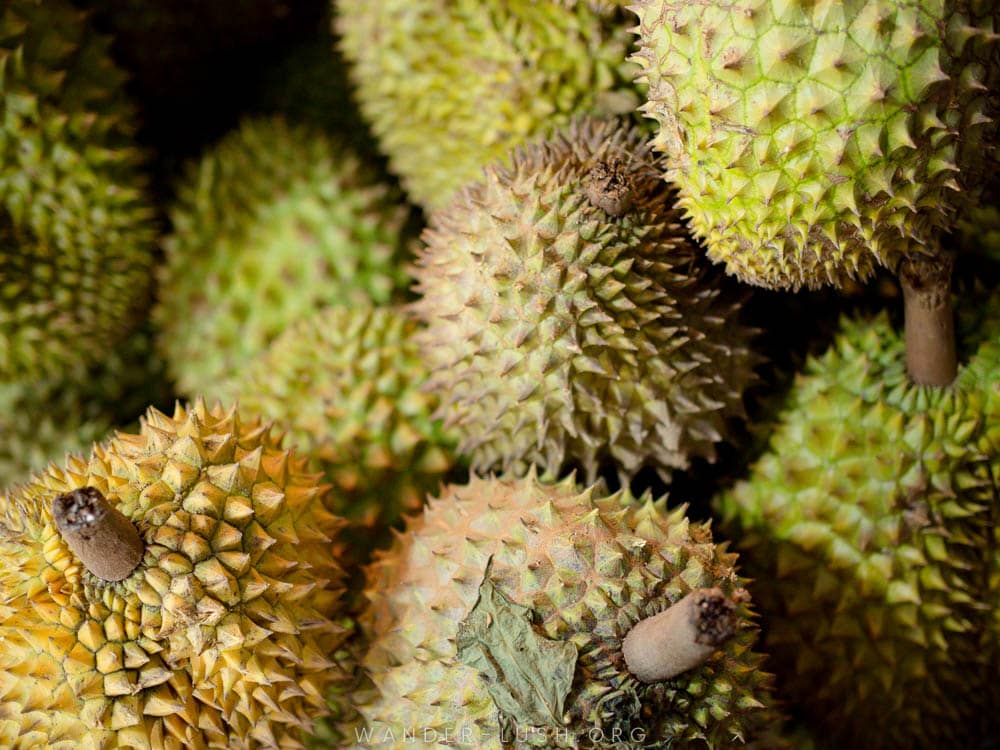

The indoor portion of Long Bien Market is well-lit but jam-packed – expect to be jostled along a bit by busy shoppers and porters. Avoid the area where the trucks unload (you’ll know it when you see it) as the traffic can be perilous.
Long Bien Market mainly stocks agricultural products, but there’s also a seafood section at the back (you’ll know it when you smell it). I couldn’t stomach it, so we chose to avoid this area.
For a birds-eye view of Long Bien Market, head up to Long Bien Bridge (enter on the right, opposite Long Bien Train Station). Note that motorbike traffic flows the opposite way to normal (i.e. people drive on the left). There’s a raised concrete pathway on the far edge of the bridge reserved for pedestrians.


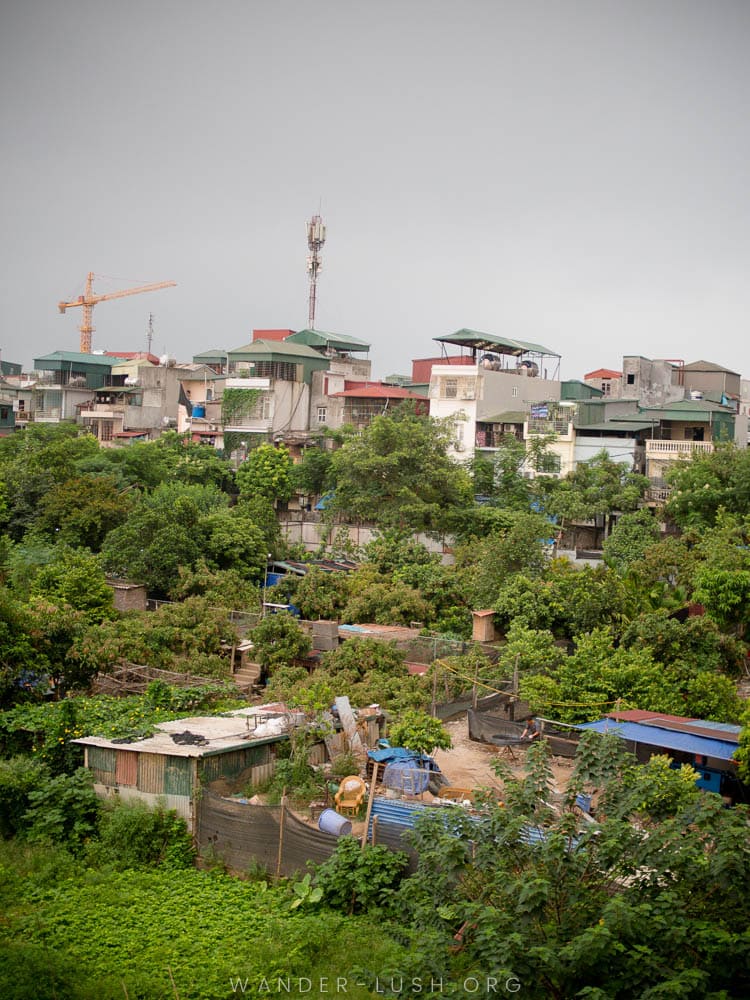
Before dawn, you’ll see lots of locals walking or running up and down the pathway. It could do with some repairs, but it’s safe. I recommend walking right up to the halfway point, where the bridge widens considerably into a something of a viewing platform.
To reach Dong Xuan Market from Long Bien Market, walk 900m southwest along Hang Dau and Hang Giay Streets. My favourite stalls are located outside along the eastern side.
More tips for visiting the markets in Hanoi
Bartering at the markets
A bunch of flowers from Quang Ba Flower Market can brighten up your guesthouse or serve as a thoughtful gift for your hosts in Hanoi. If you do decide to purchase a bunch of flowers, remember to haggle (it’s part of the process), but do so respectfully.
Long Bien Market is a wholesale market, so I don’t recommend attempting to purchase anything unless you know what you’re doing. Dong Xuan Market is also wholesale but slightly more tourist-friendly. If you do want to pick up some fresh fruit or veg, do it there.
Photography at the markets
Both Quang Ba Flower Market and Long Bien Market are packed with people going about their daily business. Getting in their way when taking photos can tick people off—and it can also be dangerous if you end up stepping into traffic.
Be mindful of photographing people’s faces – if in doubt, ask first and show them the picture after. One lady at Quang Ba insisted I didn’t photograph her stall – I’ve no idea why, but I respected her wishes.
Staying safe at the markets
It’s fine to whip out your camera or phone to take photos at Quang Ba and Long Bien. But I would recommend leaving your passport at home, and only carrying minimal cash on you. We both carried backpacks inside the markets and at no point did we feel threatened. Use common sense and be aware of your surroundings.
Traffic is by far the biggest hazard, especially at Long Bien Market. Watch out for motorbikes, which speed through the narrowest of passageways and often creep up on you or start reversing with no warning. If you’re visiting Long Bien Market later in the morning, be wary of city buses on the main street, which start their routes at around 5.30am.

Where to go for breakfast after visiting the markets
If you follow my itinerary and finish your route at Dong Xuan Market, you might like to continue walking a few more blocks south into the heart of the Old Quarter, where there are dozens of street food spots to choose from.
If you’re craving something different, Lifted, The Hanoi Social Club and Chops (all in the Old Quarter; all open early) are three of my favourite Western breakfast joints.
If you just end up visiting Quang Ba Flower Market, I recommend breakfasting at the nearby Maison de Tet Decor.
If you finish early before any cafes or restaurants open, jump in a taxi and head to Xofa, which is open 24/7 (serving breakfast from around 7am).
Where to stay in Hanoi
If it’s your first visit to Hanoi, I highly recommend staying somewhere central. The Old Quarter and French Quarter are both great for sightseeing and street food. For something quieter and with local vibes, try Truc Bach or Ngoc Ha.
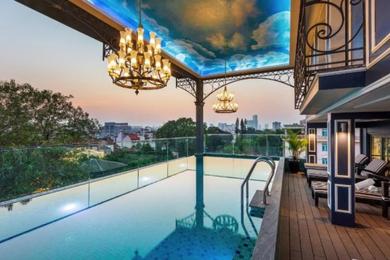
TOP CHOICE: AIRA Boutique Hanoi Hotel & Spa (⭐ 9.4). Strategically located in Ba Dinh, a local area halfway between the Old Quarter and the Temple of Literature, AIRA has polished rooms, a gorgeous rooftop pool and an excellent restaurant-bar. This is where I stayed on my first visit to Hanoi.
via Agoda
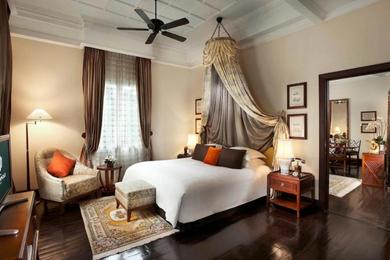
SPLURGE: Sofitel Legend Metropole (⭐ 9.2). Set inside a heritage 1901 colonial building in Hanoi’s French Quarter, this luxe resort-hotel has stately rooms, beautiful gardens and pools, and a legendary buffet breakfast.
via Agoda
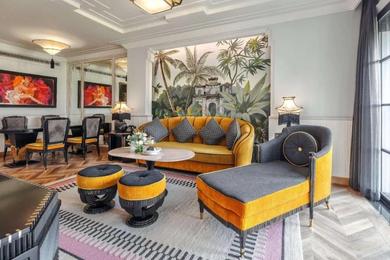
BOUTIQUE: Capella Hanoi (⭐ 9.8). Quite possibly the best designed hotel in Hanoi, Capella is located in a grand corner building in the heart of the Old Quarter. Every room features gorgeous heritage-style furnishings.
via Agoda
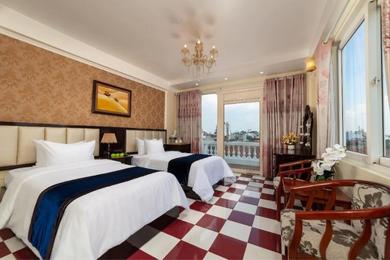
MID-RANGE: Hanoi Delica (⭐ 9.0). A great choice for budget-conscious travellers and families alike, this Old Quarter hotel has tidy, comfortable rooms and a complimentary breakfast.
via Agoda
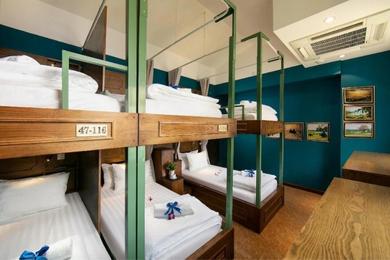
BUDGET: Little Charm Hanoi Hostel (⭐ 9.4). This popular hostel offers 4, 6 and 8-bed dormitories. The property has a pool and several accommodating shared spaces for socialising.
via Agoda
What’s the earliest you’ve ever woken up for an activity while you were travelling? Was it worth it!? Would you wake up early to visit Hanoi’s morning markets?
Hanoi Markets: Pin it & Share it


Vietnam essentials
Here are the booking sites and services I personally use whenever I travel to Vietnam.
FLIGHTS: Find affordable flights to Vietnam using Skyscanner.
VIETNAM VISA: Use iVisa to check if you need a tourist visa for Vietnam and apply for an expedited e-visa online. Use OneWayFly to obtain proof of onward travel/hotel reservation if required.
TRAVEL INSURANCE: Insure your trip with HeyMondo, my preferred provider for single-trip and annual travel insurance.
AIRPORT TRANSFERS: Pre-book a private hotel transfer from Hanoi Airport or Ho Chi Minh City Airport via Get Your Guide.
SIM CARD: Buy an eSIM and data package for Vietnam online before you go. My top choice is the Asia Link Regional eSIM by Airalo (10 GB for 30 days).
ACCOMMODATION: Find the best hotel deals in Vietnam on Agoda or book a Vietnam hostel.
TRAIN TICKETS: Reserve your Vietnam Rail tickets for the train to Sapa, Da Nang, Hue or Saigon via 12GoAsia.
BUS TICKETS: Buy your domestic bus or plane tickets in advance using 12GoAsia or Bookaway.
FOODIE EXPERIENCES: Find the best cooking classes and foodie experiences in Vietnam on Cookly. Here are my top 15 Vietnam food experiences to help you decide.
DAY TOURS: Find the best city tours and day excursions in Vietnam on Get Your Guide. Check out my top 10 best Vietnam day trips for more inspiration.
HALONG BAY: Consult my comprehensive Halong Bay guide to find the best cruises & tours.
VIETNAM GUIDEBOOK: Pick up a copy of the latest Lonely Planet guidebook for Vietnam.
More Hanoi inspiration
- The ultimate 3 days in Hanoi itinerary
- Guide to Hanoi’s Truc Bach neighbourhood
- The best Hanoi souvenirs + shopping map
- Photo guide to Hanoi Old Quarter
- The best Airbnbs in Hanoi
- Guide to visiting Quang Ba Flower Market & Long Bien Morning Market
- Alternative Hanoi: Exploring Lideco Abandoned City
- Hanoi day trip to Duong Lam Ancient Village
- How to travel to Halong Bay from Hanoi
- How to travel to Sapa from Hanoi
beautiful bunch of flowers, they are simply lovable
Nothing quite beats a street market, especially in SE Asia! I love that you’ve touched on the darker side too, though. Great post – I’ve not been to Hanoi and this is tempting me to go back to Vietnam and go further north!
Thanks, Jill! I hope you make it back soon!
I think markets offer great insights into the local culture and economy. I love exploring markets and your photographs perfectly capture the energy of the marketplace.
I agree! I always make a beeline for the local market whenever I arrive in a new town or city 🙂
Wow these markets look absolutely gorgeous!! I love visiting markets when I travel, so I will definitely visit these if I ever make it to Hanoi.
Excellent! Glad I’ve inspired you to visit 🙂
Looks like an amazing adventure! I’m sorry I missed out on it when I was in Hanoi. But, I did go to a morning fish market outside of Hoi An. An early start and the atmosphere was incredible. Definitely tough work with very little reward. thanks for the great article!
That sounds wonderful! I’ll have to check it out next time I’m in Hoi An. Thanks for the tip!
Never that early!! 🙂 Your photos are gorgeous and really capture the action of the market. Thanks also for highlighting the other side of these markets.
Thanks for the kind words, Rebecca! I thought it was important to mention the ‘darker side’ of the markets—they’re such vibrant places, but it’s something we as visitors should keep in mind.
I love early mornings when I travel, seeing a city wake up is one of my favorite things to do! How cool to visit a flower market like that 🙂
I agree! I love early mornings—when I can handle the alarm. The markets are a great incentive to get up early in Hanoi!
Every time I get up early to do something I am so glad I did, even if the getting up part can be challenging. I didn’t go to the flower markets, but when in Hanoi I did get up early just to walk aournd the lake and streets, and it completely different experience to walking around later in the day.
You’re so right. Hanoi is like a different city in the early hours! A lot of cities are. I try to wake up early at least one morning wherever I am. It’s a lot easier when the weather is warm like it is here!
Sweet holy hell, that is early in the morning! I think I’d probably be in for Quang Ba Flower Market, or I guess I could just stay up all night for Long Bien. I mean, it seems like it’s SOOO worth it! Those flowers are gorgeous and the hustle and bustle must be quite the experience!
Ha ha! It is early!! Actually I should mention that you can stay up late instead of getting up early… That works too! The flowers are especially lovely!
So friggin beautiful. Feel like I always could smell the flowers, and the limes/lemons.
Thanks, Namra! It sure is 🙂
I’m not a morning person but I am a flower person, so this is something I’d totally force myself to wake up for. I did have the chance to see a floating flower market here in Saigon during Tet and it was one of the coolest things ever. That being said I arrived late and I quickly realized I’d missed the hustle and bustle…and most of the flowers. I should have woken up earlier! Also, I love the part about responsible tourism. Thanks for reminding us that there’s more to what goes on at these markets than meets the eye. Sometimes it’s too easy to forget.
That’s so cool, Justine! I think Tet is the best time to see any flower market so that was good thinking to go then! It’s incredible how early the markets get going. The city is so peaceful in the early hours… I think that makes it worth it!