You can still feel a lot of the old Alma-Ata in modern Almaty – and the thing that impressed me most about Kazakhstan’s biggest city is the way it embraces its past while expressing a contemporary identity that feels very distinctly Kazakh.
Almaty is in the midst of a major renovation spree, and I was struck by the reverence with which old buildings and architectural details – especially Soviet-era mosaics – are being preserved and reimagined for a new generation.
If you’ve been reading this blog for a while, you’ll know just how much I appreciate that kind of approach to urban development.
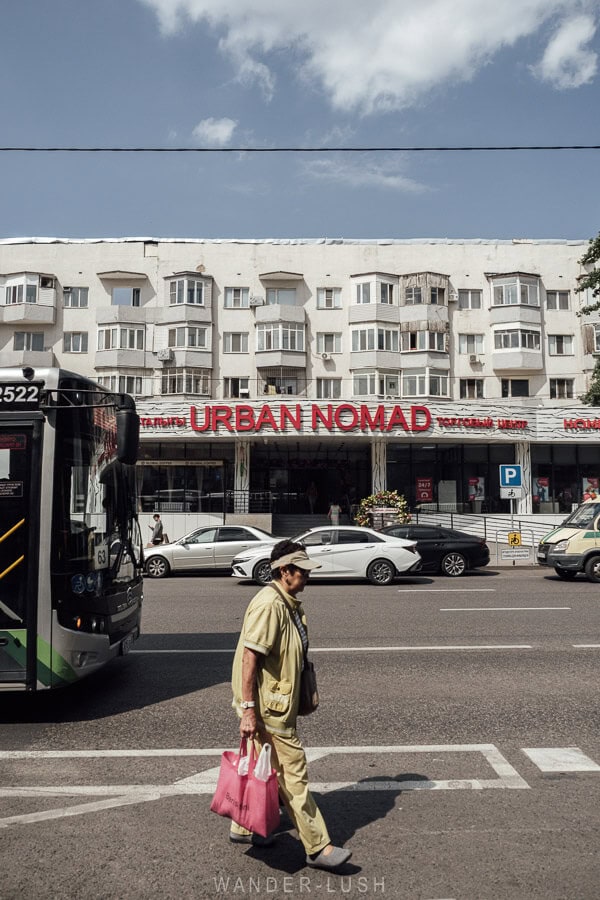
Add to that leafy streets, excellent coffee and a seemingly endless supply of interesting little details, and you have all the ingredients for a wonderful city break.
I spent a week in Almaty on my first visit, and – as I rushed to inform almost every local I met – I am already looking forward to going back for more (likely a winter trip for skiing at Medeu and Shymbulak). Almaty is very much my kind of city, and a big part of its appeal is that it reminded me of Tbilisi.
Here are my 13 favourite things to do in Almaty, with a particular focus on architecture, design and cafe culture.
Please note: This post contains affiliate links, meaning I may earn a commission if you make a purchase by clicking a link (at no extra cost to you). Learn more.
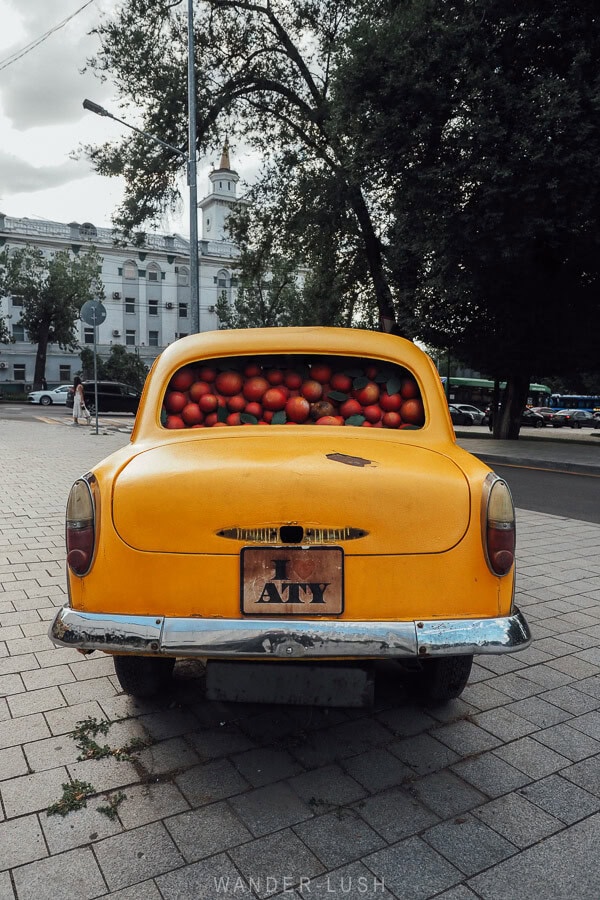
5 quick travel tips for Almaty
1. Where to stay in Almaty
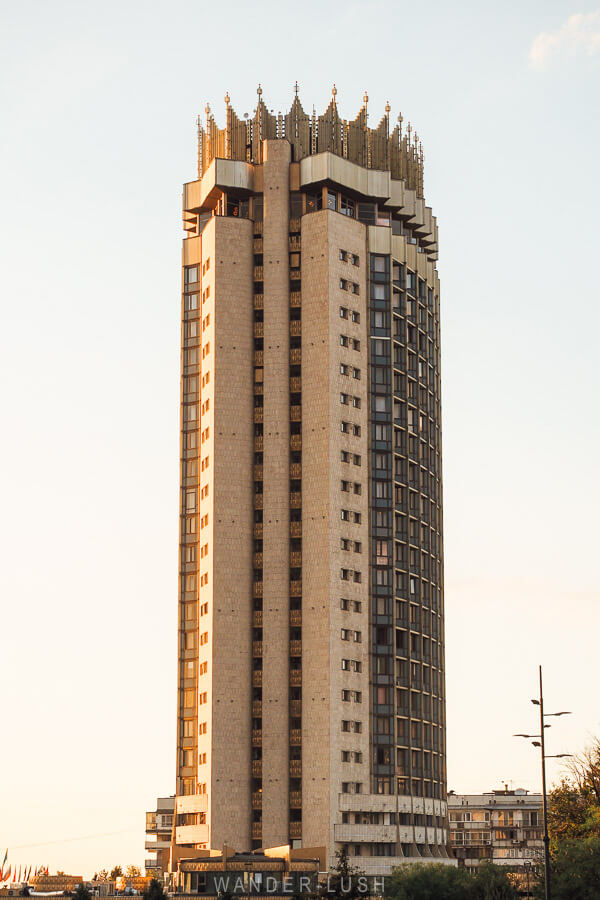
We stayed at three different hotels: Urban Yurt, Hotel Kazakhstan and Almaty Hotel. Of the latter two, I much preferred Almaty Hotel – the breakfast is 10/10, and the renovated rooms are spacious. Hotel Kazakhstan (directly above, left) is an icon, but we really were not impressed with the layout of our room (it certainly didn’t justify the price tag). Urban Yurt has laundry facilities and lovely communal spaces, and is my top choice for a longer stay.
2. Taxis & getting around
Here’s the first similarity with Tbilisi: Almaty’s traffic is insane. I recommend planning your days geographically to avoid spending too much time in the car. Yandex Go is the taxi app of choice and works perfectly for airport transfers, too. For shorter distances, walking or taking the metro (easy tap-on with card/contactless) is going to be more efficient. Central Almaty is pleasantly walkable.
3. Get an eSIM before you arrive
We found that public WIFI in Almaty almost always requires SMS verification, which made it impossible to get online without a local phone number. I highly recommend getting an eSIM instead. I used Airalo and the connection was flawless, both in Almaty and on our side trip to the mountains.
4. ATMs & payments
We didn’t encounter any local ATM withdrawal fees when taking out Kazakh tenge with Wise, which was a nice surprise. Cards are widely accepted in Almaty, but I recommend keeping some cash handy for markets and small purchases.
5. Consider an overnight trip to the lakes & canyons
We ended up spending a week in total in Almaty, but 2-3 full days is ample for the average traveller. If you have time, I highly recommend a side trip to Charyn Canyon, Kolsai Lake and Kaindy Lake. We did this overnight tour, which included a comfortable yurt stay and plenty of time at each attraction. It’s still a lot of driving, but it’s more manageable than the day trip version some people do.
13 things to do in Almaty
1. Tselinny Centre of Contemporary Culture
Tselinny was a late addition to our Almaty itinerary but it ended up being one of my highlights. Although the centre itself is quite small, for me it perfectly captures that motif I saw again and again in Almaty – the way the city marries its Soviet-era architecture and contemporary culture without erasing or apologising for its past.
This building originally opened in 1964 as the Tselinny Cinema (tselina meaning ‘virgin lands’, a reference to Nikita Khrushchev’s Soviet agricultural campaign to transform the Kazakh steppe into farmland). After various transformations – including a stint as a nightclub – the building was reimagined by British architect Asif Khan and reopened as a contemporary cultural centre in 2025.

The architecture alone makes it worth a visit. The modern facade, with its undulating white panels, conceals an elegant open interior. A monumental 42-metre-long sgraffito mural by Soviet artist Yevgeny Sidorkin – hidden behind plasterboard during an earlier renovation and rediscovered in 2018 – has been carefully restored, with some of the damage deliberately left visible.
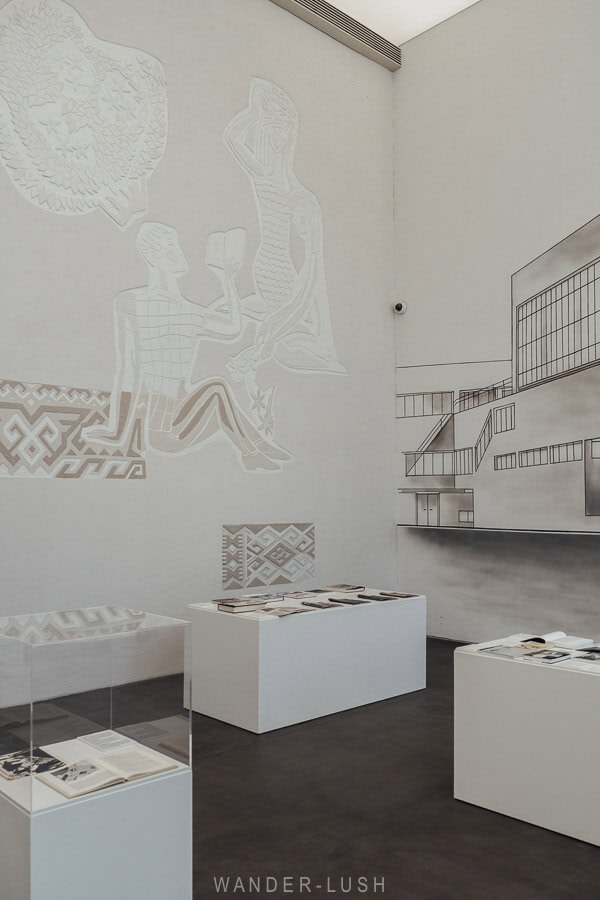

You can see most of the sgraffito from inside the ticket desk/gift shop zone, but I do recommend purchasing a ticket to see the rest of the downstairs rooms if the exhibition showing is of interest. We saw The End of the Avant-Garde: Architecture of Totalitarianism – couldn’t have planned it better myself!
2. The Green Bazaar Winter Pavilion
Almaty’s Green Bazaar (Kök Bazar) is one of the city’s oldest markets, with a history that goes back to 1875 when a merchants’ trading courtyard known as Gostiny Dvor was established here. The enormous complex has been expanded and renovated several times over the years, but thankfully at the time of my visit, the Soviet-era Winter Pavilion was still standing in its current form.


Completed in 1975 by Odessa-born architect Mark Pavlov, the covered hall is a wonderful example of Soviet modernism. Its cavernous interior features a geometric coffered ceiling and nine pyramid-shaped skylights that flood the space with natural light. A mezzanine gallery wraps around the trading floor, offering a vantage point for photography.
Architecturally, it’s quite different to the domed Chorsu Bazaar in Tashkent, but I would happily rank it alongside Central Asia’s great market halls.
It was surprisingly subdued when we visited in the afternoon – we could freely move between the long rows of colourful fruit and veg, dried fruits and nuts, spices, Korean salads and qurt balls without interruption.
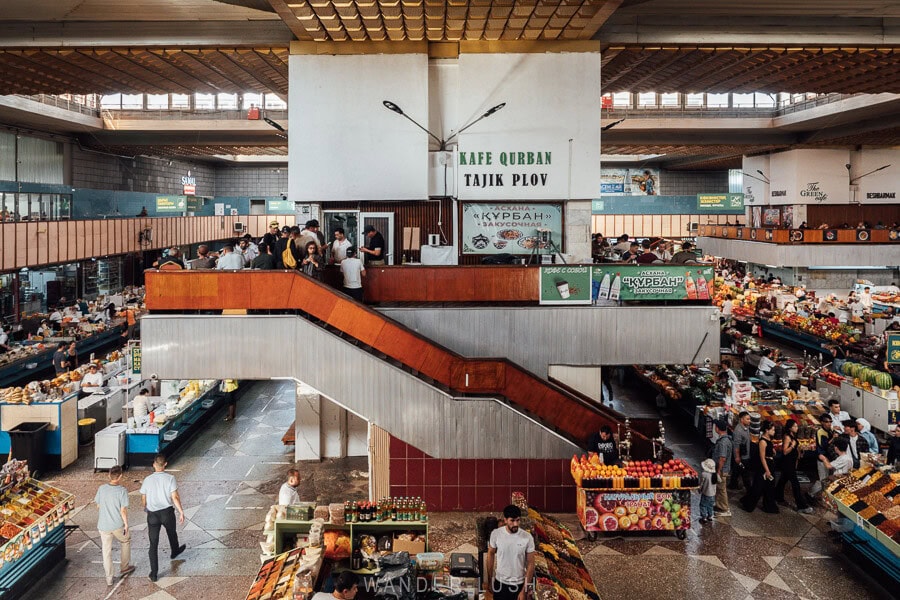
The Green Bazaar covers a huge area, and we actually got a bit disoriented trying to find the original building amongst all the newer additions and ad-hoc street markets. If you’re visiting specifically for the Winter Pavilion architecture, there is an entrance here on Zhibek Zholy Avenue.
I wasn’t surprised to learn after my visit that a major renovation is now underway. Works are set to continue into 2028, so you might well encounter closed sections. I hope the building’s original character will be preserved.
3. Breakfast at Aqqu
Aqqu was my favourite food find in Almaty – a contemporary cafe with a Soviet-inspired interior, incredible mosaics, and an excellent breakfast menu. I absolutely love this style of design and desperately wish we had more examples of it in Georgia!
The cafe has quite a history. The original Aqqu was established in the 1960s and became a popular meeting place for Almaty’s artists, writers and intellectuals. The name means ‘white swan’ in Kazakh – a reference to the pair of graceful gliders that lived in the cafe pond. After the original building was destroyed, the site sat empty for decades before Aqqu was revived in 2025.


The new glass-walled pavilion takes its inspiration from the original cafe and the city’s Soviet modernist aesthetic. To recreate the atmosphere, the design team studied old photos (there are some displayed around the dining room) and sourced vintage objects from local flea markets. The centrepiece is a series of colourful swan mosaics by artist Anastasia Zharko – not Soviet originals, but new works created in the spirit of the old cafe. Even the swan logo was reconstructed from archival materials.
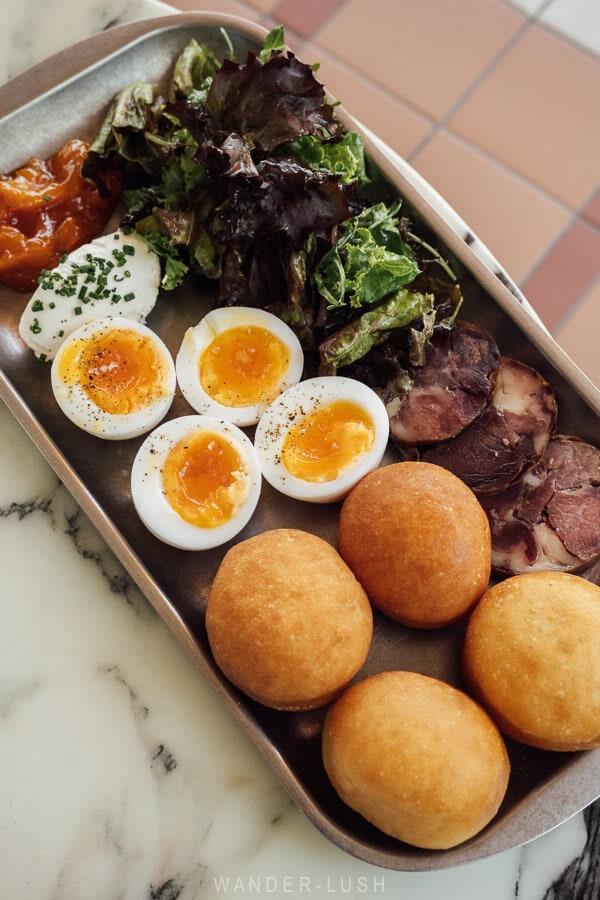
The food and coffee did not disappoint, either. I couldn’t go past the signature Aqqu Breakfast (pictured above), a spread of six-minute eggs, kazy (traditional Kazakh horsemeat sausage), golden baursaki (fried dough balls), kaymak cream and apricot jam.
4. Almaty Hotel mosaic
It was an image of this mosaic – specifically a photo taken by our friends Kim and Del of Going the Whole Hogg – that first put Almaty on my radar almost a decade ago. Seeing it in person (and shamelessly emulating their photo!) was high on my priority list for this trip.
The Almaty Hotel opened in 1967 and was once one of the most prestigious accommodations in the Kazakh SSR. The eight-storey building – with its distinctive curved facade – narrowly escaped demolition in 2007 and has since undergone an extensive renovation.
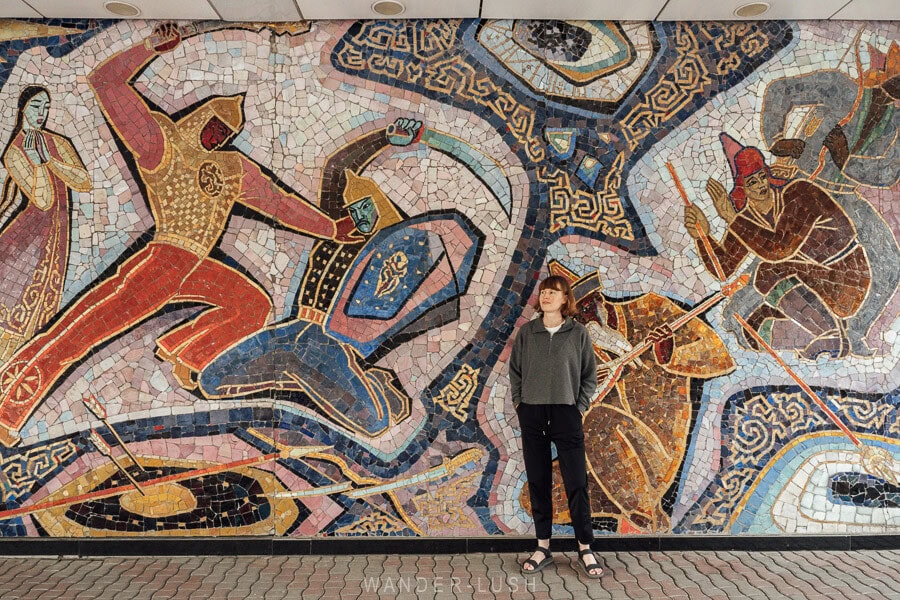
Two enormous mosaics flank the main entrance. The older of the two, Enlik-Kebek (1965), was created by artists Moldakhmet Kenbaev and Nikolai Tsivchinsky, and depicts scenes from a tragic love story – the Kazakh Romeo and Juliet, if you will.
The more contemporary Silk Road mosaic (2004) by Vladimir Tverdokhlebov traces the city’s history from the days of camel caravans to modern Almaty. Both are incredibly vivid.
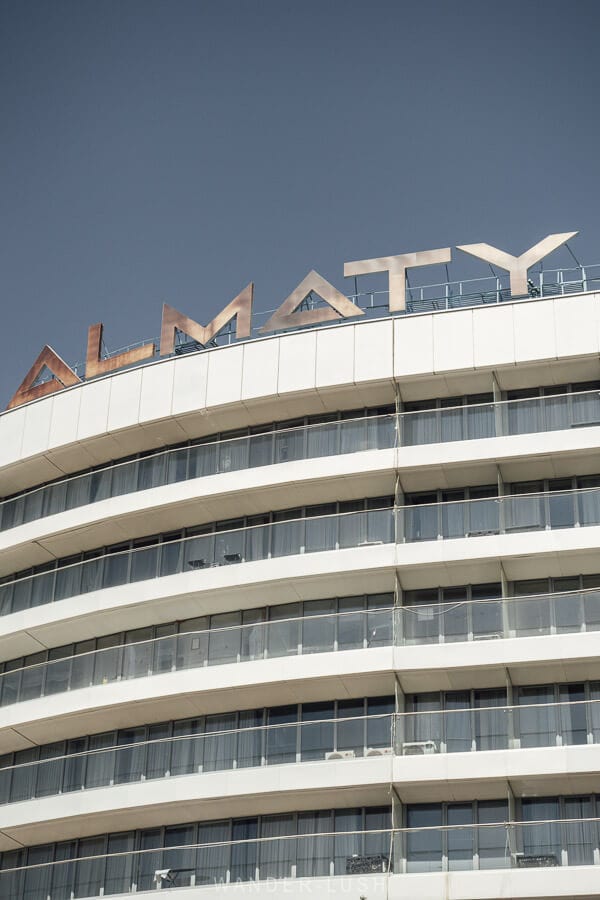

We originally stopped here on our first day in the city to photograph the mosaics, then popped inside to pick up a paper map. The staff were so friendly that when we returned to Almaty from Kyrgyzstan, we decided to spend a night at the hotel. I’m very glad we did – the refurbished rooms are spacious and beautiful, and the breakfast buffet is excellent – head and shoulders above what we experienced at the Hotel Kazakhstan.
5. Wedding Palace & State Circus
Two more must-see examples of Almaty’s Soviet modernist architecture are located a short walk from one another on Abay Avenue.
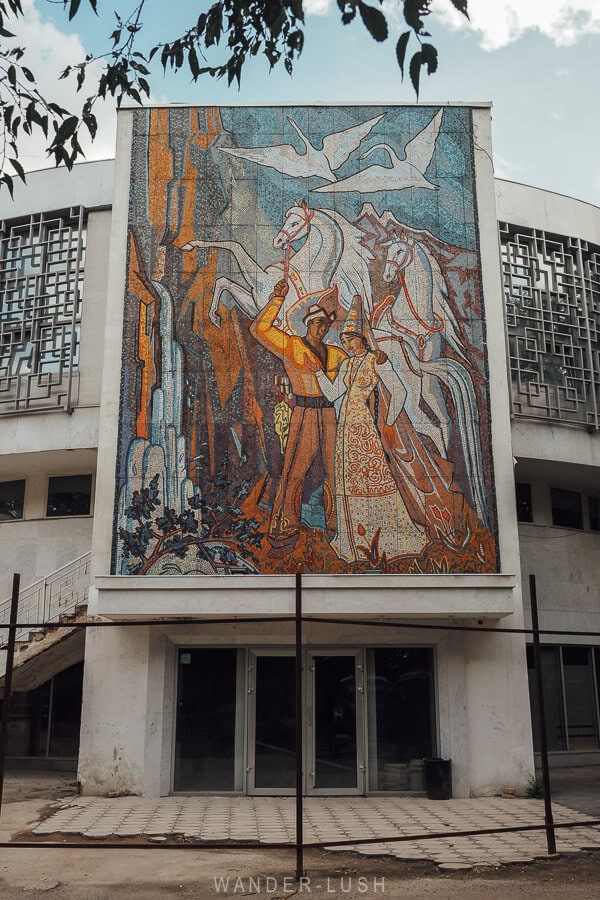
The Wedding Palace, also known as Zhas Otau, opened in 1971 and was the first purpose-built wedding hall in the Kazakh SSR. Designed by a team of architects led by Malbagar Mendikulov, its circular form is said to represent two interlocking wedding rings. The white facade is decorated with geometric latticework inspired by traditional Kazakh ornaments.
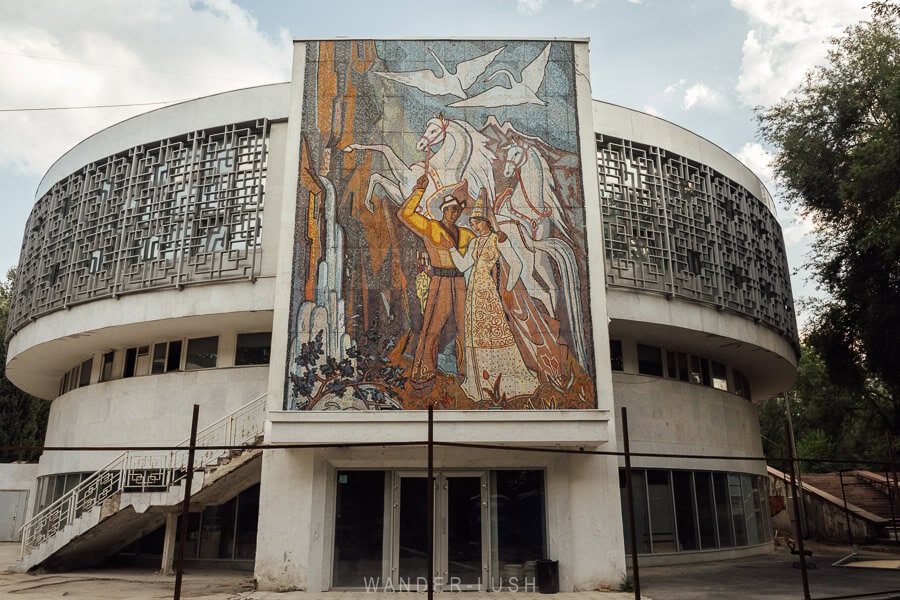
When we visited, the building was closed for renovation and no matter how sweet we talked, we were sadly not allowed to go inside. Thankfully, we could still admire the mosaics on the exterior. The smaller panel near the main entrance, depicting a couple in traditional dress (pictured below left), is a contemporary addition from 2017.
Make sure you walk around the back because this is where you’ll find the original, much more impressive Soviet-era mosaic titled Qyz Zhibek (pictured above). Also created by Moldakhmet Kenbaev and Nikolai Tsivchinsky (the same artists responsible for the original Almaty Hotel panno), the frieze depicts a young couple flanked by rearing white horses and swans.


Nearby, the Kazakh State Circus opened a year later in 1972, and was designed by Vladimir Katsev and Innokenty Slonov, who drew inspiration from the traditional Kazakh yurt for its circular form and domed roof. Though not as striking, it reminded me a bit of the circus building in Chisinau.
6. Almaty Museum of Arts
One of Almaty’s newest cultural attractions, the Almaty Museum of Arts, opened in September 2025. Founded by Kazakh businessman and art collector Nurlan Smagulov, it is the first major private museum dedicated to modern and contemporary art in Central Asia, with a collection of more than 700 works by local and international artists.
Designed by British firm Chapman Taylor, the building is impressive in its own right. Two interlocking volumes clad in limestone (representing nature) and aluminium (for urbanism) reflect the city’s relationship with the surrounding Tian Shan mountains. Inside, a soaring, light-filled atrium known as Art Street connects the exhibition spaces, with elevated walkways offering a bird’s eye perspective over the entrance hall.
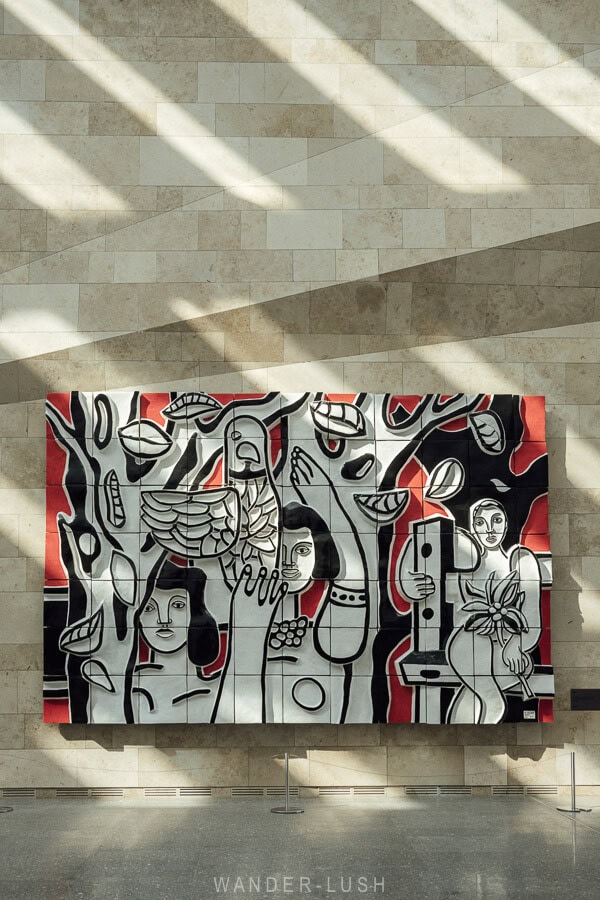

It’s hard to get away from mosaics in Almaty… An enormous ceramic panel titled Les femmes au perroquet (Women with a Parrot, above left) by French artist Fernand Leger is the first work that greets you in the atrium.
One of the galleries houses Junction (2011), a monumental installation by Richard Serra, and there are several more contemporary sculptures outside, including a 12-metre-tall portrait of a woman by Spanish artist Jaume Plensa.
The museum is small, but the architecture is impressive – plus the excellent air conditioning makes it a good place to escape the summer heat.
7. Coffee with a Kazakh twist at TEREZE
Almaty has a wonderful specialty coffee scene, with independent roasters and beautifully designed cafes on almost every block. We had perfect flat whites every time at the popular Flask – but my favourite find was TEREZE, a small cafe near the Green Bazaar.
Opened by a brother-and-sister team in 2024, TEREZE occupies part of an old building on Zhibek Zholy. Their special ‘local menu’ is inspired by the surrounding neighbourhood, with ingredients sourced quite literally from next door – qurt (salty dried fermented cheese) and zhent (a traditional sweet made from roasted millet) come from the Green Bazaar, while other drinks incorporate chocolates and sweets from the nearby Rakhat confectionery factory.
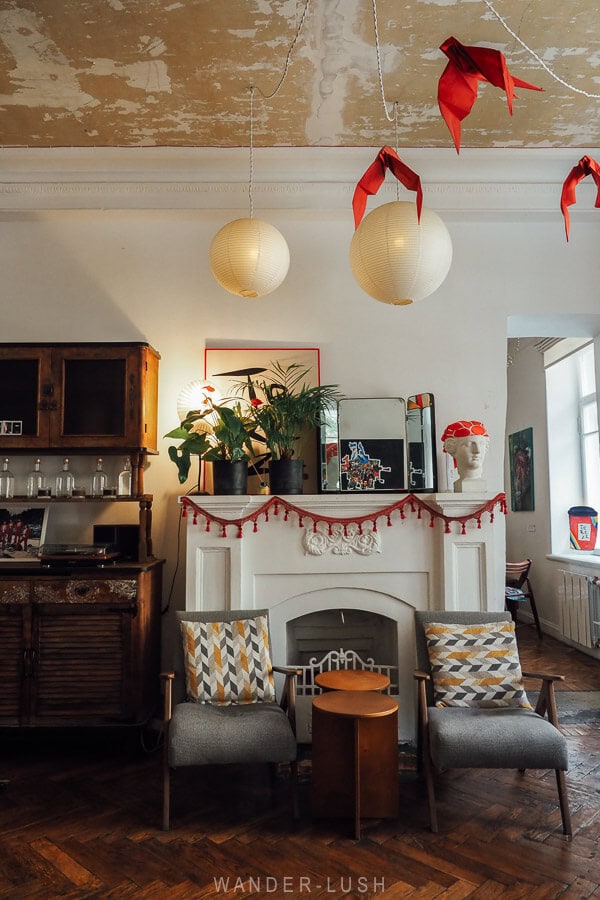


There are some very creative items here: A raf coffee with zhent and cheese foam, a Botagoz latte with salted toffee, and an Azhar cappuccino inspired by a popular Kazakh treat. I ordered the strawberry latte with qurt, which was delicious. They also serve traditional Uyghur atken tea.
The desserts are similarly offbeat – the Shubat Toffee Mousse made with fermented camel’s milk, creamy toffee, coconut and white chocolate was my pick.
8. Locally designed souvenirs at SINICHKI.STORE
SINICHKI.STORE on Aiteke Bi Street was the best place we found for locally designed souvenirs in Almaty.
The shop started out in around 2019 as Ptichki-Sinichki, a collective showroom for independent Kazakhstani brands and vintage sellers, and has since evolved into a little emporium of original gifts, bringing together the work of local illustrators, designers, jewellers and craftspeople.

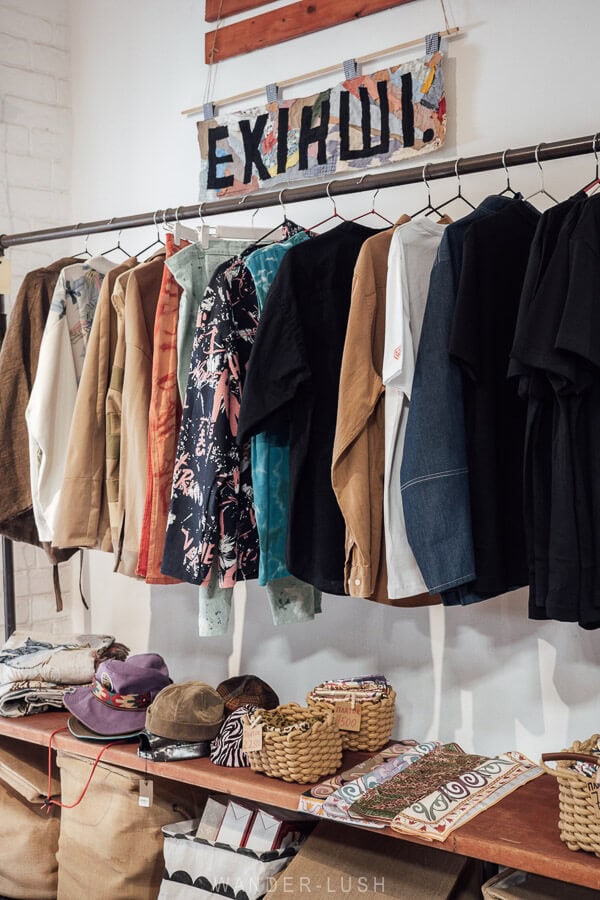
A lot of the merchandise celebrates Almaty itself, especially its Soviet-era architecture. Prints by Tau Prints depict local landmarks, and there are works by Almaty designer Rufina Mussina, whose colourful illustrations feature the Hotel Kazakhstan and the Abay Opera Theatre.
There is plenty more to browse, from jewellery decorated with traditional Kazakh ornaments to handmade ceramics, clothing, illustrated postcards and all sorts of quirky little objects. We came away with several printed scarves, fridge magnets and stickers.
9. Panfilov Park (Ascension Cathedral & the Memorial of Glory)
Housing two of Almaty’s best-known attractions – the colourful Ascension Cathedral on one side, and the enormous Soviet-era Memorial of Glory on the other – Panfilov Park is an essential stop on any tour of the city.
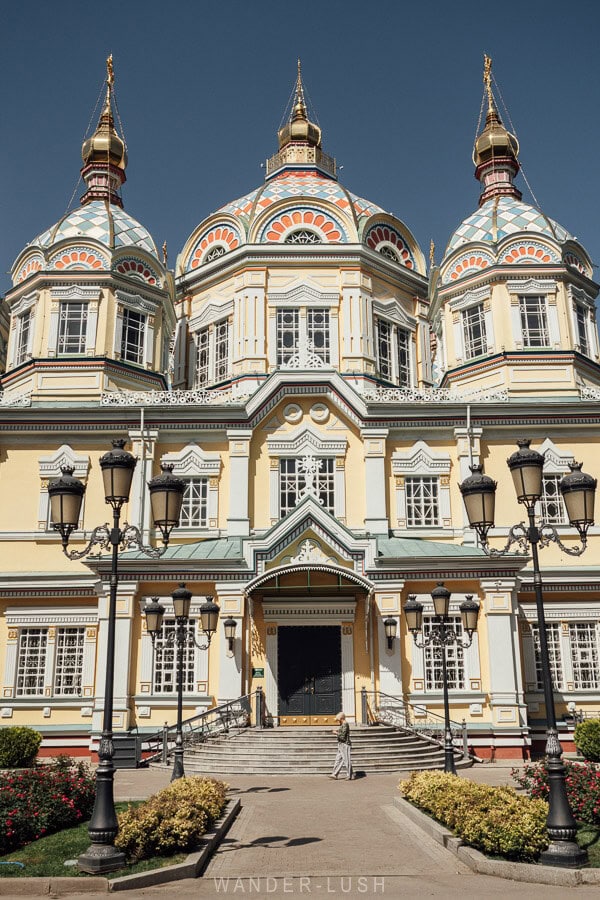
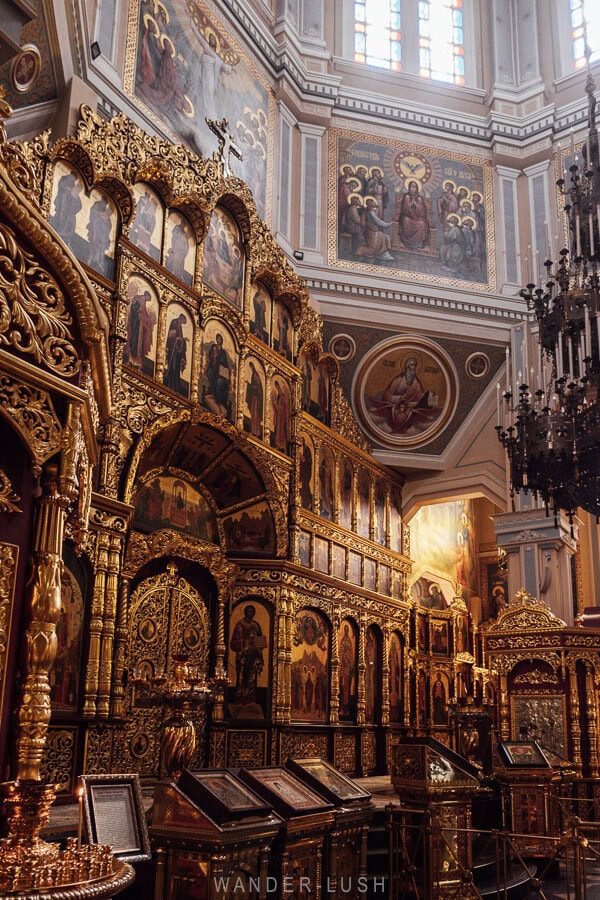
With its yellow facade and colourful harlequin domes, Ascension Cathedral looks incredible from every angle. It is one of the most prominent surviving landmarks from the era of Verny, as Almaty was known under the Russian Empire. Established as a military outpost in 1854, the city was renamed Alma-Ata by the Soviets in 1921 before becoming Almaty following Kazakhstan’s independence.
The cathedral was completed in 1907 on a design by architect Konstantin Borisoglebsky that was later modified by engineer Andrei Zenkov (hence its alternative name, Zenkov Cathedral). Built almost entirely from Tian Shan spruce, the structure was specifically engineered to withstand earthquakes – good thing, as just four years later the devastating 1911 earthquake destroyed much of Verny.
At the eastern end of the park, the imposing Memorial of Glory commemorates Soviet soldiers who fought and died in the Great Patriotic War. Unveiled in 1975 to mark the 30th anniversary of the Allied victory, the enormous ensemble features a central copper relief known as Feat, which has three-dimensional soldiers bursting through a wall.
An Eternal Flame flickers in front of the monument, surrounded by black stone blocks containing earth brought from different Soviet battlefields and Hero Cities.

The park itself is named after the 28 Panfilov Guardsmen, which was formed in Alma-Ata in 1941 under the command of General Ivan Panfilov. According to the celebrated Soviet account, the soldiers from the 316th Rifle Division made a heroic last stand against German tanks outside Moscow, sacrificing their lives to defend the capital. The story became part of USSR folklore, though it was later challenged by historical investigations, which revealed that some of the supposedly fallen soldiers had actually survived.
There is plenty more to see as you wander through the park, including the Ykylas Museum of Folk Musical Instruments, housed in a decorative wooden building from 1908 – another surviving piece of old Verny.
10. Almaty Central Mosque
Located a short walk north of the Green Bazaar, the Central Mosque is relatively new, having been constructed between 1993 and 1999 after Kazakhstan gained independence from the Soviet Union on the site of an earlier wooden mosque built by Kazakh settlers from the southeastern Karatal region.
I wouldn’t normally feel the need to describe a mosque as pared-back – but compared with a lot of the other Almaty landmarks on this list, the lines and decorations are refreshingly simple.

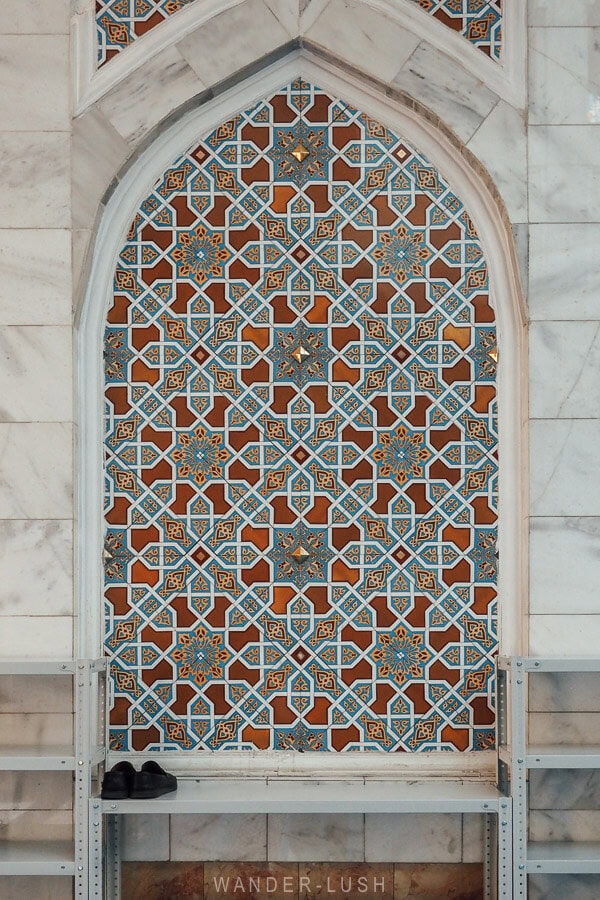
Capable of accommodating up to 7,000 worshippers, it features a 36-metre-high central dome and a separate 47-metre-tall minaret.
The interior decoration is remarkable for the way it combines Islamic architectural traditions with elements of Kazakh folk art. Artist Gaziz Yeshkenov and his team drew inspiration from the 14th-century Mausoleum of Khoja Ahmed Yasawi in Turkestan, incorporating motifs that resemble traditional syrmak felt carpets and the wooden latticework of a Kazakh yurt.
The Central Mosque is an active place of worship, but non-Muslim visitors are welcome to enter outside of prayer times.
11. The Almaty Metro
Like the metro systems in Tashkent and Moscow, Almaty’s underground is worth visiting for the architecture alone. But unlike its more famous counterparts, the Almaty Metro is not actually Soviet-era – something that surprised me given its appearance.
Construction of the metro began in 1988, when Kazakhstan was indeed still part of the Soviet Union – but after more than two decades of delays, the first seven stations only opened in December 2011.
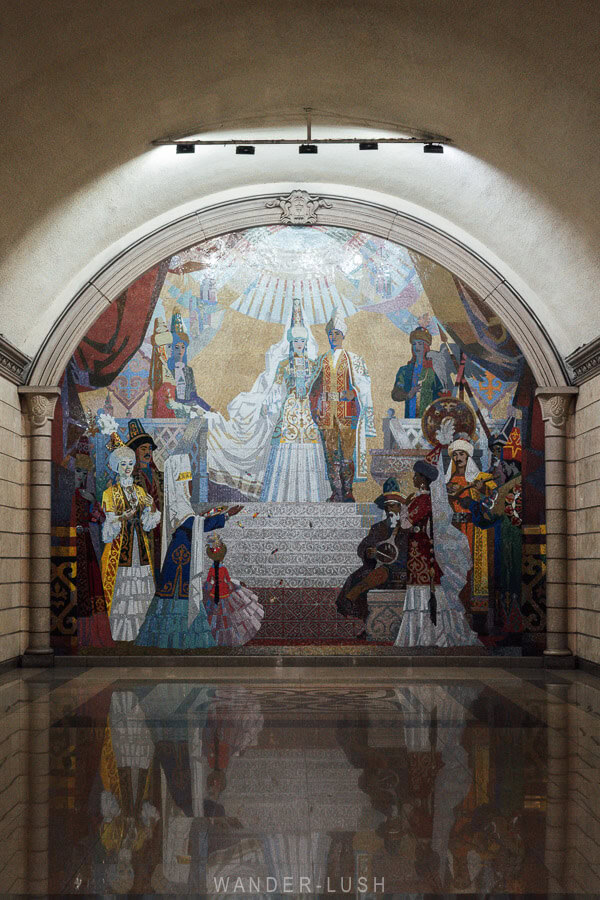
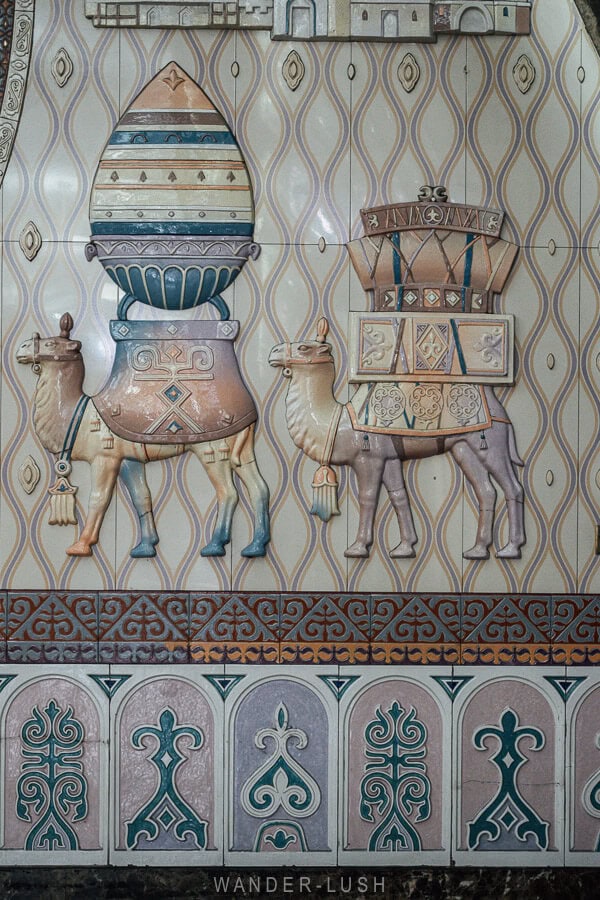
Although the architecture follows the Soviet tradition of monumental stations, the decorations are distinctly Kazakh, with references to nomadic culture, traditional textiles and national heroes. Many of the original works were created by a team led by Gaziz Yeshkenov – the same artist responsible for the ceramics inside the Central Mosque.
The most impressive station is probably Mukhtar Auezov Theatre (above left), named for the celebrated writer and playwright. At the far end of the platform, an enormous mosaic depicts a traditional Kazakh wedding, with the newlyweds standing beneath a shanyrak (the circular crown of a yurt, which symbolises family and home). The station walls are decorated with 16 circular reliefs depicting scenes from nomadic life.
Another highlight is Saryarka (below), one of the newer stations that opened in 2022. Named after the vast steppe region of central Kazakhstan, it features a beautiful relief of galloping white horses against a backdrop of Astana’s modern skyline. Smaller wall panels depict the landscapes, flora and fauna of the Kazakh steppe in a palette of ceramic, stone and metal.
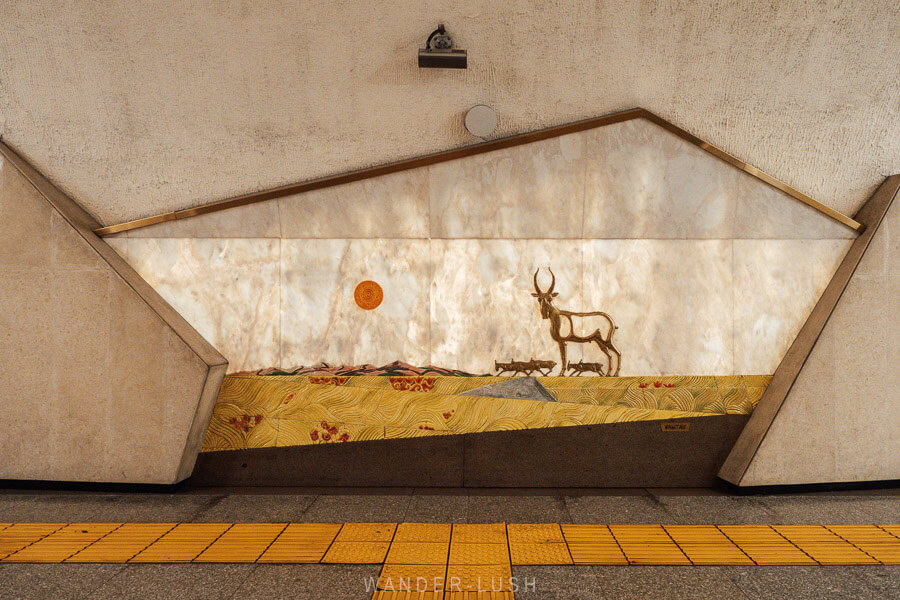
Zhibek Zholy (above right), with its elaborate ceramic murals depicting ancient trade routes, is also worth stopping for, as is Almaly, where colourful stained-glass panels celebrate the city’s association with apples.
A ride on the metro costs just 120 KZT or ~25 US cents. We had no issues photographing the stations with our cameras.
12. Aul Residential Complex & Sairan Lake
If you’re interested in modernism and Brutalist architecture, the Aul Residential Complex is another must-see in Almaty. Located west of the city centre (a metro and taxi ride away), this extraordinary collection of apartment towers is one of the most distinctive examples of late Soviet residential architecture I’ve encountered.
The complex was designed in 1983 by a team of architects led by Boris Voronin. What you see today is only a fraction of the original vision – Aul, meaning ‘village’ in Kazakh, was conceived as part of an ambitious plan to redevelop the surrounding Tastak district, with 33 residential towers of varying heights clustered together with communal spaces and supporting infrastructure.
Very much like the Skybridge project in Tbilisi, the collapse of the Soviet Union and subsequent economic downturn meant that it was never fully realised – in the end, only four towers were raised.

Each building has a cloverleaf-shaped floor plan, allowing the towers to be arranged at different angles to create interconnected courtyards. They are made from monolithic reinforced concrete, poured using a special continuous technique called slip-form construction to help them withstand seismic activity.
I had seen plenty of photographs of Aul online, and was expecting something rather grey and depressing (which to be fair, I do enjoy) – but in reality, I found it surprisingly cheerful! The pale-blue facades, leafy courtyards and play areas soften the structures and make it feel lived-in – which it very much is. This is a residential area, so do be respectful of people’s privacy when exploring and taking photos.
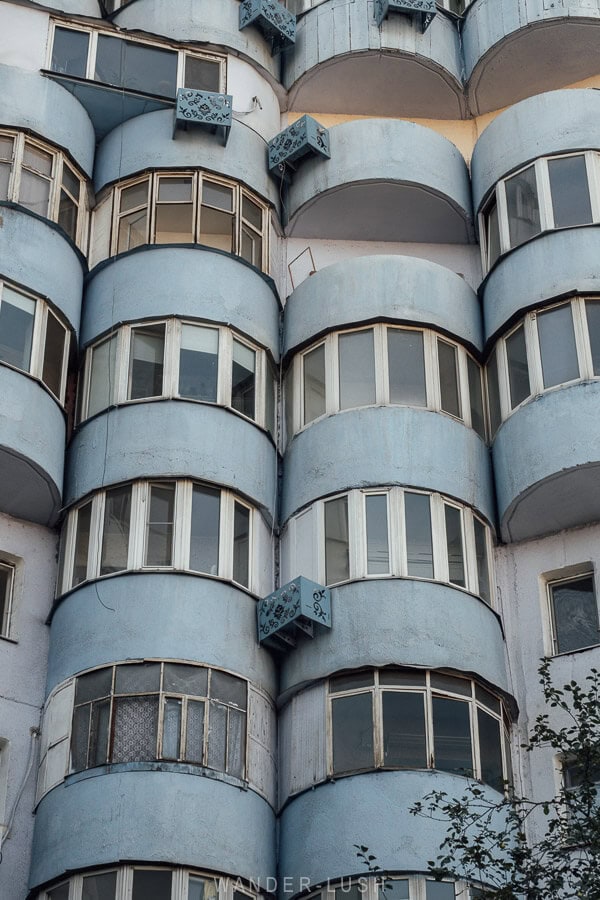

A short walk away, Sairan Lake is an artificial reservoir surrounded by a newly landscaped park. Located on the site of a former sand and gravel quarry that supplied construction materials for Almaty’s expanding residential districts, the lake was created in 1971 by damming the Bolshaya Almatinka River.
After decades of neglect, the area underwent a major renovation in 2025, and now has a beautiful 2.5-kilometre waterfront promenade. This is the perfect spot for iconic Almaty photos of the Tian Shan mountains rising behind the city (on a clear day, anyway).
13. Kok-Tobe Cable Car
For the best view of Almaty, though, I recommend taking the cable car up to Kok-Tobe, a hilltop park overlooking the city (a-la Tbilisi’s Mtatsminda).
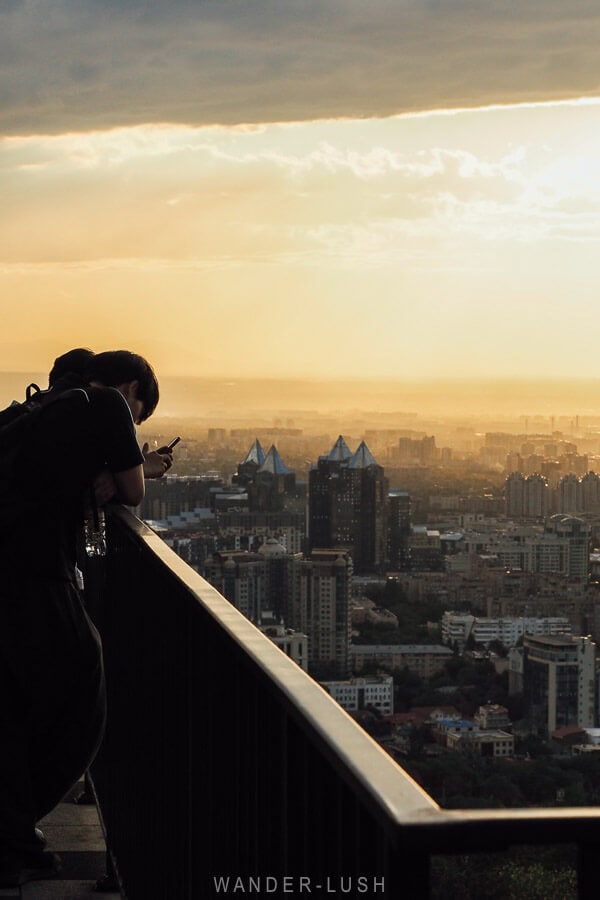
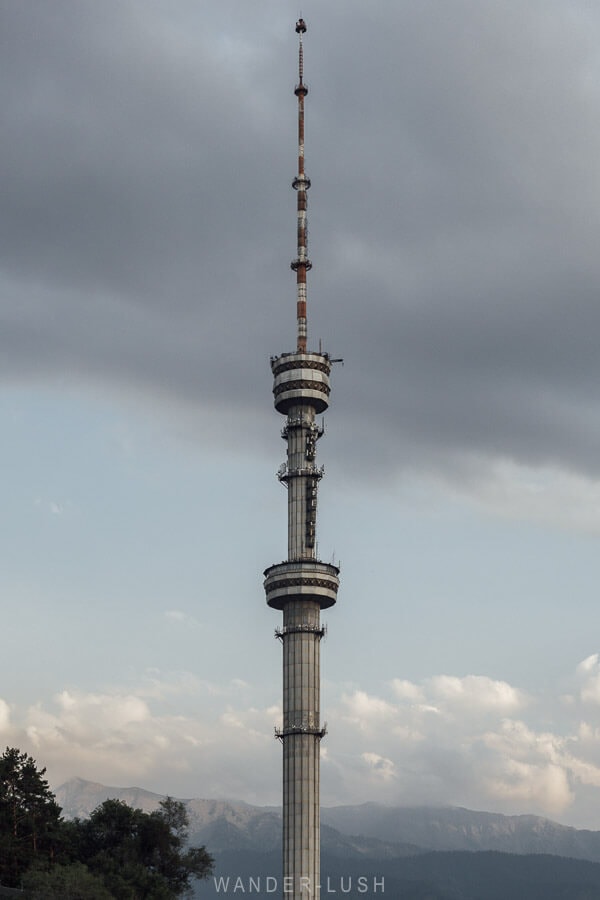
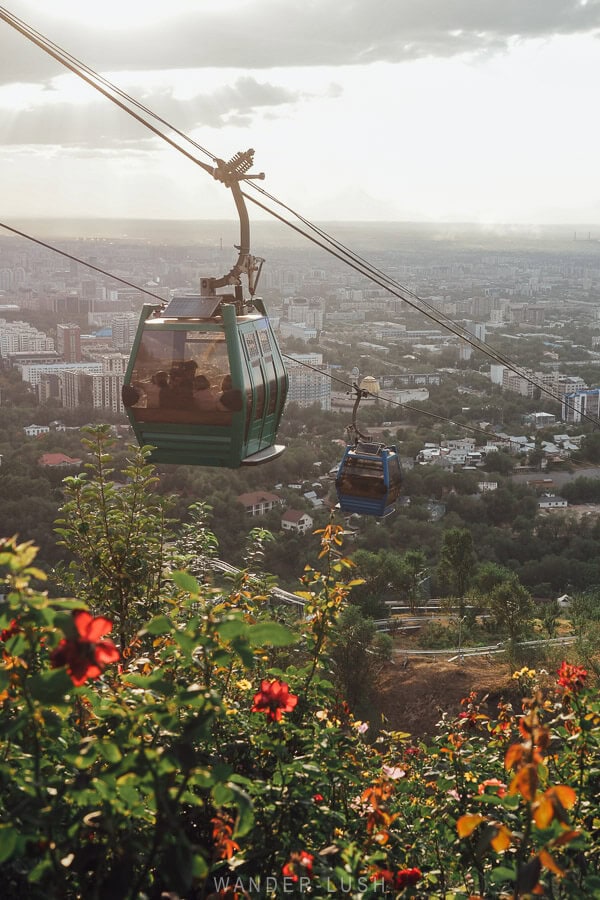
The original cable car opened in 1967 and interestingly, was designed by engineers from where else but Tbilisi, who travelled to Kazakhstan to oversee its construction. The original system had two large cabins, but was replaced in 2016 by a modern 1.6-kilometre cableway and 17 smaller gondolas.
The journey takes around six minutes, departing from Dostyk Avenue near the Palace of the Republic. Tickets are expensive – 10,000 KZT or ~22 USD return for an adult.
At the top, the sprawling park contains a Ferris wheel, children’s rides, souvenir shops, restaurants, and a toboggan. At the far end, there is a cafe with a terrace overlooking the city – and an outdoor viewpoint that anyone is welcome to visit.
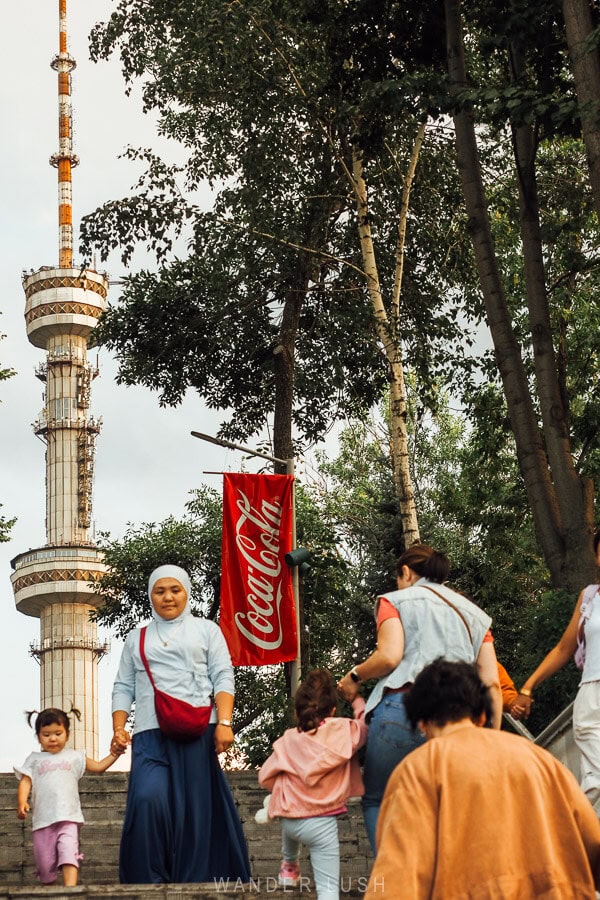

Now this is the last mosaic – I promise!
Tucked behind the rides, Girl with a Souvenir (also known as Sulushash, above right) was created in 1970 and has a remarkable survival story. Commissioned for a souvenir shop on what was then Lenin Avenue, the three-tonne artwork was almost destroyed during renovations in 2005.
Alpamys Kenbaev, the son of one of the mosaic artists Moldakhmet Kenbaev, happened to be passing by on a trolleybus when he saw workers smashing away at the facade with sledgehammers. He intervened, salvaged the remaining pieces, and restored the mosaic himself, eventually reassembling it on a purpose-built steel frame at Kok-Tobe in 2017.
Kok-Tobe does get busy on summer evenings, so I recommend coming up with at least 90 minutes to spare before golden hour then heading straight back down once the sun has set to avoid the crush.
Side Trip: Charyn Canyon, Kolsai & Kaindy Lakes
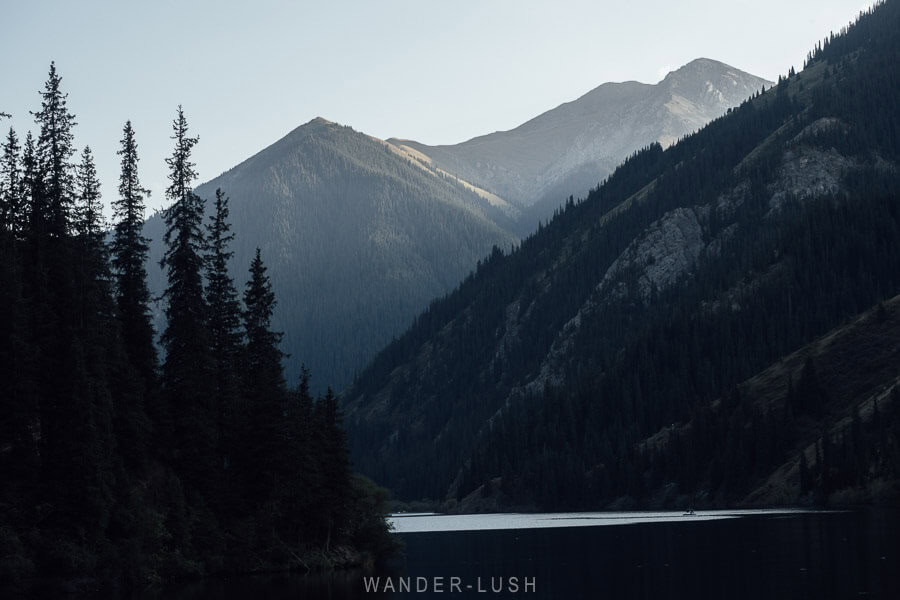
If you have an extra couple of days in Almaty, I recommend heading east to explore some of the most impressive landscapes in this part of Kazakhstan. Charyn Canyon, Kolsai Lakes and Kaindy Lake can be easily combined into one side trip.
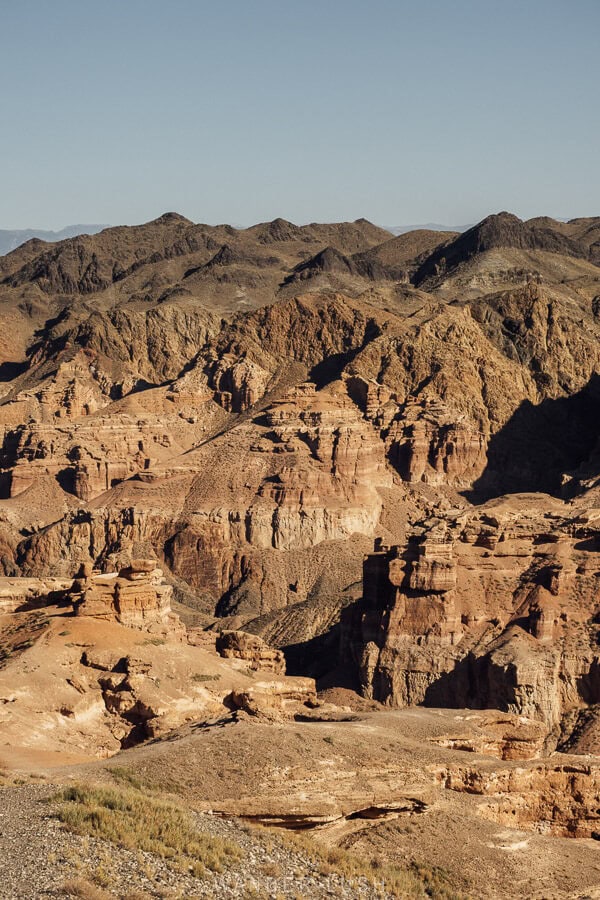
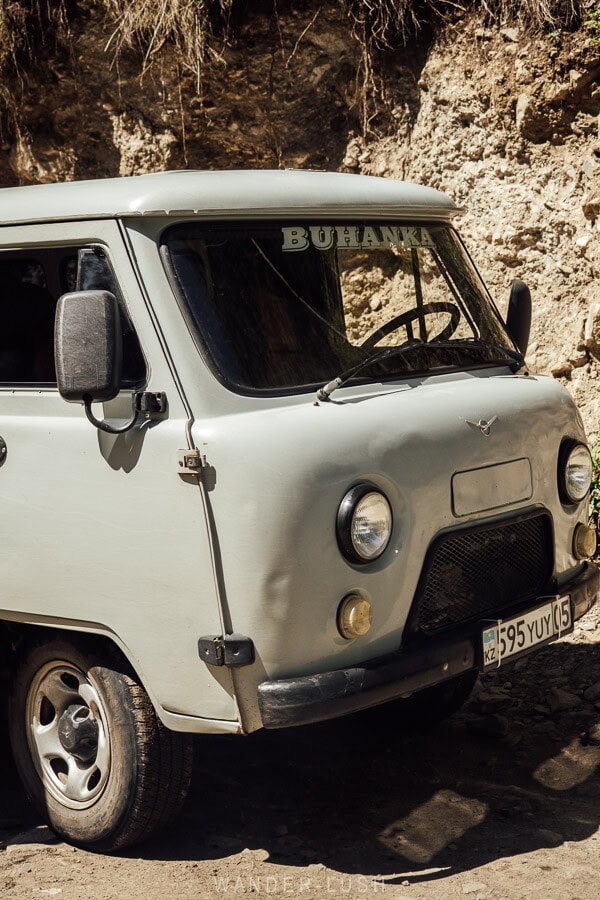
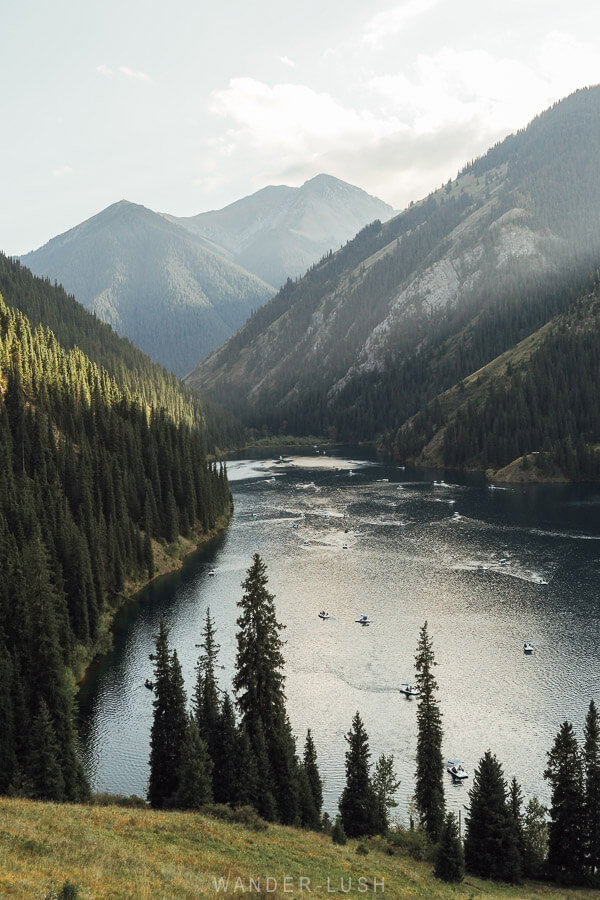
We chose this two-day guided tour with an overnight yurt stay over the single day trip option. We had more than enough time for sightseeing at each location, including a couple of hours at Kolsai Lake and longer walks at Kaindy and Charyn.
Our guide, Axultan, was one of the best guides we’ve had anywhere in the world. (He also does private hikes and tours – DM him on Instagram to get in touch.)
There is room for improvement on the food front, but the overnight stay was terrific. After a cold plunge in a magical forest spring and a lively evening of entertainment with the group, we slept in an elevated yurt – which was surprisingly warm and comfortable, unlike our Aral Sea yurt in Uzbekistan. If you do book this tour, bring your own snacks, and remember to have your karaoke song picked out in advance.
Where to stay in Almaty
Almaty Hotel
My favourite of the three accommodations we stayed at. This historic Soviet-era hotel, with its famous mosaics and curved facade, has an excellent location opposite the Abay Opera Theatre. Staff were very friendly, and the renovated rooms were great. Some floors have yet to be refurbished, so check which room category you’re booking.
→ Check prices & availability on Booking.com
Urban Yurt
Urban Yurt (pictured below) is a small, modern guesthouse on Panfilov Street, with beautifully designed rooms and a little coffee shop downstairs. The location is excellent, within walking distance of the Green Bazaar, Panfilov Park, and plenty of cafes and restaurants. Rooms are compact but very well equipped, with thoughtful touches. Note that there is no lift, and if you’re a light sleeper, request a room that’s far from the hallway laundry.


Hotel Kazakhstan
Opened in 1977, the 26-storey, gold-crowned Hotel Kazakhstan is one of Almaty’s most recognisable landmarks. The location near the Kok-Tobe cable car is convenient, and the upper floors have fantastic views. We didn’t quite get the nostalgic USSR hotel experience we were hoping for – the lobby and shared spaces have been totally transformed. And as mentioned, the layout of our room was far from ideal.
All comments are moderated and may take a little while to appear. If you’ve submitted your comment, I’ve got it!