This summer, I had a chance to visit Baia’s Wine, an award-winning vineyard in western Georgia, for a wine tour and home-cooked meal. Here’s how you can experience this unique day trip from Kutaisi, too.
Please note: This post contains affiliate links, meaning I may earn a commission if you make a purchase by clicking a link (at no extra cost to you). Learn more.
Transparency: Our ‘Wine and Dine’ tour was generously hosted by Budget Georgia. As always, all opinions and recommendations expressed here are 100% my own.
Want to visit Baia’s Wine? Book your Wine and Dine experience through Viator. The price includes transfers to/from Kutaisi or Batumi, wine tasting, tour of the vineyard, and a beautiful home-cooked dinner. Tours are available year-round (including in winter).
Our van pulled up at the house in Obcha village on a Monday evening in between bursts of summer rain. There wasn’t a soul around. ‘Baia, Baia’, our driver shouted in the direction of the vineyard, hoping to hear an answer from somewhere amongst the five hectares of tangled grape vines beyond.
While he searched, we waited in front of the Abuladze family home – a typical Georgian house featuring a long, open balcony strung with washing lines and a water well out the front.
Were it not for the small wooden sign mounted next to the gate, you’d never know this was a commercial winery.
But that’s not unusual.
In a country with an estimated 100,000 family vineyards, most Georgians are engaged with wine making and have been for generations. Viticulture is very much a family affair.

It wasn’t long before Gvantsa appeared. Hair in a bun and dressed in mismatched clothes and mud-caked gumboots, the first words out of her mouth were an apology for her eccentric outfit. She had been busy all afternoon working in the vineyard.
It had been an unseasonably wet July in western Georgia’s Imereti region. For us tourists, the unpredictable showers and dark skies had been a minor inconvenience. For Gvantsa and her family, the rain was a serious problem. An outbreak of fungus can pose a real threat to a biodynamic vineyard like theirs, so Gvantsa had been working overtime to spray the vines with copper.
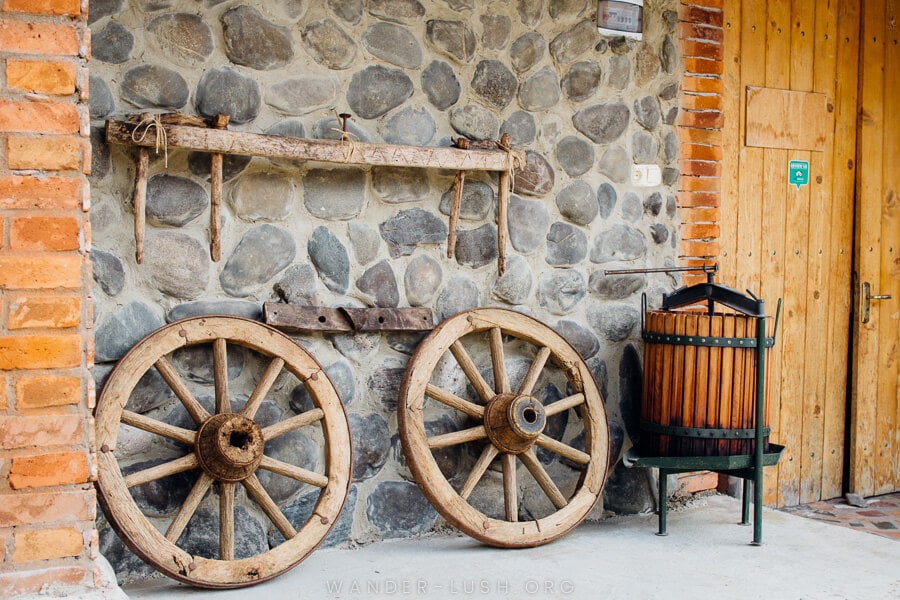
Most people think of Kakheti when they think of Georgian wine. The wine trail that runs south from Kutaisi in western Georgia’s Imereti region is lesser-known, but just as worthy of a visit.
Family vineyards like the one Gvantsa manages with her two siblings, Giorgi and Baia, have been operating on these fertile lands for four generations or more. You could say that wine making is in their blood.
The sisters are causing a bit of a stir in an industry traditionally dominated by men. Baia first got the idea to expand her family winery and become a professional winemaker when she was studying in Tbilisi. Like more and more young people, she moved back to her family’s village to pursue her dream.
In the family dining room where we would later sit down for dinner, every inch of wall space is taken up by framed awards and certificates. Baia, the eldest of the trio at 25 years old, has become the face and name of the family’s commercial label. Her biggest accolade to date is being named on Forbes 30 Under 30 list for European art and culture in 2019.
The name ‘Baia’s Wine’ is well-known outside of Georgia. When I found out the family property is open to visitors and close enough to visit from Kutaisi, I immediately wanted to go.
We didn’t get to meet Baia (she had a new baby to take care of at the time of our visit), but Gvantsa and their mum treated us to an amazing evening of food and wine. Here’s a taste of what went on.

Tour of the vineyard
Like most wine tours in Georgia, our visit to Baia’s Wine began with a tour of the property. We headed up to the balcony to get a good look at the vineyard.
Gvantsa gave us a breakdown of the entire wine-making process, from tending the vines to harvesting the grapes. Each region and each family does things a little differently, so it’s always interesting to hear things explained in the wine maker’s own words.
Four endemic varieties of wine grapes are grown on the property: Tsitska, tsolikouri, krakhuna and otskhanuri sapere. The siblings produce red and amber wines using methods learned from their parents, which were passed down from their parents, and so on.
When asked when this year’s grape harvest would take place, Gvantsa automatically reached for her mobile phone. She opened up her calendar app to double check which weekend she had blocked out to pick the grapes by hand. This is all decided by correlating the weather with the lunar cycle. The harvest shouldn’t take place during a full moon, Gvantsa explained, because of the gravitational pull.
This is just one example of how science meets tradition and ritual in Georgia’s wine-making tradition.

The fermentation process
After this introduction, we headed downstairs into a cool, dampish room. Traditional Georgian wine is fermented and aged not in stainless steel drums or oak barrels, but in huge clay vessels known as qvevri.
As soon as we entered the cellar, I immediately noticed a dozen or so qvevri buried deep beneath the tiled floor, only their round lids visible above the surface. Taking care not to tread on any of the wooden disks, we admired the collection of bottles and wine-making ephemera on display.
Against this backdrop, Gvantsa continued with her narration. Approximately 30 percent of the grapes harvested retain their skins – known as ‘skin-contact’ wine making – which gives the wine its deep amber colour and tannin-y flavour profile. The first stage of fermentation takes place in the qvevris, and the winemaker must constantly stir and test the brew.
Next, the wine is placed in steel drums housed in an adjoining room where it is left for another three or four months. Boxes of empty glass bottles and corks – 5,000 of them, to be precise – are stored in this room, ready for bottling the next harvest.

Degustation and dinner
With a basic understanding of the process under our belts, it was time to try Baia’s Wine for ourselves.
We sat down at a long communal table as Gvantsa poured us all a glass of amber, the first of many. In the background, her mum started ferrying dishes to the table from the family kitchen: Khachapuri, generous salads, colourful pkhali, plates of succulent chicken, and other Imeretian specialty dishes.
We dove into the delicious home-cooked meal, only pausing for the occasional toast. It was usually our driver, seated at the head of the table, who raised his glass first. Unfortunately for him, he was stuck drinking water!
Watch my short video from Baia’s Wine!
Visiting Baia’s Wine from Kutaisi
The best way to visit Baia’s Wine and participate in a degustation and dinner is by booking a tour through Budget Georgia. Their ‘Wine and Dine’ package includes transportation to and from the vineyard, a guided tour of the property by one of the Abuladze family members, plus a full spread of food and bottomless wine.
The tour is available year-round, including throughout winter, with transfers from Kutaisi or from Batumi.
Check tour prices and availability here on Viator or book direct with Budget Georgia and save 10% when you mention Wander-Lush.
If you’re interested, there is also a guesthouse at Baia’s Wine where you can spend a night or two sleeping amongst the vine leaves!
Where to stay in Kutaisi
If it’s your first time visiting Kutaisi, I highly recommend choosing a hotel that’s located in the city centre. See this neighbourhood guide for detailed recommendations, or check out my top Kutaisi accommodation picks below.

BOUTIQUE: Hotel Memoire (⭐ 8.9). Located on the cusp of Kutaisi’s historic Jewish Quarter, behind the Colchis Fountain, this hotel has dark and sultry rooms decorated with vintage wallpapers and antiques, plus an atmospheric wine bar restaurant.

UP-SCALE: Best Western Kutaisi (⭐ 8.3). Situated at the end of the White Bridge, footsteps from Kutaisi centre, this hotel has a magnificent rooftop bar-grill with river views. Quality service, well-appointed rooms and a generous buffet breakfast are all on-point with the Best Western brand.
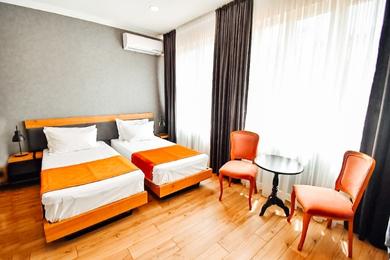
MID-RANGE: Hotel 1887 (⭐ 9.5). This historic 19th-century house is a 10-minute walk from the Colchis Fountain. Rooms pair original wooden panelling and parquet floors with minimal, Scandi-style furnishings. There is a garden, and some rooms have private balconies.

BUDGET: Bao Hostel (⭐ 9.4). This cosy hostel is just 5 minutes’ walk from the Colchis Fountain and offers dorm-style rooms with ensuite bathrooms. The shared lounge and kitchen are tastefully decorated with plenty of natural light and old-world touches.
You might also be interested in…
- The ultimate Georgia itinerary: Four detailed & custom-designed itineraries
- Georgia Travel Guide: All of my 200+ posts plus my top travel tips
- Georgia travel tips: 25 essential things to know before you go
- Places to visit in Georgia: 50+ unique & underrated destinations around the country
- The best things to do in Tbilisi: Favourites, hidden gems & local picks
- 35+ best restaurants in Tbilisi: Where to eat Georgian food
- 15 best day trips from Tbilisi: With detailed transport instructions
- The best time to visit Georgia: Month-by-month guide to weather, festivals & events
More Kutaisi ideas
- The best things to do in Kutaisi, a suggested itinerary
- Where to stay in Kutaisi, detailed neighbourhood guide plus the best hotels
- 25 alternative things to do in Kutaisi, offbeat attractions & hidden gems
- How to get from Kutaisi Airport to the city centre, detailed guide
- The best Kutaisi restaurants, where to eat in Kutaisi
- Visiting the caves & canyons around Kutaisi, a popular day excursion
- Guide to visiting Tskaltubo from Kutaisi, abandoned sanatoriums
- Guide to visiting Chiatura from Kutaisi, Soviet-era cable cars
All comments are moderated and may take a little while to appear. If you’ve submitted your comment, I’ve got it!