The mud volcanos and petroglyphs at Gobustan National Park are two of the most interesting things to see in Azerbaijan. Here’s how to travel from Baku to Gobustan to visit both on easy and affordable day trip.
Post-apocalyptic is the only way to describe the landscape in Gobustan National Park. Situated just 67km south of Baku (or an hour’s drive) along the Caspian coast, Gobustan (Qobustan) is all rock and oozing mud, scars and craters.
Easily accessible as a day trip from the capital, the mud volcanoes near Baku are a must see if you’re visiting Azerbaijan.
Here’s my travel account, plus everything you need to know about visiting the mud volcanoes and UNESCO-Listed petroglyphs on a Gobustan tour from Baku.
Please note: This post contains affiliate links, meaning I may earn a commission if you make a purchase by clicking a link (at no extra cost to you). Learn more.
Gobustan day trip overview
- Distance from Baku to Gobustan: 67km (42 miles)
- Gobustan National Park hours: 9am–5pm daily
- Gobustan entrance fee: 10 AZN (includes a guide)
- Best Gobustan day trip: Gobustan, Mud volcanoes, Fire temple, Fire mountain Group Tour with Bag Baku

Exploring the Gobustan mud volcanoes
Despite initial appearances, Gobustan is not actually dead but living – living in the 14,000 residents who call the nearby town home; living in the blistering mounds and temperamental coastline that are constantly shifting on Mother Nature’s whim.
Beyond, an azure Caspian floats just out of reach, a backdrop to the flat-top mountains this retreating inland sea pummeled into shape. Above, the azure sky is dotted with choppers surveying the oil rigs below.
Azerbaijan is often described as otherworldly, and Gobustan is otherwordlyness incarnate.

Like what you see? check out more of my best photos from Azerbaijan.
It’s not oil or tar bubbling up from the earth as you might imagine, but mud – thick, gooey, cold mud. More than half the world’s mud volcanoes – about 300 in total – are found in Azerbaijan, and some of them are here in Gobustan.
Mud volcanoes are not really volcanoes at all, but take their name from their resemblance to the molten-lava kind. Mud volcanoes come in all shapes and sizes and many are very small. Because they have no lava and rarely erupt, it’s safe to get up close.

Methane and carbon dioxide gases released from deep within the Earth cause Gobustan’s mud volcanoes to constantly bubble away, releasing a slow drizzle of wet mud that paints the ground grey and black.
Gobustan’s weather is windy and salt-crusted, so the mud dries out quickly, cracking and changing colour almost before your eyes.


Exploring this wicked landscape is great fun; it really does feel like you’re standing at the edge of the Earth out here. A vista of Gobustan is like a glimpse at the end of existence.
The stark, almost hostile landscape is a wonderful juxtaposition to the other tourist attraction this area is famous for – a place where people come to ponder the beginning of life as we know it.

Gobustan Gobustan Rock Art Cultural Landscape and petroglyphs
Most people don’t travel to Gobustan for the mud volcanoes – they come for the petroglyphs.
Petroglyphs are symbolic and figurative ‘drawings’ made by early humans by chiselling shapes into the patina of exposed rock. Petroglyphic rock art (crude as it may be) is evidence of the development of symbolic thinking, making it one of the most important artefacts of early human history.
The Gobustan rock art petroglyphs date back up to 40,000 years to the Upper Paleolithic, Mesolithic and Neolithic periods. More than 6,000 individual carvings were discovered here in the 1930s and have been protected through the Gobustan National Park (Gobustan Milli Parkı) ever since.

The Gobustan National Park Museum sits adjacent to the petroglyphs and this is the first port of call for visitors. The museum contains interactive displays that explain the meaning of the carvings as well as a more general exhibition to help you understand the context of Gobustan.
Many of the petroglyphs found here depict horses, goats, lions and big game. Evidence suggests that animals were carved into the rock as part of pre-hunting rituals – or maybe even for target practice.
Other petroglyphs are visual records of Gobustan’s culture: dance ceremonies, pregnant women depicted in profile and abstract tamgas or status symbols.

Outside the museum, walking tracks wind through Gobustan’s surreal landscape of stacked boulders, rock shards and caves, tumbledown from the countless earthquakes this area has endured.
This part of Gobustan is noticeably greener, but it’s just as windswept and dry as the mud volcanoes.
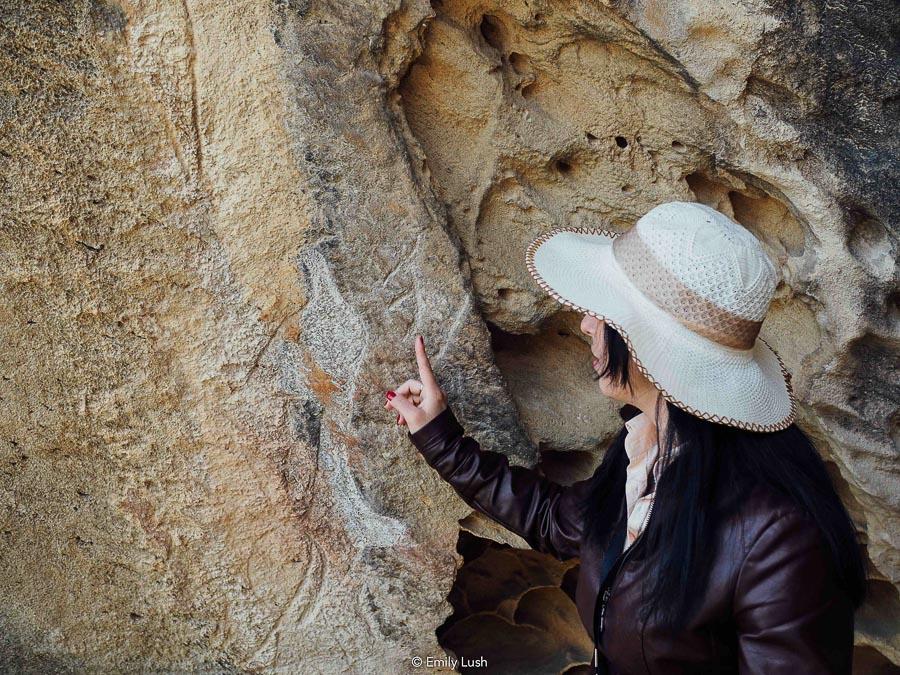
It’s essential to visit the museum before going out to see the petroglyphs in-situ. The carvings are well-preserved but difficult to identify, so it helps to know what you’re looking for. Better still, have a guide from the museum accompany you like we did.

How to travel from Baku to Gobustan
Gobustan National Park makes for an ideal trip out of Azerbaijan’s capital. The mud volcanoes are located half an hour’s drive from the museum, so it’s a good idea to pair the two and make a day of it.
The museum is well signposted and you should have no trouble getting there by taxi or bus. The mud volcanoes, however, are off-road and a bit hidden away.
Therefore, the most convenient way to see Gobustan’s petroglyphs and mud volcanoes is with local company Bag Baku. They run daily group tours to Gobustan from Baku (leaving at 9.30am and returning to Baku in the late afternoon) plus private tours on request.
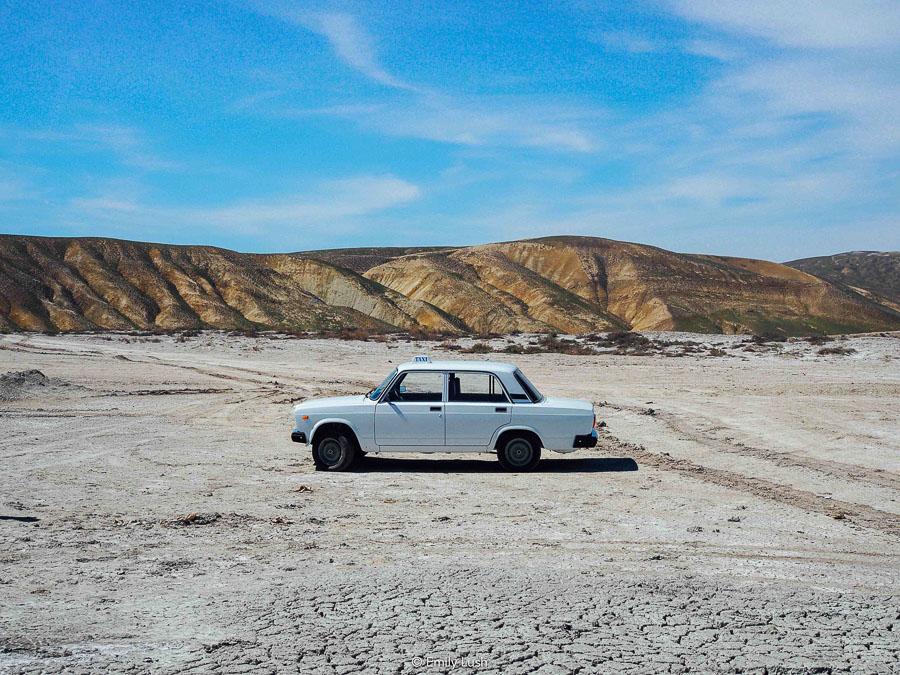
At the museum, they’ll organise your guide. Bag Baku staff then coordinate with a fleet of Lada taxi drivers to take you out to the volcanoes. On the way back to Baku, they now make a stop at Ateshgah Fire Temple and the Yanar Dag ‘ burning mountain’.
Prices start from 54 USD per person for the group tour or 82 USD for a private tour, including transport and an English speaking guide.

How to get to Gobustan from Baku using public transport
To get to Gobustan from Baku independently, you’ll need to use a combination of public transport and taxis.
First, take a south-bound bus 125 from Azneft Square to the Karvansaray Shopping Centre (0.40 ANZ; 30 minutes). Cross the road to Bina Shopping Centre and board the south-bound 195 bus (1.30 AZN; 45 minutes) to Gobustan House of Culture in the centre of Gobustan town.
From there, a local taxi to the National Park takes around 10 minutes and should cost ~12 AZN. A taxi to the petroglyphs and the mud volcanoes combined should cost ~30 AZN.
What to bring with you to Gobustan
- Good walking shoes. The terrain is rough around the mud volcanoes, so comfy walking shoes are absolutely essential.
- A hat. You’ll be spending a lot of time outdoors and since the area is very exposed, sun protection is key (even in winter). It’s also a good idea to carry a travel raincoat and/or collapsible umbrella in case you get caught in the rain.
- A refillable water bottle. Avoid single-use plastics whenever you can. I love my S’Well water bottle for warm climates because it doesn’t sweat.
- Snacks. Apart from a small ice cream and tea store inside the museum grounds, there’s no real opportunity to buy food. Best to bring some snacks with you.
- Biodegradable wet wipes. Try this convenient travel pack.
Where to stay in Baku
If it’s your first time in Baku, I highly recommend choosing a hotel located inside or close to the walls of the atmospheric Old City.

TOP CHOICE: Deniz Inn Boutique Hotel (⭐ 9.5). Located within the Old Town walls, 5 minutes from Maiden Tower, this cute hotel has tidy rooms with balconies and a rooftop terrace. Breakfast is served in a quirky dining room decorated with Caucasian carpets.

BUDGET: Cth Baku Hostel (⭐ 9.2). Located in the popular student neighbourhood of Yasamal, west of the Old City and just footsteps from Nazimi Metro Station, this hostel has budget-friendly private rooms with shared bathrooms and comfortable communal spaces for socialising.

MID-RANGE: Centric Baku Boutique Hotel (⭐ 9.8). Located just outside the Old City walls close to the National Museum, this modern, stylish hotel has chic rooms with city views. A terrific breakfast is included.

HIGH-END: The Merchant Baku (⭐ 9.6). Located right on the old wall, 600m from the Palace of the Shirvanshahs, this opulent hotel has spacious rooms with private balconies and a gorgeous Silk-Road-inspired cocktail lounge.
Azerbaijan essentials
Here are some of the websites and services I use for planning a trip to Azerbaijan and the Caucasus. Remember to check out my full list of travel resources for more tips.
FLIGHTS: Find affordable flights to Baku on Skyscanner.
VISAS: Use iVisa to check if you need a tourist visa for Azerbaijan and apply for an expedited visa online.
DOCUMENTATION: Use OneWayFly to obtain proof of onward travel/hotel reservation for your visa application.
TRAVEL INSURANCE: Insure your trip with HeyMondo, my preferred provider for single-trip and annual travel insurance (use my link for 5% off).
AIRPORT TRANSFER: Pre-book a private transfer from Baku Airport to your hotel.
RENTAL CAR: Use Local Rent to find an affordable rental from a local agent.
ACCOMMODATION: Find the best Azerbaijan hotel deals on Booking.com or book a Baku hostel.
SHORT ON TIME? Get to know Baku on this Old City walking tour, or join this panoramic night tour to see Baku in her best light.
ALI AND NINO: Pick up a copy of Ali and Nino, Azerbaijan’s national novel. I can guarantee that Kurban Said’s evocative descriptions of Baku will get you excited for your trip!
More Azerbaijan travel resources
- Best day trips from Baku, more options beyond Gobustan
- Azerbaijan travel guide, all my resources in one place
- Azerbaijan itinerary, my suggested 7-day route for first-time visitors
- Azerbaijan Georgia itinerary, 2 weeks in the Caucasus
- Full Caucasus itinerary, for Georgia, Armenia & Azerbaijan
- What to do in Baku, my tips for the capital
- Visiting Baku Old City, a UNESCO site
- The Heydar Aliyev Center, my favourite photos & visitors’ tips
- Things to do in Sheki, my favourite place in Azerbaijan
- Visiting the Khan’s Palace in Sheki, my top tips
- Staying in a Silk Road caravanserai, a night to remember
- Baku to Sheki, how to travel & where to stop along the way
- Things to do in Khinaliq, hiking, homestays & more
- Things to do in Lahic, copper workshops & old streets
- Carpet weaving in Quba, a must for textile-lovers
- Baku to Tbilisi by overnight train, a guide to the sleeper train
- BTAK train from Baku to Kars via Tbilisi, all the latest news
- My favourite photos of Azerbaijan, inspiration for your trip
- Travelling Azerbaijan by bus, tips for using overland transport
Baku to Gobustan mud volcanoes: Pin it!


Hi. Can you please help me with some information regarding the mud volcanos. I will be travelling in Jan 2022 and would really like to visit the mud volcanos. Can you please let me know if it is correct time and if i would be able to see the active volcanos considering it is winters.
Also, can you let me know which is the peak and off season to visit mud volcanos?
Hi Jalpa, I went in late winter/early spring so it should be possible.
You should contact BagBaku to confirm. Thanks!
Hello Emily,
Thank you very much for this great and comprehensive story. I am going to Baku end of this month and I have contacted bagbaku and they confirm the price for the group tours which you provided. I am really looking forward to visiting this National Park. Thank you very much for helping out:)
Hi Rafal!
Glad I could be of help. Have a wonderful time in Baku and a great tour! It was one of the highlights of the Caucasus for us 🙂
Enjoy!
I am going to Baku in September. I contacted your suggested tour company and they quoted 110 AZN for the trip that cost you 35 AZN. (And my quote is without entrance fees, where yours were included)……has it escalated so fast?
Hello! Thanks so much for reaching out.
I’ve just been in touch with the owner of the company. There has indeed been a small fee increase of 20 AZN. I am updating my post now to reflect this change.
We think the 150 AZN you were quoted was probably for a private tour. If you check in with them again and request to join an existing tour, the price should be 45 AZN excluding entry to the park, which is an extra 10 AZN.
I hope this helps!
Such a nice article about Baku and Azerbaijan.
Excellent blog and images.
Cheers, Mike!
I agree with you.