The best things to do in Georgia in summer, from mountain hikes and highland festivals to wild swimming, stargazing, and other summer-only experiences.
A watermelon cooling off under a running tap, mtsvadi on the grill – summer in Georgia has an unmistakable feel.
With so much of the country being mountainous, it’s the time of year when everything suddenly feels open and achievable. It’s a season of long days and even longer nights, when Tbilisi buzzes well into the evening and the wine often starts flowing from mid-morning!


Summer weather usually arrives in Georgia around the middle of June and lingers until September – a month locals sometimes refer to as the ‘fourth month of summer’.
And while it’s no secret that summer isn’t my favourite season – I much prefer glowing autumn days and cool spring evenings – there are still things I look forward to every year because they simply aren’t possible at other times. This includes high alpine hikes, road trips on remote mountain passes, highland festivals, and more.
To inspire your trip planning, here are 15 of my favourite things to do in summer in Georgia.
Also see my tips for visiting Tbilisi in summer, with suggestions for how to beat the heat.
Please note: This post contains affiliate links, meaning I may earn a commission if you make a purchase by clicking a link (at no extra cost to you). Learn more.
Special things to do in Georgia in summer
1. Visit Tusheti while the road is open

One of the most remote mountain regions in Georgia’s Greater Caucasus, Tusheti is connected to the rest of the country by a single, precipitous mountain road – one sometimes counted amongst the world’s most dangerous.
In recent years, work has been done to make the road to Omalo a lot safer. But because of the high elevation – peaking at 2,850 meters – the Abano Pass is only accessible for a short period each year, usually from late May through to October.
Spring and autumn reveal the beauty of Tusheti’s Transhumance traditions, where shepherds move their flocks up and down the pass in search of greener pastures. For travellers, late June until mid-September is the best time to visit, as road conditions are more stable, guesthouses are open, roving festivals sweep through the villages, and hiking trails are accessible.
A skilled driver and some advance planning is required to make the journey up to Omalo, Dartlo, and the other villages. If you’re lucky enough to be around when the road is open, you should definitely consider venturing to this remote corner of the country that not many Georgians even get to visit.

If the Abano Pass sounds too intimidating, a slightly ‘softer’ alternative is Khevsureti – another historic mountain region sandwiched between Tusheti and Kazbegi. It is easier to reach from Tbilisi and every bit as adventurous and atmospheric, with its fortified tower-villages, homestays and short hiking trails.
2. Drive the epic Zagari Pass

The road from Ushguli to Kutaisi is probably my favourite drive in Georgia. A rough dirt track up until a few short years ago, as of 2024, it is a fully concreted road that is navigable in a regular car (no 4WD required), with a travel time of around four hours.
Zagari (also called Zagaro) is not as high as Abano, but it similarly closes over the winter, reopening towards the end of May and closing again with the first snowfall in October. The scenery between Ushguli and Lentekhi is incredible, with a couple of marked viewpoints, a church, and several villages you can call into along the way.
Zagari is an alternative way to reach Ushguli and its UNESCO-listed towers without having to take the longer road through Zugdidi and Mestia. Or you can stitch the two routes together to make a Svaneti driving loop, as described here in my Svaneti itinerary.
3. Experience a highland festival

Summer – particularly July and August – is festival season in Georgia’s highlands. Exact dates and details are often difficult to pin down, so it’s best to think of these festivals as an added bonus rather than something to plan your whole trip around.
Annual events include Atnigenoba in Tusheti – marked by feasting, singing, and the brewing of Tush beer – and Shuamtoba, a celebration of mountain culture in the village of Beshumi (also see #4 below).
The Bakhmaro Cup is one example of a doghi where horse riders battle it out for a blue ribbon. It takes place on the same date every year: August 19th (Transfiguration Day).


Kvirikoba is another unique highland festival: Staged at Lagurka Church in Svaneti, it centres on an old strength-testing tradition where men attempt to lift giant stones over their shoulders and hoist heavy church bells.
Other summer rituals and pilgrimages include Chiakokonoba, an ancient fire-jumping tradition with pre-Christian roots, and Lomisoba, a pilgrimage to a remote church near Gudauri.
Georgia travel resources I recommend
Planning a trip to Georgia? Here are 5 resources I use & recommend.
- Mandatory insurance: Cover.ge. Get a budget-friendly health & accident insurance policy that meets Georgia’s new entry requirements. Use wanderlush for 5% off.
- Private transfers in Georgia: GoTrip.ge. Find a professional, English-speaking driver. Prices are locked in when you book & you can stop wherever you want.
- Hiring a car in Georgia: Local Rent. Save money when you rent directly from a local agent. Pick-up & drop-off are available from any address.
- Tbilisi tours & day trips: Friendly.ge. Knowledgeable guides, safe drivers & creative itineraries. Use wanderlush for 10% off.
- Accommodations: Booking.com. The biggest selection of properties in Georgia, including guesthouses in rural areas.
4. Take a backcountry road trip through Upper Adjara’s summer pastures

Upper Adjara – the mountainous interior zone of the region best known for its Black Sea beach resorts and the city of Batumi – is a completely unique part of Georgia that is even more untouched and unknown than Tusheti in some ways.
Combining the sea with refreshing waterfalls and high mountain scenery, Adjara is perfect for a summer road trip. The road through the Goderdzi Pass is free of snow and ice and securely open from May onwards. Families from these mountain communities in the Lesser Caucasus also observe transhumance rituals, only because of the region’s historic ties with the Ottoman world, their summer villages are known as yaylalar.
Along with yayla villages such as Beshumi, you can find alpine gardens, painted wooden mosques, and quirky sights such as the Khabelashvili Covered Bridge. In late summer, you will see people preparing for the winter ahead by chopping wood and gathering hay – a reminder of how harsh life is in the remote mountains.
5. Chase the clouds on Gomismta

Gomi Mountain (Gomismta) and Bakhmaro (the latter hosting the August Horse Cup, mentioned above) are two lesser-known mountain escapes that are popular with locals but rarely visited by international travellers. Both lie in Guria, Georgia’s smallest region by size and one of my favourites thanks to its fascinating tea industry and subtropical landscapes.
The thing to do at Gomismta is drive up for sunset. The unusual topography in this area causes cool air from the Black Sea to rise and meet the mountains, creating a unique phenomenon where the surrounding valleys are often buried in thick, low-lying clouds. Summer provides the best conditions for this, and it’s also the most pleasant time of year for wandering around the village or overnighting in an A-frame cabin.
Georgians love an outdoor picnic, and in summer you will see people transporting full set-ups to the ridge – mini charcoal grills, umbrellas and all.
6. Stargaze in Abastumani

The Abastumani Astrophysical Observatory was the first high-altitude astrophysical observatory in the USSR when it opened in 1932. Scientists based here have contributed dozens of important discoveries over the decades, and today the still-active facility also welcomes visitors for guided tours.
Day tours lead visitors through the observatory and its small museum, while evening tours also offer the chance to look through the 40cm Refractor – the oldest working telescope on the grounds, assembled in 1937. Tours are available from spring to autumn, but July and August offer some of the best conditions for stargazing. On clear summer nights, you might even see Saturn after 11pm.
A Romanov-era spa resort, Abastumani has a main street lined with beautifully preserved restored dacha houses, hot springs, and pine forests laced with hiking trails. The clean air and cooler temperatures make it one of the best places in Georgia to escape the summer heat.
7. Tour the Dmanisi Archaeological Reserve


Dmanisi in southern Georgia’s Kvemo Kartli region is one of the most important archaeological sites in the world. It was here that archaeologists uncovered some of the earliest hominin remains ever found outside Africa, rewriting what we know about early human migration.
The Museum-Reserve is an active archaeological site, with Georgian and international teams carrying out excavations every summer. Because it closes in winter and spring, the warmer months are the best time to visit. A small open-air museum sits atop the mound, where you can also trace the contours of a medieval citadel. It’s an immersive, hands-on site and a particularly good choice for kids.
PromotedDon't miss out on today's trending deals!
Join thousands of users enjoying exclusive benefits right now.
For an offbeat day trip from Tbilisi, pair Dmanisi with the nearby town of Bolnisi – a former German colony with its own PDO and burgeoning wine scene – or one of the many other archaeological sites in the region.
8. Ride the ski lifts without the snow


The chairlifts at Georgia’s four ski resorts close for maintenance in spring and autumn either side of the winter sports season. In Gudauri, Goderdzi, Bakuriani and Hatsvali (Mestia), each reopens for a short summer season, usually between late June and mid September.
This is a great opportunity to get big-mountain Caucasus scenery without having to slog it on a steep hiking trail. Some upper stations have short ridge trails, viewpoints or high-altitude cafes.
Kobi-Gudauri is the most spectacular cable car in Georgia in my opinion, with its unbeatable views of Mount Kazbek.
9. Hike Georgia’s high alpine trails
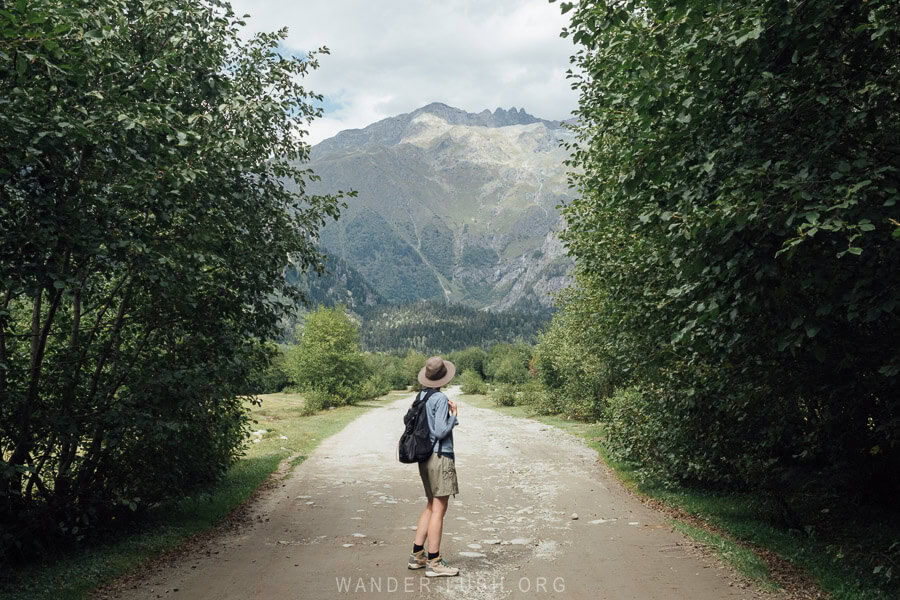
It goes without saying that summer is prime time for hiking in Georgia’s high mountains. Lower valley hikes such as Juta and Truso near Kazbegi can be open from mid to late May, depending on the year and how much snow there is. But higher routes take much longer to clear.
Above around 1,800 metres, snow often lingers until late June or early July, and can start returning in October. That’s why July to September is generally the most reliable window for snow-free hiking in places such as Kazbegi, Svaneti and Racha, as well as Khevsureti and Tusheti.
The most popular trekking routes – including the classic Mestia to Ushguli hike – are usually best done from June at the earliest, with optimal conditions from mid-June through to the end of August. This is also peak season, when trails, guesthouses and mountain villages are at their busiest.


Personally, I much prefer hiking in Svaneti in early autumn, when the light is softer, the valleys are quieter, and the weather is cooler. The autumn colours in the mountains are phenomenal. But shoulder season has its downsides: More rain, shorter days, and colder nights.
Trails around Kazbegi are accessed via rough mountain roads, so it’s generally safer to attempt Juta especially in July or August, when the road is less likely to be muddy or washed out.
→ Mestia to Ushguli hiking guide (published soon)
10. Cool off in the Abasha River

Martvili Canyon is a popular summer destination in Georgia, but it is not the only place to experience Samegrelo’s incredible river landscapes.
Gachedili Canyon sits along the same stretch of the Abasha River as Martvili, but the experience here is completely different. There are no boardwalks, no ticket booths and no queues – just cliffs draped in greenery, turquoise pools, and spots where you can actually swim. On summer weekends, some of these spots get quite busy with local families.
This part of Samegrelo – an easy day trip from Kutaisi or a good overnight stop on the way to Mestia – is hot and humid in summer, so shaded river spots like Kaghu Waterfall are a welcome escape from the heat. For a longer hike, the Oniori Waterfall trail leads through the forest to a series of high cascades.
As always with wild swimming, use common sense: Avoid entering the water after heavy rain, watch out for slippery rocks, and don’t swim anywhere with a strong current.
11. Swim in the Lailashi Secret Pool
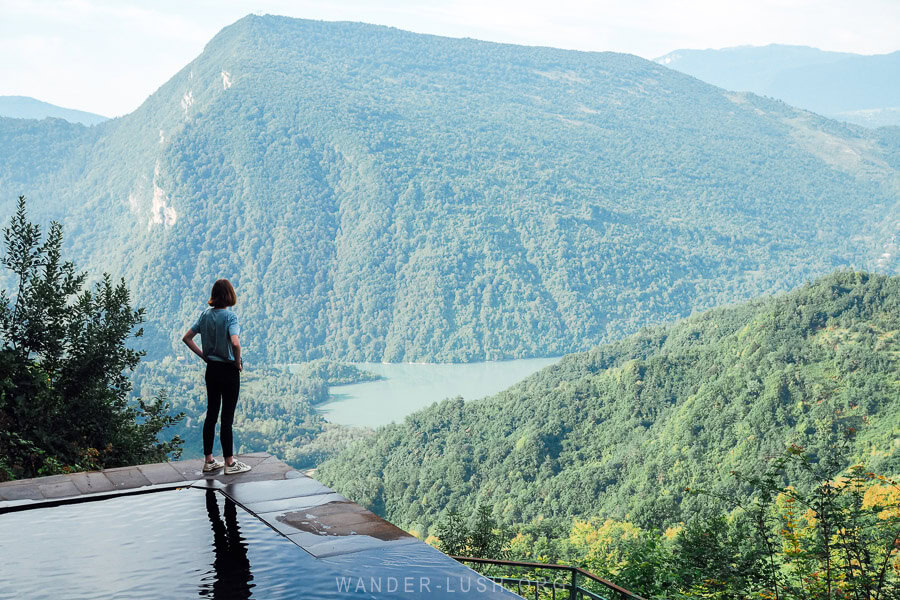
Georgia is known for its hot springs and sulfur baths, but there are a couple of mineral water pools that are suitable for summer. One is the Lailashi ‘Secret Pool’ – AKA the Okronishi Fountain.
Sitting between the mountains high above the Lajanuri reservoir in Lechkhumi region, this is Georgia’s answer to an infinity pool! Who needs a fancy hotel rooftop pool when you have natural swimming spots like this.
The pool is fed by mountain springs that cycle out constantly and is refreshing to say the least. Outside of summer, the fountain is often emptied or not maintained, so July through September is the best time to go both for swimming and for beautiful views of the mountains reflected in the water.
Lailashi itself is a magical little village with a historic synagogue, Georgian and Armenian churches, and ties to the Silk Road. If you’re coming from Racha or Kutaisi and aiming for the Zagari Pass (see #2 above), it’s an easy detour from the main highway via a sealed mountain road.
12. Eat trout by a lake or fish by the sea


Fish does not play a prominent role in Georgian cuisine, but in summer it becomes something of a destination dish – especially when travelling to the mountains or the Black Sea coast.
Trout restaurants are a common sight in Georgia: Essentially a simple eatery set up along a river, lake or reservoir, often with a small trout farm attached. Fresh-caught freshwater trout is grilled to order, sometimes stuffed with walnut paste. At some places, you can even hire a rod and catch your own!
Eating fish on the Black Sea is another classic summer pastime, with several purpose-built seafood restaurants opening up and down the coast during the warmer months. My favourite is Taraghana Fish, just outside Kobuleti. We’ve been coming here for years, and have watched it evolve from a small waterfront venue into a more polished restaurant with a terrace overlooking the water.
13. Chill on the Black Sea at Tsikhisdziri


Summer is not the best time to visit Batumi as it’s very busy and the streets are often gridlocked. If you want a taste of the coast during its lively peak season – and if you want to dip your toes in the Black Sea – you are much better off seeking out the pebble and black-sand beaches to the north or south of the city.
Anaklia is one of my favourite spots on the Black Sea – it combines clean beaches with quirky architecture and epic sunset views.
Just north of Batumi, Tsikhisdziri is another great spot, with clean water and a dramatic coastline of jagged rocks and sheltered coves. It used to be a locals-only swimming cove (literally nicknamed ‘Secret Beach’) until a beach club opened up a few years ago. Run by Adjara Group (of Rooms Kazbegi and Fabrika fame), Shukura Tsikhisdziri is a bar-restaurant that occupies a hollowed-out heritage building high above the shoreline, with a palm-fringed walking path down to a waterfront bar and swimming platform set above the sea.
Abandoned villas and country houses that date to the time of the Russian Empire are dotted through the steep hills around Tsikhisdziri. For a unique place to stay, Castello Mare is built atop a 24-meter-high rock that towers over the sea on the site of a century-old dacha house. I spent a night here a few years ago and loved the experience.
DJ events and festival afterparties are often held here in July and August. Shukura usually opens again in mid-June, and I recommend going early in the season to avoid the busy traffic.
14. Watch the raptor migration


From mid August to mid October, Batumi becomes one of the world’s most important raptor migration bottlenecks, with more than one million birds of prey passing through the corridor between the Black Sea and the Lesser Caucasus each autumn. In 2025, Batumi Raptor Count recorded a milestone season, tallying more than 1.5 million raptors for the first time in its history.
Batumi Raptor Count has several dedicated permanent watchpoints in the hills above Batumi, including at Sakhalvasho and Shuamta, where visitors can observe the migration during the season. Even if you’re not a serious birder, driving up to one of the count stations in late summer or early autumn is a fun detour from the beach.
In a similar vein, a boat ride through Kolkheti National Park – a vast wetland ecosystem on the Black Sea known for its birdlife – is a great experience for nature-lovers. Speed boats can be chartered from Poti or Anaklia to take you deep into the hidden waterways.
15. Attend a music festival
Along with folk festivals in the highlands, summer brings a full program of concerts and music events to Tbilisi, Batumi, Shekvetili, and beyond.
The big one is Tbilisi Open Air, Georgia’s largest contemporary music festival, usually held in June or July and featuring a mix of international headliners, Georgian artists, and electronic acts. For something more intimate, Blues Fest Lagodekhi brings live music to the edge of Georgia’s oldest national park in Kakheti.
On the Black Sea coast, the Black Sea Jazz Festival is the major summer event. Classical music fans should also look out for the Tsinandali Festival, held at the historic Tsinandali Estate outside Telavi and usually timed for late summer or early autumn.
Summer is also when Tbilisi’s nightlife moves outdoors, with open-air raves, courtyard concerts, and pop-up performances happening across the city. Dates and lineups are often announced at the last minute – you can check for event listings on TKT.GE.
Georgia summer travel tips
Stick to the highlands. For summer travel in Georgia it’s best to prioritise the mountains where it’s cooler, minimise time in the cities, and avoid Vashlovani and the arid south-east where it can be dangerously hot.
Book ahead. Pre-book accommodations in popular locations and smaller mountain villages where beds are limited, and buy tickets for the train well ahead of time, as popular routes such as Tbilisi-Batumi always sell out during the summer months.
Check road conditions carefully. Mountain roads (and lowland roads alike) can close after rain or landslides, even in summer.
Be prepared for mountain weather to change quickly. Pack a raincoat and warm layers even in July/August if you’re visiting the mountains.
Don’t expect Tbilisi to be operating at full steam. Many locals leave the city in July and August, and some smaller businesses, restaurants and cafes close for summer break. The capital can feel like it’s running on a skeleton schedule, so always double-check opening hours before making any plans.
You might also be interested in…
- The ultimate Georgia itinerary: Four detailed & custom-designed itineraries
- Georgia Travel Guide: All of my 200+ posts plus my top travel tips
- Georgia travel tips: 25 essential things to know before you go
- Places to visit in Georgia: 50+ unique & underrated destinations around the country
- The best things to do in Tbilisi: Favourites, hidden gems & local picks
- 35+ best restaurants in Tbilisi: Where to eat Georgian food
- 15 best day trips from Tbilisi: With detailed transport instructions
- The best time to visit Georgia: Month-by-month guide to weather, festivals & events
Such an inspiring read, Emily! Hooray for Summer!!!
Thanks, Aoife! Finally good weather is here!