Weaving through the forested mountains and gorges between Borjomi and Bakuriani, the historic Kukushka is Georgia’s only scenic railway.
Developed during the Romanov era, the 37-kilometre narrow-gauge line opened in 1902, and is best known for its soaring iron bridge attributed to Gustave Eiffel.
For more than a century, the railway connected the spa town of Borjomi with the mountain resort of Bakuriani. Then in 2020, the Kukushka was suspended indefinitely.
I had the opportunity to ride the train in March of that year, mere days before the closure – and trust me, I’m still kicking myself that I missed my chance! Now, every time I visit Borjomi, I make a point of popping into the railway station to see if the old rolling stock is still there. Like many people, I have been waiting with bated breath for news about the Kukushka’s long-awaited relaunch.
With services now expected to resume this winter, this guide brings together the latest official announcements, the history of the railway, its route and stations, and all the practical information you need for riding the legendary Kukushka.
Please note: This post contains affiliate links, meaning I may earn a commission if you make a purchase by clicking a link (at no extra cost to you). Learn more.
Latest update: Is the Kukushka train running?
No, the Borjomi-Bakuriani Kukushka train is not currently operating. Passenger services are expected to resume in December 2026 following an extensive restoration project.
On October 9, 2026, Georgia’s Minister of Economy and Sustainable Development, Mariam Kvrivishvili, announced that rehabilitation work was nearing completion, and that the historic railway would return to service in December. That’s earlier than the previous target of January 2027, which was announced in April.
No specific date has been announced yet. So if you’re planning to visit Borjomi and Bakuriani this winter, keep an eye on this page for updates. I will add the confirmed timetable, ticket information and my own experience on the restored railway as soon as details become available.
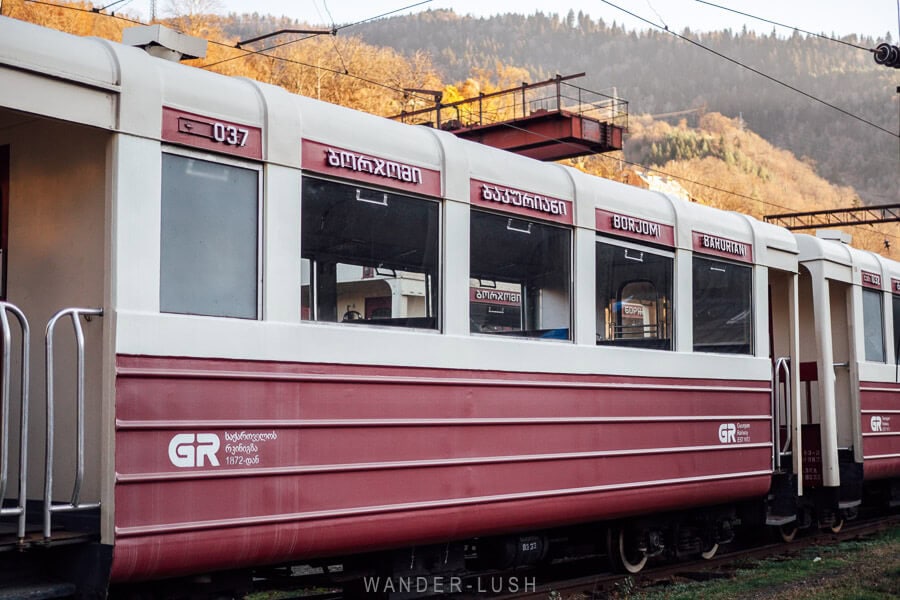
Kukushka train essentials
- Current status: Suspended; reopening December 2026 (TBC)
- Route: Borjomi → Daba → Tsaghveri → Tsemi → Tba → Libani → Sakochavi → Bakuriani
- Distance: 37.2 kilometres
- Journey duration: 2.5 hours
- Speed: Approx. 15 kilometres/hour
- Timetable: Not yet available
- Ticket prices: Not yet announced
What is the Kukushka train?
The Kukushka is a historic narrow-gauge mountain railway connecting the spa town of Borjomi in southern Georgia with Bakuriani, one of the country’s oldest winter resorts. The name Kukushka is the Russian word for ‘cuckoo’ – a reference to the bird-like whistle the original steam locomotive made.
The railway follows a route through the northern Trialeti Mountains, part of the Lesser Caucasus, gaining approximately 880 metres in elevation as it makes its way up to Bakuriani.
What makes the Kukushka particularly unusual is its 900 mm track gauge. The rails are much closer together than those on Georgia’s standard railway network (1,520 mm). This was done to negotiate the difficult mountain terrain and make tighter curves more manageable. If you look at the track path on the map, there are indeed a lot of twists and turns.

The story of the Kukushka begins in the late 19th century, when Borjomi was growing into one of the Russian Empire’s most fashionable spa destinations. Celebrated for its mineral springs, Borjomi attracted wealthy visitors, members of the imperial court and the Romanov family, who maintained an estate in nearby Likani in addition to a palace in Abastumani.
As the resort developed, so did its transport connections. The main railway reached Borjomi in the 1890s, while plans were made for a second, narrower line extending into the mountains.
Construction of the Borjomi-Bakuriani railway began in 1897 and in January 1902, the train took its first passengers. In 2017, it was designated a protected cultural heritage complex, a listing that encompasses the track, historic stations, the famous Eiffel Bridge (more on that below), and the rolling stock.
Passenger services on the Kukushka were suspended in 2020, leaving the historic railway dormant for several years. Then in April 2026, the Georgian government announced a comprehensive rehabilitation project encompassing the historic stations, electric locomotive, and passenger carriages.
More than just a commuter train or a tourist attraction, the Kukushka is a piece of Georgia’s railway history. It combines engineering heritage, the romance of the Romanov connection, incredible mountain scenery, and a sense of nostalgia.
Kukushka train timetable
As of autumn 2026, there is no confirmed timetable for the restored Borjomi-Bakuriani train. Georgian Railway has announced plans for four daily services.
Before its suspension, the Kukushka operated twice daily in each direction, departing Borjomi at 7.15am and 10.55am, and returning from Bakuriani at 10am and 2.15pm. The journey took approximately 2.5 hours each way.
I will add the new timetable here as soon as it is released.
Kukushka ticket prices & how to book
Before its suspension, tickets for the Kukushka were very inexpensive, costing 2 GEL per person one-way. Passengers could only purchase tickets aboard the train.
I expect that the price for the restored train will be significantly higher than that – though nothing has been announced yet.
Online reservations have come a long way since 2020, so I also anticipate that it will be easy to pre-purchase Kukushka tickets online through Georgian Railway and third-party websites such as TKT.GE.
I will update this section with verified ticket prices, payment methods and booking tips once sales open.
What to expect on board the ‘new’ Kukushka
Historic locomotive & vintage-style carriages
When the Kukushka first launched in 1902, its carriages were pulled by a small Porter-type steam locomotive. The railway was electrified in 1967, when the steam engines were replaced by Czechoslovak-built Škoda locomotives.
One of these historic electric locomotives, a Škoda 11-04, was included in the railway’s 2026 restoration project, with plans for a comprehensive mechanical and electrical overhaul.
The passenger carriages have also received a beautiful vintage-inspired redesign. Tbilisi-based Studio 995 was involved in the project, replacing the old red-and-white colour scheme with an elegant forest-green theme.
Early photographs shared by the studio on Instagram show green upholstered seats arranged in facing pairs with overhead metal luggage racks. Wood panelling, vintage-style ceiling lights and framed retro Georgian travel posters complete the nostalgic look.
Mountain scenery & the Eiffel Bridge
The Kukushka travels through one of Georgia’s most beautiful mountain landscapes, snaking through the Borjomi valley and climbing into the Trialeti Mountains.
It passes through dense forests of spruce, fir and pine trees, interspersed with small mountain villages. The scenery is especially beautiful in autumn, when the deciduous trees turn golden, and in winter, when the forest is blanketed in snow.
Which side of the train has the best views?
Based on passenger accounts, the left-hand side (facing the direction of travel) is preferable when going uphill from Borjomi to Bakuriani, while the right-hand side is recommended for the return journey. I’ll test this myself when I ride the restored train.
One of the highlights of the route is the historic Eiffel Bridge, located between Tsaghveri and Tsemi. Commissioned by the Romanovs and designed by French engineer Gustave Eiffel, it was installed by Georgian engineers in 1902 and is the railway’s most recognisable landmark. More on the bridge below.
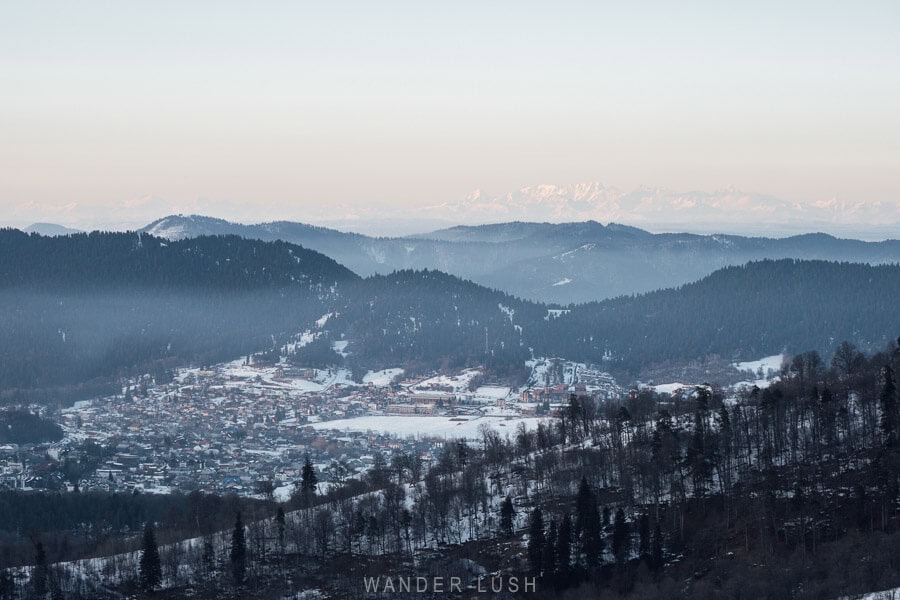
Historic stations along the way
The Kukushka was originally built as a functioning transport connection, serving smaller communities along the Borjomi-Bakuriani route.
Pre-suspension, stops were short – not long enough to jump off and do some sightseeing before reboarding. All these villages are also connected by road, so it’s an option to explore them by car as well.
Several historic railway stations survive along the route, including five that were included in the 2026 rehabilitation project: Daba, Tsaghveri, Tsemi, Libani and Bakuriani. The restoration tender calls for preservation of their original architectural character, including the neatly dressed stone facades, traditional pitched roofs and historical colour schemes, wooden doors and window frames.
The Kukushka train route: Borjomi to Bakuriani
The Kukushka is very much a journey to enjoy for its own sake rather than simply a way of getting from Borjomi to Bakuriani. The train travels at a very leisurely pace (!), with six stops along the way:
Borjomi → Daba → Tsaghveri → Tsemi → Tba → Libani → Sakochavi → Bakuriani
Departing from Borjomi
The Kukushka used to depart from the railway station often referred to as Borjomi Cargo or Borjomi Freight, located in the Charkhistskali area near the entrance to town.
Borjomi’s second station – the historic Borjomi Parki, near the entrance to Borjomi Central Park – is served by the regular Tbilisi-Borjomi passenger train, but it was not the Kukushka’s usual departure point.
On your way to the station, look out for the old steam locomotive displayed on a plinth on the roadside. This preserved engine is a relic of the Kukushka’s steam-powered era.

Borjomi to Tsaghveri: Climbing out of the valley
From Borjomi, the railway line gradually ascends through the mountains towards Daba and Tsaghveri. This lower section passes through a landscape of wooded hillsides, river valleys and settlements that developed along the transport corridor.
Daba is one of the historic stations being restored. The wider Daba area is known for its medieval church.
The Kukushka operates on a single-track railway, with passing loops at some stations to allow trains travelling in opposite directions to pass each other. Under the old timetable, the uphill and downhill services met at Tsaghveri Station, giving passengers an opportunity to see a second Kukushka train with a different locomotive.
Tsaghveri to Tsemi: Crossing the Eiffel Bridge
Between Tsaghveri and Tsemi, the railway crosses its most famous piece of infrastructure: The iron bridge associated with Gustave Eiffel. Commissioned by the Romanov family, the bridge spans a steep gorge and carries the narrow-gauge track high above the valley.
It’s tricky to get photos of the bridge from on board the train itself – but there is a marked viewpoint along the Borjomi-Bakuriani road where you can get a great view of the bridge from above. More details below.
Tsemi to Bakuriani: Forests & mountains
Beyond Tsemi, the railway continues its ascent through higher-elevation forest landscapes. Libani is an especially interesting stop because of its abandoned sanatorium, which is a 15-minute walk from the Libani Railway Station.
→ Related reading: How to Visit the Abandoned Sanatorium Libani
As the railway approaches Bakuriani, the landscape becomes increasingly mountainous, with dense forests and views of the highlands.

Arriving in Bakuriani
Bakuriani Railway Station is the historic terminus of the narrow-gauge line. The station building dates to 1906 and was constructed from tuff stone. The original design included fireplaces in both the waiting room and the station offices – presumably to keep passengers and staff warm during Bakuriani’s snowy winters.
The railway station is located in town, some distance from the ski areas at Didveli and Kokhta. Local taxis are available, and the Bolt app works in Bakuriani too.

Where to get a view of the Eiffel Bridge
The soaring iron bridge located between Tsaghveri and Tsemi is credited to Gustav Eiffel, while its assembly was overseen by the Georgian engineer Besarion Keburia. More than a century after its installation in 1902, it remains the most striking surviving feature of the original railway.
You do not need to ride the Kukushka to see the Eiffel Bridge – in fact, the views of the bridge from outside the train are even better.
There is a marked roadside viewpoint near the turn-off towards Tsemi village from the main Borjomi-Bakuriani Road, where you can look down onto the bridge in the valley. A clearing on the side of the road makes it safe to pull over, and a sign erected at the spot says a little about the bridge’s history.
Eiffel Bridge viewpoint location on Google Maps: 41°47’55.7″N 43°28’11.0″E

If you want to photograph the Kukushka crossing the Eiffel Bridge, the old timetable indicates that trains from Borjomi reached the bridge approximately 45-55 minutes after departure, while trains coming from the Bakuriani direction crossed it around 1.5 hours into the journey.
So, at approximately 8am, 11.25am, 11.40am, and 3.40pm.
Planning your ride on the Kukushka
There are several ways to incorporate a slow ride on the Kukushka into your Georgia itinerary – whether you want to ride the railway in both directions, or combine a one-way journey with some time exploring Borjomi and Bakuriani.
The best option will depend on the new timetable, but here are a few things to consider when planning your trip.
Can you ride the Kukushka train up & back in a day?
Under the old timetable, it was possible to travel from Borjomi to Bakuriani and back in one day. Taking the 7.15am departure gave passengers approximately 4.5 hours to explore Bakuriani before catching the 2.15pm return train back. The later 10.55am departure left less than an hour in Bakuriani before the last return service.
A same-day return trip starting in Bakuriani was not possible entirely by train. However, passengers could travel one way aboard the Kukushka and return by marshrutka or taxi, which takes considerably less time (more details on road transport below).
Can you ride the Kukushka on a day trip from Tbilisi?
It is theoretically possible to experience the Kukushka on a day trip from Tbilisi. Just keep in mind that Borjomi is approximately 2.5-3 hours from Tbilisi by road, while the Kukushka journey takes 2.5 hours each way – which makes for a very long day.
Combining the Tbilisi-Borjomi passenger train with the Kukushka is a little trickier. Under the current schedule, the morning train leaves Tbilisi at 6.35am, stopping at Borjomi Freight at approximately 10.41am. That would leave you with around 14 minutes to connect to the 10.55am Kukushka. Coming back, the last Kukushka from Bakuriani was scheduled to reach Borjomi at 4.45pm, just after the afternoon train to Tbilisi passed through at around 4.40pm.
Perhaps the new timetable will make it easier to change trains in Borjomi, or possibly even buy combination tickets for the entire journey from Tbilisi to Bakuriani – let’s see!
Generally though, for a more enjoyable experience, I recommend spending at least one night in Borjomi or Bakuriani rather than trying to squeeze everything into a single day.
Other ways of travelling between Borjomi & Bakuriani
Until the Kukushka resumes passenger services, the only way to travel directly between Borjomi and Bakuriani is by road. Even after the railway reopens, road transport will remain the fastest and most flexible option, especially if you want to ride the train in one direction only.
The two towns are approximately 25-30 kilometres or 40-50 minutes apart by road.
Marshrutka vans run between Borjomi and Bakuriani bus stations, with several departures throughout the day and a fare of 3 GEL. Alternatively, a private taxi costs approximately 50-70 GEL, while driving yourself gives you the flexibility to stop at places such as the Eiffel Bridge viewpoint and Libani along the way. In winter, be mindful of snow and icy road conditions (snow tires are mandatory between December and March).
→ For detailed transport information, including marshrutka schedules, taxi options and driving tips, see my dedicated guides to travelling from Tbilisi to Borjomi and travelling from Tbilisi to Bakuriani.

All comments are moderated and may take a little while to appear. If you’ve submitted your comment, I’ve got it!