In land-locked Armenia, Lake Sevan has a very special, almost spiritual significance.
This feeling is heightened by the fact that two more lakes connected with ancient Armenia, Lake Van and Lake Urmia, now lie outside the country’s borders in Turkey and Iran respectively.
Armenians treat their biggest lake with a kind of reverence. That’s why I felt so guilty for hating on Lake Sevan after my first visit back in 2019. It was the middle of July, it was baking hot, and the lake was overrun with people. I didn’t get it, and I never expected to return.
Four years later, I did venture back – albeit reluctantly. But I’m glad that I did because my opinion about Lake Sevan changed.
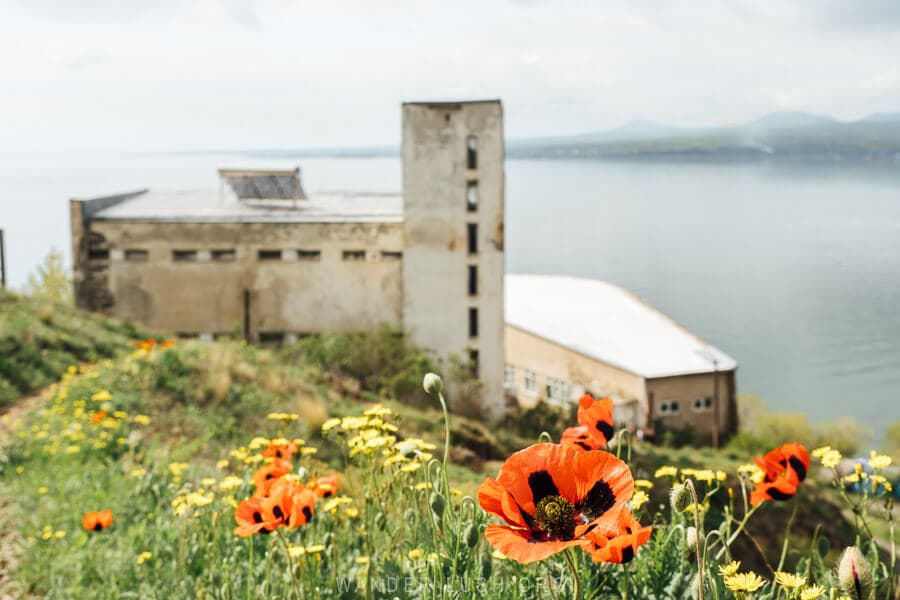
Visiting in spring when the hills were awash with red poppies, the light was soft and there were far fewer people around made a world of difference.
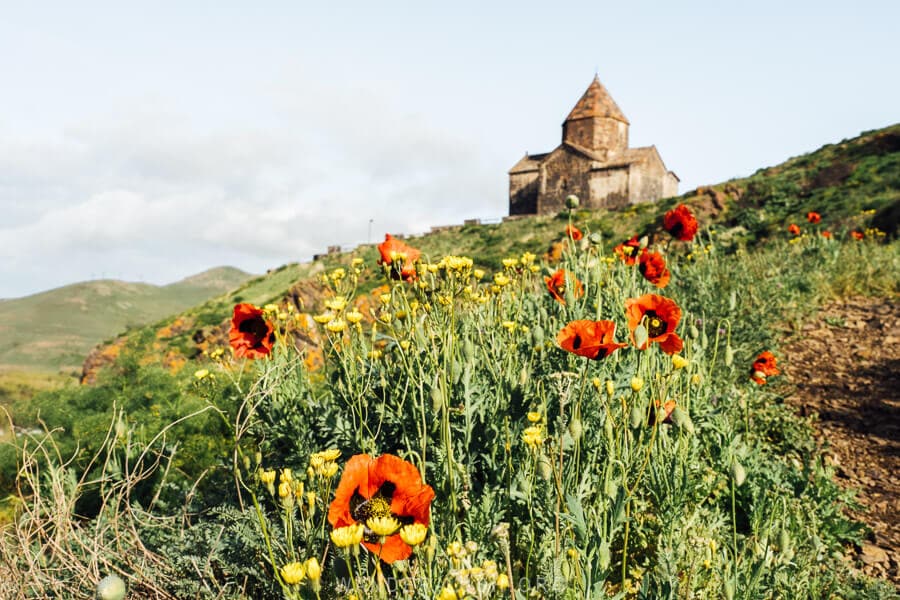
The deciding factor was spending the night at the iconic Sevan Writers’ House. It was a very unique experience, and it also meant that I got to explore the Sevan Peninsula in the early hours of the morning when there was not another soul in sight.
Under the right circumstances, I think that Sevan is a welcome addition to any Armenia travel itinerary. This short guide to visiting the biggest freshwater lake in Armenia will show you what to do at Lake Sevan, where to eat, and my tips for planning a visit.
Please note: This post contains affiliate links, meaning I may earn a commission if you make a purchase by clicking a link (at no extra cost to you). Learn more.
Briefly about Lake Sevan
Located in eastern Armenia, 65 kilometres or roughly an hour by car from Yerevan, Lake Sevan is the largest freshwater lake in the Caucasus region and one of the biggest alpine lakes in Eurasia.
The volcanic lake covers an area of 1,360 square-kilometres (525 square-miles) and is completely enveloped by perennially snow-capped peaks. The average depth of the lake is 27 metres, and the deepest point is 81 metres.

Sevan is located on a plateau and is deceptively high – just shy of 2,000 metres or 6,300 feet above sea level. As a result, it is noticeably cooler here, hence its popularity as a summer retreat for local tourists.
Travel tip: Always pack a jacket for Lake Sevan. Nights are cool, the wind chill off the lake can be intense, and big storms often hit on summer evenings.
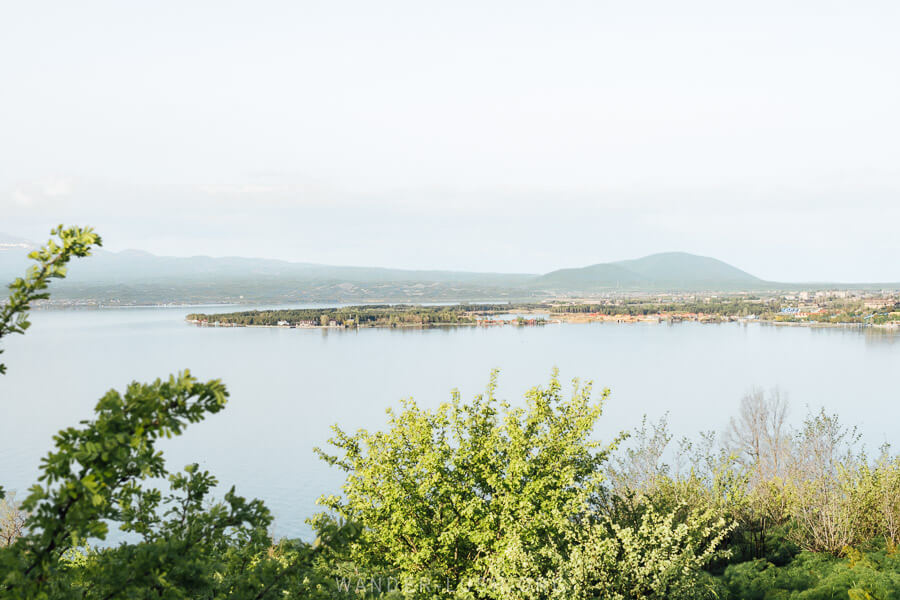
There are various resorts and villages scattered around the shoreline. By far the most popular place to aim for is the Sevan Peninsula, located at the north-western tip of the lake, close to the eponymous town of Sevan.
How the peninsula came to exist is quite an interesting story. In the Soviet era, Sevan was exploited for irrigation and hydroelectric power. A tunnel bored in the 1930s caused the lake’s water level to drop by up to 20 metres. (Projects in the 1960s and 1980s helped to stabilise the water level, but much of the damage to the area’s bird habitat and biodiversity was already done.)
When this happened, a 3-kilometre-long land bridge was revealed, and the small island in the north-western corner of the lake where the 9th-century Sevanavank Monastery stood was transformed into a peninsula.

Now connected to the mainland, this area became the focus of tourism development. The Sevan Writers’ House, a guesthouse-retreat for the Armenian Writers’ Union, was built in 1933 along with various summer resorts and sanatoriums.

Today, Yerevanians and local tourists flock to Lake Sevan during the summer season for fishing, water sports and swimming on the country’s only beaches.
Looking for a Lake Sevan day trip?
Lake Sevan is easy to reach from Yerevan or Dilijan using public transport (see instructions below). If you prefer to join a guided tour, there are some excellent programs available from both Yerevan and Tbilisi.
You might not have time to cover all the points of interest marked below, but you will get to see the highlights.
From Tbilisi, I recommend this tour:
- Day tour to Dilijan and Sevan Lake from Tbilisi with my partners at Friendly.ge – with the option to continue to Yerevan or return to Tbilisi
And from Yerevan, I recommend:
- Private transfer to Lake Sevan from Yerevan, including hotel pick-up
- Guided trip to Sevan with stops in Dilijan, Haghartsin, Lake Parz and Goshavank
- Group tour to Lake Sevan and Tsaghkadzor with a trout barbeque lunch!
Alternatively, you can use GoTrip to book a private driver for the day and explore the entire Sevan Lake area on your own timeline.
Things to do at Lake Sevan
1. Visit Sevanavank

Sevanavank or ‘the Black Monastery’ sits in the middle of the peninsula and is the most iconic landmark in the Sevan area.
The name Sevanavank refers to the wider monastic complex, which once contained four churches, living quarters and a defensive watchtower (purportedly constructed from black tuff stone, hence the name). It was first established in the 4th century shortly after St. Gregory the Illuminator declared Christianity Armenia’s official state religion, making it one of the oldest monasteries in Armenia.
Two churches are still standing today. The larger of the pair, the Church of St. Karapet was constructed in 874 AD by monks who arrived on Sevan Island a century earlier. The smaller Holy Mother of God church was added later. The ruins of the Church of St. Harutiun can also be seen.


When it was still located on an island, Sevanavank was an isolated hermitage. In the 1800s misbehaving monks were sent here as a punishment. If you ask me, being banished to a beautiful island and living off trout couldn’t have been that bad… Oh, but they weren’t allowed to eat meat. Or drink wine. The last monks left Sevan in the early 1930s shortly before the lake was drained and the island ceased to exist.
There are beautiful khachkar stones scattered all around the churchyard. Inside St. Karapet’s, there is a rare stone carving that shows the face of Jesus Christ. Just like at Noravank Monastery, Jesus is depicted with almond-shaped eyes – a tactic that was used to prevent Mongol invaders from destroying the church.
To get up to Sevanavank, follow the pathway and staircase that starts from the car park near Hayetsi restaurant. It is a short (~ 5 minutes) but fairly steep climb to the top.
2. Wander up to the scenic viewpoint

Sevanavank’s elevated position on the Sevan Peninsula commands incredible views of the open water and snow-capped mountains in the distance. For an even better view, take the path on the east side of the monastery to climb further up the ridge.
The scenic viewpoint is marked here on Google Maps. The path up is well-trodden and easy to manage.
At the end of the path there are some old concrete ruins that you can scale for an even higher vantage. Looking to the south-west, you can see the top of the Sevan Writers’ House, and looking back to the west towards the mainland you can clearly see the defined shape of the peninsula with water lapping on both sides.

Walking back down the path, you get a nice view of the tops of both churches (pictured above).
3. Look down over Surb Hakob Chapel
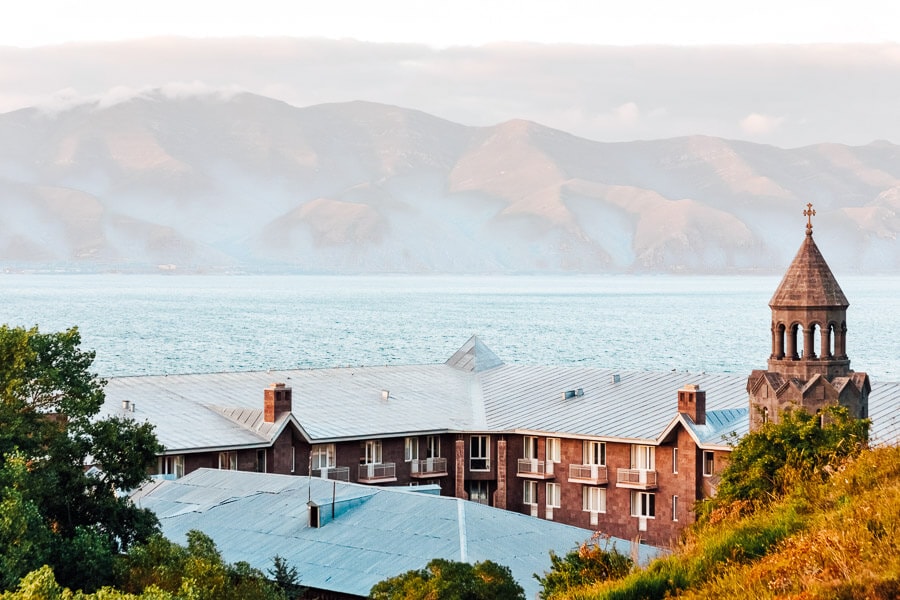
On the side of the hill to the north of Sevanavank there is a working seminary called the Vazgenyan Theological Academy. It was founded in 1990 and contains a beautiful chapel, Surb Hakob, on its grounds.
As far as I am aware the seminary complex is closed to the public. You can look down over the U-shaped building and the courtyard chapel from the winding path that leads up to Sevanavank.
4. Sleep (or eat) at the Sevan Writers’ House

To be completely honest, it was the Sevan Writers’ House and not Sevanavank Monastery that first drew me to visit this part of Armenia. As a huge fan of Brutalism and Soviet history, it’s a building I just had to see in person.
The Sevan Writers’ House or Sevan Writers’ Union Resort was built in 1933 on the southern side of the peninsula. Similar to the Composers’ House in Borjomi, Georgia, it was designed as a sort of retreat where artists from across the Soviet Union and from abroad could stay and work.
There are two parts to the building: The older Residence Hall was designed in 1932 by Gevorg Kochar and Mikael Mazmanyan. It is embedded in the hillside and today contains guestrooms. The iconic curved structure that juts out over the water was and still is a cafe. Known as the Lounge, it was added later in 1963 by the same architect duo.

Sleeping at the Writers’ House is a very memorable experience. If you’re a fan of Soviet history and architecture, I think it’s a must do. Hotel guests get access to the entire complex including areas the public cannot reach. Rooms are basic but comfortable enough, and eating breakfast in the Lounge as the morning light pours in through the big windows is just incredible!
Reservations can be made via Booking.com.
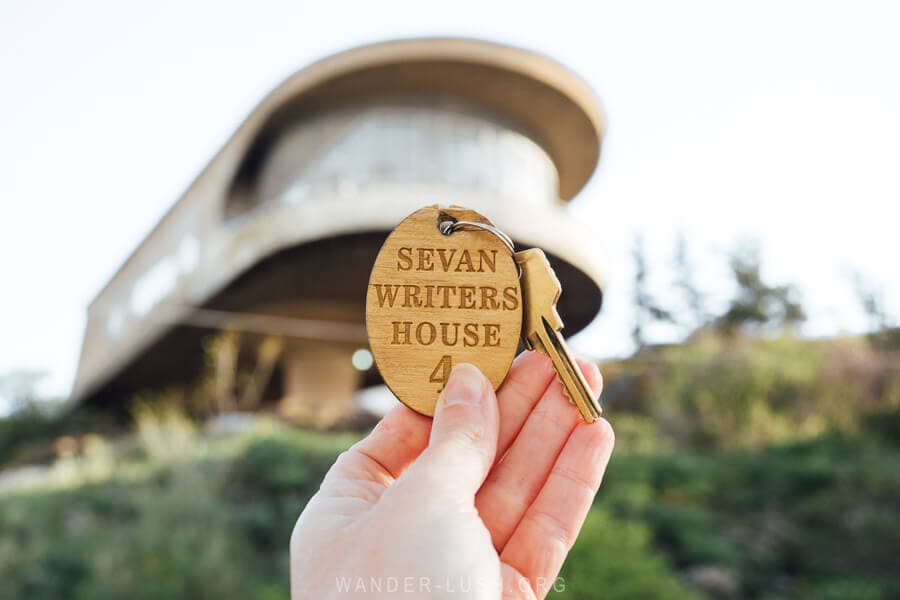
If you’re not a guest, you can still visit the restaurant inside the Writers’ House Lounge for a drink or a meal. In recent years information panels and archival photo displays were set up inside the cafe, but they have not been maintained. I have heard reports of staff asking people to leave the property – so I don’t recommend just wandering in.
If you want the full experience, book a room. Otherwise you can view the UFO-like cafe from the road below, at this point.
There is a back path to access the Writers’ House from the south-eastern corner of Sevanavank. But if you are just visiting the restaurant, I recommend entering through the main gate, located here.
5. Go swimming or diving in Lake Sevan

The southern edge of the lake is suitable for swimming and boat trips, with a long shoreline of pebbly beach. There are several small beach bars located on the water’s edge under the Writers’ House.
You can swim in Lake Sevan – but both times I was there, the water was surprisingly choppy. Do take care.
Note that on the eastern end of the island, close to the Writers’ House, there is a summer residence for the Armenian President. This entire area is off-limits and photography is forbidden, so be careful not to accidentally wander in by mistake.

Other watersports are available on the lake, with boats and jetskis available to rent from hire shops that pop up during the summer season.
You can even go diving in Lake Sevan! Altitude 1900, the area’s first PADI diving club, opened a year ago on the eastern side of the lake and is a 20-minute drive from the peninsula.
Join a guided freediving, scuba diving or snorkelling expedition to explore the reefs and underwater forests below Lake Sevan’s surface. Altitude 1900 also rents out SUP boards, kayaks and sea bikes.
6. Eat fresh fish

Lake Sevan supplies Armenia with around 90% of its fresh fish, including trout, whitefish and crayfish. Quite naturally freshwater fish is the meal of choice when visiting Sevan. There are special fish restaurants scattered all over the peninsula and lining the main highway.
We asked for a local’s recommendation and ended up eating at Gagari Mot. It was pricey, but the fish was very good. The big dining rooms are set right along the water, so you get a beautiful view of the lake as you eat.
I could have sworn that our Russian-speaking waitress told us we were eating trout. Surely it wasn’t Sevan trout, though – this endemic species is endangered.
The fishing industry on Sevan is another experiment from Soviet times. The lake’s whitefish is an introduced species from Russia’s Lake Ladoga, and Sevan trout were introduced to Issyk-Kul Lake in Kyrgyzstan.
7. Climb the Soviet Viewing Platform

This fishtail-shaped structure is located just off the highway on the way from Sevan back to Yerevan (see the location here). Known as the ‘Soviet Viewing Platform’, it was built in 1978 by the architect Makabe Manuelian.
Twin narrow staircases at the back of the monument lead to the open-air deck. The view is not exactly fantastic… I don’t know why it was built so far from the lake’s edge. It faces south onto some fields – but on a clear day, you can see out to Sevan.


The area around the platform was recently cleaned up (previously it was a bit of a dumpsite), and it looks like the structure has had some touch ups done to its lichen-covered rock mosaic facade.
If you love this symbol of Sevan, it is one of the pieces of architecture that artist Nvard Yerkanian has chosen for her range of modernist-inspired illustrations and prints.
More things to do around Sevan
8. See the lesser-visited Hayravank Monastery

Also located on the edge of Lake Sevan but lesser-visited than Sevanavank, Hayravank Monastery was built around the same time (between the 9th-12th centuries) and contains a main church, a chapel and a narthex gavit.
Like Sevanavank, Hayravank is perched on the edge of the lake. Its location atop a rocky outcrop is arguably even more impressive. When viewed from the south over the shallow lake water, Hayravank has a Mont-Saint-Michel look about it.
To get to Hayravank from the Sevan Peninsula, take a taxi or a marshrutka bound for Gavar, the closest town to the monastery. You can use the same method to travel to Noratus for the khachkar cemetery (see below).
9. Admire the ancient khachkars at Noratus Cemetery

Located past Hayravank, around 40 minutes’ drive from Sevan Peninsula, Noratus Cemetery is a historical graveyard that is famously home to the world’s largest collection of khachkar stones.
The seven-hectare cemetery contains around one thousand moss and lichen-gilded khachkars, each with its own unique carvings. The oldest stones date to the late 10th century.
10. Explore Sevan town
Just 10 minutes by road from Sevan Peninsula, Sevan is the main town on the lake. It is small and quiet, but there are a couple of points of interest here including the Tourist Information Centre and Bohem Studio, a trendy teahouse that often hosts live music, film screenings and other special events.
Best time to visit Lake Sevan
Lake Sevan is a seasonal destination. Many of the restaurants and shops on and around the peninsula are closed outside of summer. If you’re visiting in the shoulder season or during winter, it definitely helps to have your own car.
Obviously I am not a huge fan of Sevan in summer. I much preferred visiting in spring, when the weather was cooler and it was far less crowded. My last trip was in the middle of May – perfect timing for the wildflowers.
Most people visit Lake Sevan for a day trip from Dilijan or Yerevan, but I highly recommend spending a night here. If you’re travelling overland, Sevan is an ideal pit stop between Tbilisi and Yerevan. On my most recent visit, we departed Tbilisi in the morning, did our sightseeing around the Debed Canyon (including the UNESCO-listed monasteries Sanahin and Haghpat), then arrived at Lake Sevan in the late afternoon. We had the next morning to explore the lake before continuing on to Yerevan.
I actually preferred staying at Lake Sevan rather than in Dilijan – sadly Armenia’s ‘Little Switzerland’ failed to win me over the second time around.
How to get to Lake Sevan
Travelling from Yerevan, marshrutka minivans depart from the Northern Bus Station throughout the day. Travel time to Sevan town is just over one hour, and tickets cost around 800 AMD. A taxi the rest of the way to the peninsular costs around 1,000 AMD.
Travelling from Dilijan, all Yerevan-bound vans pass by Lake Sevan so you can jump on any van and get out early on the highway. Tickets cost around 500 AMD and travel time is 20 minutes.
Travelling from Tbilisi, take a Yerevan-bound van from Avlabari Metro Station or Ortachala Bus Station and jump out early at Vanadzor. You can pick up a second van to Sevan from there.

Where to stay at Lake Sevan
There are several accommodations on the Sevan Peninsula and plenty more hotels and guesthouses in and around Sevan town.
My top pick is the historic Sevan Writers’ House, one of the most unique accommodation experiences in the Caucasus (up there with the Sheki Karvansaray Hotel in Azerbaijan and the Tskaltubo Spa Resort in Georgia).
Hotel guests get unfettered access to the complex. In the morning you can use the secret path to walk directly up to Sevanavank and watch the sunrise over the lake.
Rooms are basic but comfortable enough for a short stay, and breakfast is served in the cafe overlooking the water. See my full write up for more information and photos.
→ Check prices and availability for the Sevan Writers’ House here on Booking.com.
Armenia Travel Guide
Discover insider tips, itinerary inspiration, and all the best things to see, do and experience in Armenia!
Armenia Essentials
My favourite resources and tools for planning a trip to Armenia.
Find affordable flights to Armenia
Yerevan Airport transfer
Save on museums & transport
Hire a car in Armenia
Get an e-visa for Armenia
Find the perfect accommodation
Book city tours & day trips
Order the latest Lonely Planet
More from Armenia
- The Ultimate Armenia Itinerary
- Things to do in Yerevan, 25 must-sees and alternative spots
- Where to find authentic and meaningful Armenian souvenirs in Yerevan
- Don’t miss the GUM Market, Yerevan’s colourful produce hall
- Tips for being a responsible tourist in Armenia
- The best day trip from Yerevan
- Guide to Gyumri, Armenia’s second city
- Guide to visiting the UNESCO monasteries, Haghpat and Sanahin
- How to travel between Armenia and Georgia by overnight train
- 12 things you should know before travelling to the Caucasus
Armenia Travel Guide
Discover insider tips, itinerary inspiration, and all the best things to see, do and experience in Armenia!
Armenia Essentials
My favourite resources and tools for planning a trip to Armenia.
Find affordable flights to Armenia
Yerevan Airport transfer
Save on museums & transport
Hire a car in Armenia
Get an e-visa for Armenia
Find the perfect accommodation
Book city tours & day trips
Order the latest Lonely Planet
More from Armenia
- The Ultimate Armenia Itinerary
- Things to do in Yerevan, 25 must-sees and alternative spots
- Where to find authentic and meaningful Armenian souvenirs in Yerevan
- Don’t miss the GUM Market, Yerevan’s colourful produce hall
- Tips for being a responsible tourist in Armenia
- The best day trip from Yerevan
- Guide to Gyumri, Armenia’s second city
- Guide to visiting the UNESCO monasteries, Haghpat and Sanahin
- How to travel between Armenia and Georgia by overnight train
- 12 things you should know before travelling to the Caucasus
All comments are moderated and may take a little while to appear. If you’ve submitted your comment, I’ve got it!