Lelo Burti is a special sporting event and cultural festival that takes place once a year on Orthodox Easter Sunday in Shukhuti, a village in Western Georgia’s Guria region.
I was lucky enough to attend Lelo Burti in 2022, and again in 2025. Much like celebrating Orthodox Epiphany on Paravani Lake, it is always an intense experience, but a lot of fun!
Out of respect for the recent passing of the Patriarch, the 2026 Lelo Burti festival did not take place. But the festival is set to return in 2027, and will be held on May 2.
In this guide, I’ll share a little bit about the history of Lelo, our experience at the festival, and my advice for attending – including how to get to Shukhuti, where to stay nearby, and other tips.
The photos included in this post are from both the 2022 and the 2025 festivals.
Please note: This post contains affiliate links, meaning I may earn a commission if you make a purchase by clicking a link (at no extra cost to you). Learn more.
Watch our Lelo Burti video
Here is the video we made of Lelo Burti back in 2022 (if you have any trouble viewing the video, try turning off your ad blocker). Or, watch it here on YouTube.
What is Lelo Burti?
Lelo Burti (‘field ball’) is a traditional full-contact ball game with a 800-plus-year history. It even gets a mention in the epic The Knight in the Panther’s Skin by Georgia’s national poet, Shota Rustaveli.
According to some sources, lelo first emerged during the days of the Ottoman Empire, specifically after a fierce battle where a small group of Gurian fighters managed to defeat an Ottoman battalion. The first lelo matches were played to commemorate their victory – sort of like a reenactment.

Over time, lelo gained popularity as a sport and matches took place regularly all over the country, with different cities and towns rallying behind their home teams. In the Soviet era, lelo was standardised and rules were put in place.
For whatever reason, rugby union eventually came to replace lelo and the folk sport lost popularity. Today lelo is only played once a year in Guria.

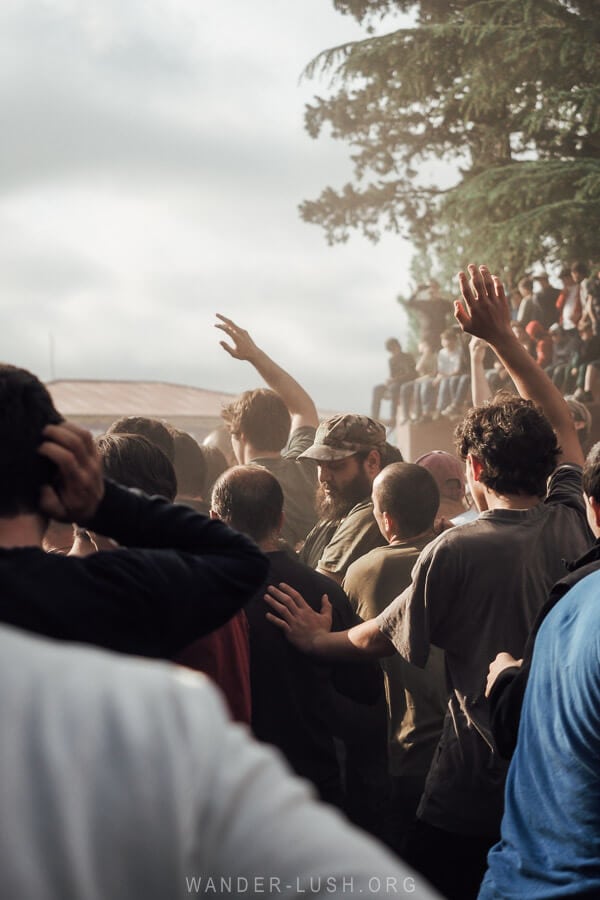
People wait all year for lelo to come around – it’s a chance for everyone to get together and for the competing teams to test their mettle. On the day, hundreds (sometimes thousands) of men and boys from the two opposing villages, Upper and Lower Shukhuti, go head to head, while hundreds more people from surrounding villages and far-away cities come to watch the spectacle.
Lelo is played with a 16-kilogram ball. It’s outer shell is soft black leather, and inside it’s stuffed with sawdust, dirt and sand. Before the match, it is ceremoniously sewn shut and blessed by the local priest. White lettering is applied to indicate the year, with a new ball coming into play every match.

As the game begins, the players form a giant scrum. The aim of lelo is to drive the ball towards the goal line – in this case, the goal lines are two streams. There is no passing or throwing the heavy ball, only pushing and tugging. Most players never touch the ball, instead their role is to press against the mass of humans to propel the scrum towards the goal line.
It can go on for hours as the knotted scrum rolls down streets, through backyards, over fences, and across fields. Players rotate in and out, breaking away from the crowd for a breath of fresh air or a drink of water. There is some strategy involved: players yell to each other over the din to try and goad the ball through openings, while on the sidelines, spectators cheer when the ball moves their desired way and throw up their hands in frustration whenever the opposing team gains ground.
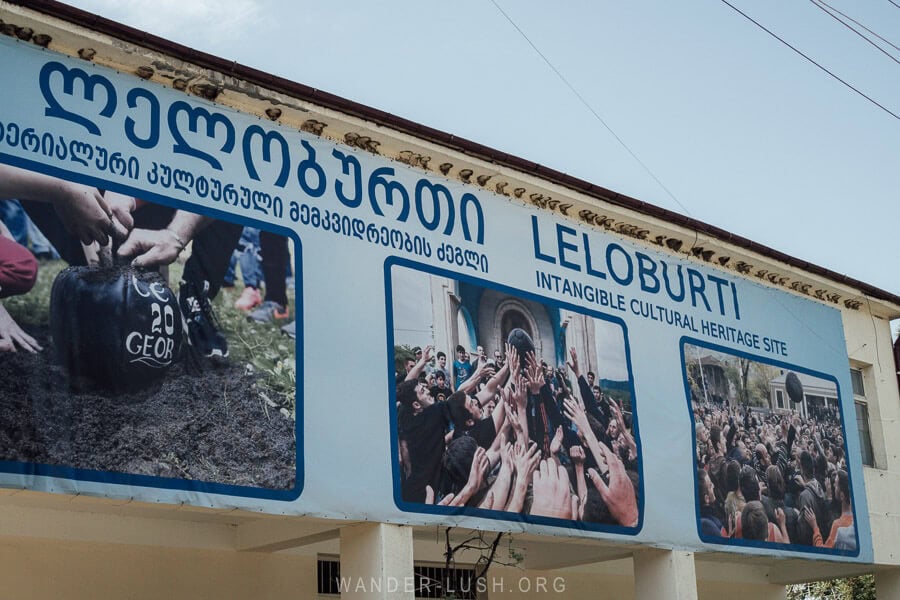
In the past, it was believed that the winning team would secure a better harvest for their village. Today, lelo is played to honour the dead. After the game finishes, the victors carry the ball to the local cemetery and place it on the grave of someone who has passed away during the previous year.
Lelo has an important ritualistic purpose as well as being a form of entertainment that brings the entire Lanchkhuti municipality together. For one afternoon, the small village of Shukhuti is in the national spotlight.
What it’s like to attend Lelo Burti: Our experience
After being cancelled for two years due to the pandemic, Lelo Burti returned in 2022 with gusto. The crowd was always going to be smaller, but we still wanted to experience the festival and see Lelo up close.
We were surprised to find that Lelo has expanded significantly since then. In 2025, the festival included more activities, a big stage where music and dance performances were held between midday and 4pm, and of course a lot more spectators!

I recommend you arrive in Shukhuti by midday. By around 2pm, a big crowd would have already started to gather in front of St. George’s Church (located here). In the adjacent building, Lelo HQ, preparations for the game will already be underway.
There is always a small Easter market set up in a park adjacent to the church, selling traditional Gurian food, drinks, and handicrafts and honey. The pretty park decorated with bunting flags is quite a contrast to the messy, muddy lelo playing grounds!
Pre-game entertainment in the form of khridoli martial arts and wrestling matches take place in front of the park from as early as 11am.

Take a walk around the church cemetery to see the two lelo balls from previous years sitting atop two graves, encased in transparent cubes like museum displays.

In Georgia, it is traditional to bring food and drinks to the graveyard and feast with the departed on Easter Sunday and Monday. In 2022, we wandered through the cemetery and met a family visiting from Batumi, who called us over to share a slice of khachapuri and a glass or two of wine.
In 2025, we brought out own picnic to enjoy under a tree.

Remember to go inside the church at least an hour before the game is scheduled to kick off. In the afternoon, the new ball is placed on an altar of sorts at the back of the church, and there will be a steady stream of people coming in to have their photo taken.
There are also a few lelo statues on display in the church, including one that immortalises the church priest, Father Saba, holding the ball overhead.


Father Saba is always in high demand – there were about a dozen camera crews from different news outlets in attendance back in 2022, and all of them wanted an interview. This year, there were even more.
Despite the chaos, he greeted us with a warm smile as we entered the church.

Lelo kicks off at precisely 5pm. As part of the ritual, Father Saba takes the ball from the church and carries it into the middle of the road where the players have assembled. Someone fires a shotgun, the ball is released, and the game begins.

In 2022, Lelo lasted for around two hours. During that time, we never once caught sight of the ball – it’s kept low, locked in someone’s arms. The match might be shorter or longer than that, depending on the weather and who is participating.
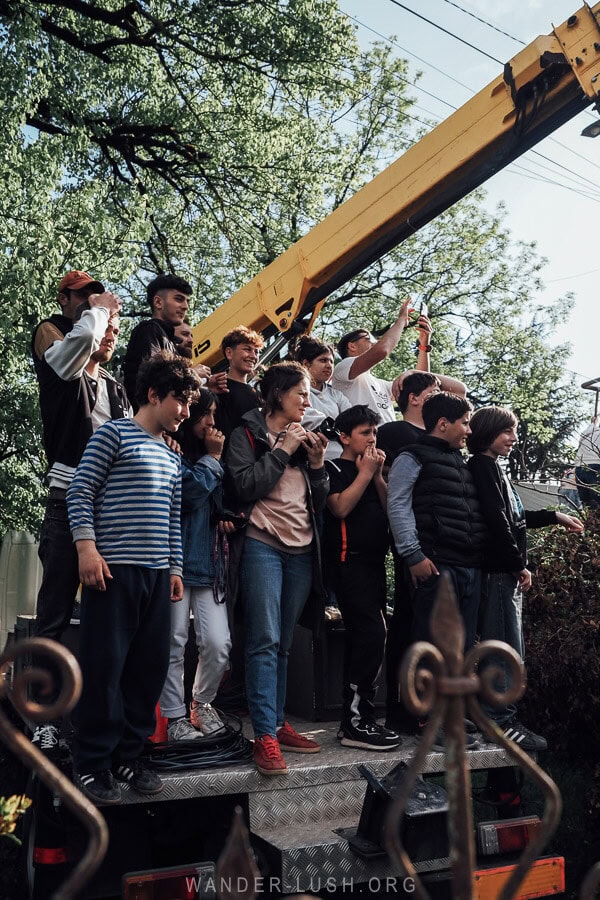
Some onlookers stake out vantage points on fences or atop shop roofs (some people were even standing in a boom lift), but the bulk of the crowd is on the ground, intermingled with the players.

You have to keep your wits about you – if the scrum starts to move, you must follow or else risk getting trampled.


There are always half a dozen drones or more buzzing above the players, and every second person on the ground has their phone out filming the show.

The first time we attended Lelo Burti, there were around 1,000 people participating in total. In 2025, I would say it was at least double that.
Throughout the match, you will see people raising their hands. This indicates that someone has fallen over and needs to be pulled from the scrum. People are very quick to get in and hoist exhausted or injured competitors out.
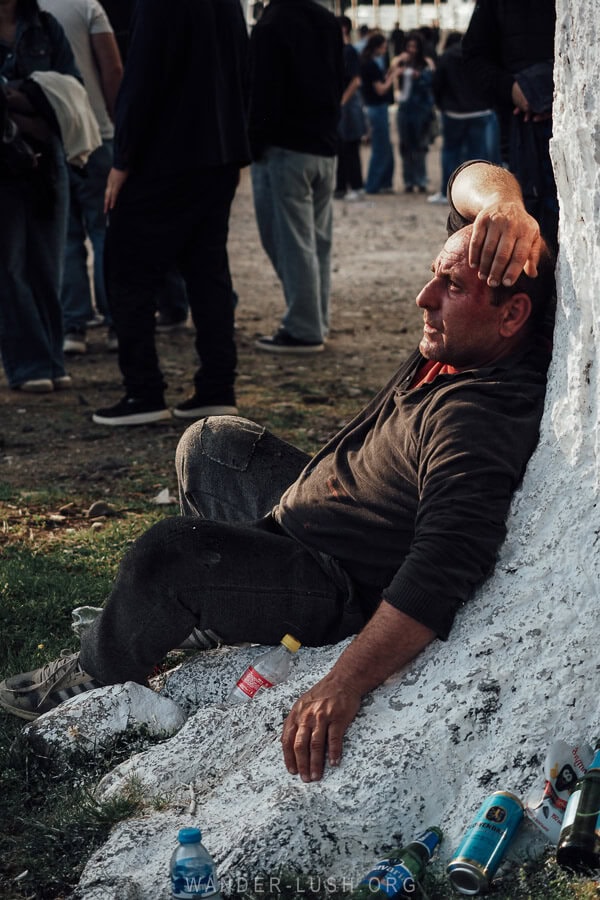
Even though the weather is still fairly cool in mid-spring, the players who emerge are red-faced and gasping for breath. Onlookers often step in to offer the men bottles or water (and cigarettes!).


As the minutes wane on, the scrum will slowly start to move down the road in one direction or another.
Then the playing field will narrow as the ball is dragged between rows of houses in the direction of the stream. Somehow someone will get the ball up over the fence, and the crowd will follow, clamouring over the wires.

If Zemo takes the lead (like it did in 2022), the scrum will eventually arrive in an open grassy field. The scrum creeps this way and that, leaving a sea of mud, trampled earth and lost shoes in its wake.

The final hour or so of our first lelo match was a stand-off, with neither team gaining much ground. Then all of the sudden, the scrum gained momentum and one team was able to wrestle the ball through a muddy patch and into the stream. Upper Shukhuti claimed victory.

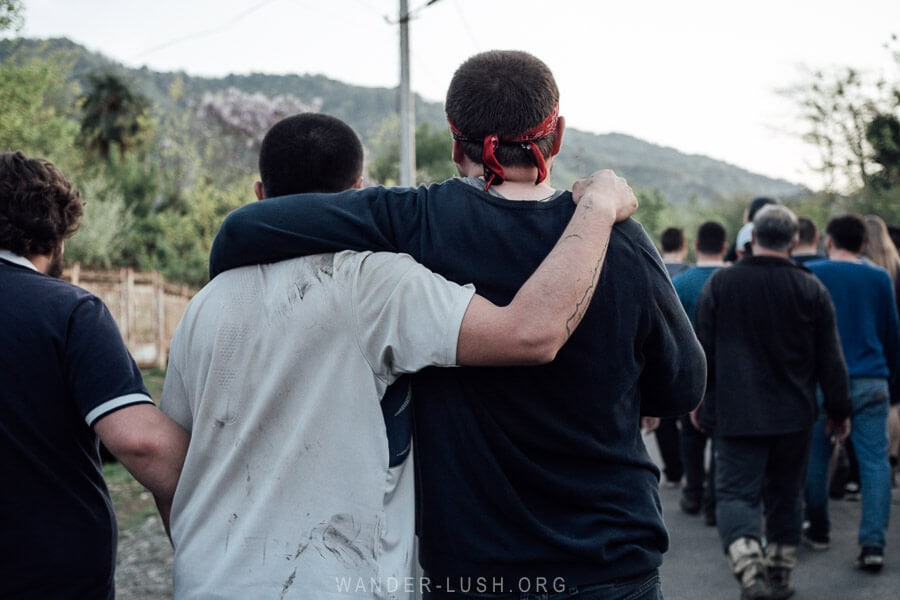
There was pure elation from the winning side, while the losing players and their fans evaporated into the crowd. We followed the line of victorious men down the road to a two-storey wooden house, where there was more cheering and toasting.
Someone dropped the ball from the balcony into the crowd below, then everyone – even little kids – had a go at hoisting it above their head for a photo.

Most people peeled away at this point, but we decided to stay with the procession. We followed the players as they wove through a line of honking cars and up a long, steep village road.

The procession stopped at several houses along the way to let the family see the ball and get their photo taken.

We paused in front of a rusty tin shed, and a big glass bottle of red wine was brought out to share. Using a plastic tube, the men syphoned the wine into small glasses, baptising the ball once or twice and handing the rest of the glasses out to the crowd.


It was dusk by the time we finally arrived at the cemetery on the hill. A huge feast was waiting. After a big gaumarjos, a player settled the ball on the grave and sat in silence. More speeches and toasts followed.

At this point, things became much more sombre and intimate. We thought it was a good time to take our leave, so we departed back down the hill.
Tips for Lelo Burti
Lelo Burti is a big celebration that attracts people from the surrounding towns and villages. Everyone is welcome to attend – including tourists. If you happen to be in the country in time for Easter Sunday, I highly recommend going.
Upcoming dates for Lelo Burti
Lelo Burti always falls on Orthodox Easter Sunday.
- Sunday April 12, 2026 (cancelled as a mark of respect following the recent passing of the Patriarch)
- Sunday May 2, 2027
- Sunday April 16, 2028
- Sunday April 8, 2029


How to get to Shukhuti
Shukhuti is located in Western Georgia in Guria region, 70 km west of Kutaisi (around one hour by road) and 90 km north-east of Batumi (around 90 minutes by road).
The easiest way to get in and out of Shukhuti is with your own car. The game usually finishes after dark, and there aren’t any guesthouses nearby, so it’s preferable to have your own car (or an organised lift) to get home.
Make sure you arrive nice and early – the main road through the village is closed off ahead of the game from 10am onwards, and it doesn’t reopen until lelo is finished. You need to park outside of the ‘lelo zone’ – I recommend finding a spot on the road shoulder before this petrol station, or on a backstreet after the roadblock if you are heading back in the direction of the sea.
If you don’t have a car, you can travel to Shukhuti using public transport (marshrutka van). Orthodox Easter Sunday is a public holiday in Georgia but marshrutkas still run, albeit on a reduced schedule.
Vans from Tbilisi and Kutaisi bound for Batumi travel along the highway through Lanchkhuti. You can take any one of these vans and jump off early. Everyone from the area is familiar with lelo and drivers will know where to drop you.
See these guides for details:
From Batumi, you can take a van bound for Samtredia or Kutaisi from the old bus station. Before you board, remember to confirm your destination with the driver.
Where to stay after the festival
There are no hotels in Shukhuti so I recommend staying in Ozurgeti, the main city in Guria (around an hour from the village by road) or in Samtredia (40 minutes by road).
Whenever we visit Guria, we usually stay at Misha’s Place in Ozurgeti. Two more accommodations I love in this area are Komli Historic Farmhouse and Menabde Winery, both just outside Ozurgeti.
Other tips for visiting Guria for Easter
Hire a car. It will make getting in and out of Shukhuti much easier. I recommend using Local Rent to find a car – pick up is available in Tbilisi, Kutaisi, Batumi, and elsewhere.
Arrive early and park outside the road closure zone. It’s safe to park on the road shoulder. I recommend finding a safe spot past the Optima petrol station.
Keep a safe distance during the game. It can be quite dangerous if the scrum moves fast and although bystanders are usually safe, it’s not unusual for players to get injured. Watch that your camera/phone doesn’t get knocked to the ground.
Bring cash. Some vendors at the market had POS terminals, but not all. Bring some cash with you for buying food and souvenirs.
Remember that most businesses and cafes are closed for Easter. Cafeteria Doppio in Shukhuti was open on the day, serving coffee and pastries.
You might also be interested in…
- The ultimate Georgia itinerary: Four detailed & custom-designed itineraries
- Georgia Travel Guide: All of my 200+ posts plus my top travel tips
- Georgia travel tips: 25 essential things to know before you go
- Places to visit in Georgia: 50+ unique & underrated destinations around the country
- The best things to do in Tbilisi: Favourites, hidden gems & local picks
- 35+ best restaurants in Tbilisi: Where to eat Georgian food
- 15 best day trips from Tbilisi: With detailed transport instructions
- The best time to visit Georgia: Month-by-month guide to weather, festivals & events
I read your page. I liked the article about Leloburti. The article is well organized and you talk about the game in an interesting way. Thank you for presenting Georgia in such an interesting way. I wish you success.
Madloba, Pikria!