Your complete guide to visiting Mestia, from tower museums and local restaurants to the best day hikes.
With its cobbled streets, chalet-style architecture and cafes spilling out around Seti Square, Mestia has all the energy of a mountain resort.
On sunny days, hikers kick off their boots and settle into deckchairs with a latte or a cold beer. It feels almost purpose-built as a base for hiking and skiing, though of course it is nothing of the sort – Mestia’s history reaches back centuries, as the sea of fortified tower houses rising up behind the square makes abundantly clear.

Mestia is Svaneti’s main transport hub and the starting point for the famous multi-day hike to Ushguli, but it is much more than a place to lace up your boots. It is a destination in its own right, with just as much to do in town as there is out on the trails.
I first visited Mestia in 2017, and the town has changed enormously since then. Living in Kutaisi, I am lucky enough to return two or three times most years, and I have now experienced Mestia in every season and explored most of what the town and its surroundings have to offer.
This guide brings together my favourite things to do in Mestia, along with practical tips for planning your visit.
More guides from my Svaneti series:
Please note: This post contains affiliate links, meaning I may earn a commission if you make a purchase by clicking a link (at no extra cost to you). Learn more.
Quick tips for Mestia
- Allow two full days: Allow two full days to explore Mestia itself and complete one shorter hike. Stay four or five days if you want to use the town as a base for Koruldi, Mazeri and Ushguli.
- Stay central: White House Nakani is my favourite guesthouse in Mestia, or for something more upscale, I like Hotel Lahili.
- Carry cash: Some cafes and restaurants and most tower museums are cash-only. There are several ATMs and banks in the centre of town.
- Shops & other services: Mestia has several small grocery stores (including at least three branches of Nikora) where you can purchase snacks and basic supplies. There are pharmacies and banks in the centre, shops where you can hire basic camping gear and purchase things like gas canisters, a small gym and even a coworking space!
- Internet & connectivity: Magti has good 5G coverage in Mestia and the surrounding villages, but the connection becomes weaker the more remote you go. For day hikes and drives, you should always download offline maps. Hotels and guesthouses offer free WIFI. Electricity cuts are not uncommon – this recent article about Svaneti’s power supply situation is an interesting read.
Best time to visit Mestia
Mestia is a year-round destination, but the best time to visit for hiking and the outdoor activities covered in this guide is between late June and mid-September. July and August offer the most in terms of open trails, abundant transport and seasonal services, but these are also the busiest months.
My personal preference is early to mid September, when the temperature is more comfortable, the trails are quieter, and most mountain roads are still open. Towards the end of the month, the first autumn colours appear around Ushguli. Late September and the first part of October can still be lovely for shorter hikes, but the season is winding down and snow can arrive early at higher elevations.


June is beautifully green, but conditions are difficult to predict from one year to the next. Snow can linger on the higher trails, heavy rain and landslides are more common, and the Hatsvali cable cars might not have started up yet.
Winter is a completely different experience. Mestia is magical under snow, with skiing at Hatsvali and Tetnuldi, and the Lamproba ritual taking place in February. For the most reliable ski conditions, aim for late January or February.
See my separate guide to visiting Mestia in winter for Lamproba, skiing, and advice on transport and weather.
Map of Mestia
Things to do in Mestia
1. Explore Laghami Old Quarter & visit the Transfiguration Church

One of the biggest joys of visiting Mestia is simply wandering the streets. Laghami, the oldest part of town, is around a 20-minute walk east of Seti Square along the Mestiachala River, and is one of the best areas to explore on foot.
Laghami has a village feel, with pigs wandering the cobbled lanes and Svan towers rising between houses. The main reason to come here is the remarkable two-storey Church of the Transfiguration of the Saviour.

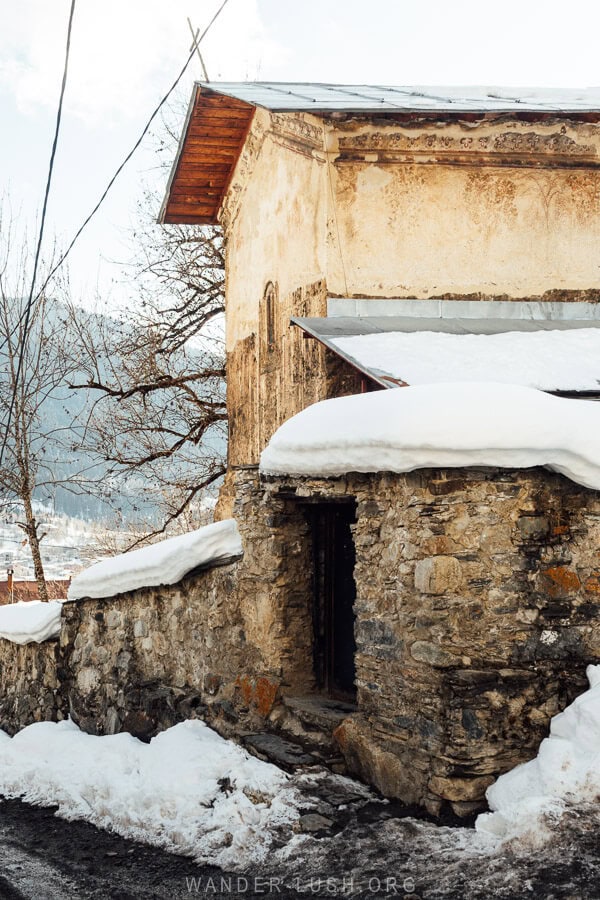
The lower church, dedicated to Saint Barbara, dates to the 9th century, while the larger upper level was added in the 13th-14th centuries. Both contain medieval frescoes, including Biblical scenes, portraits of saints and members of the local Kirkishliani noble family. Faded paintings also survive on the exterior walls.
If the church is locked, call the number posted on the gate and get in touch with the caretaker, Rezo, who will come down with the key. His family has cared for the church for generations, and he is himself part of the team working to restore the frescoes.
Look for the heavy wooden doors pinned shut with St Nino’s cross.
2. Stroll along picturesque Ushba Street at dusk or dawn


For some of the most iconic views in Mestia, head up to Ushba Street, an elevated road that rises above the centre and runs perpendicular to Tamar Mepe Street.
This central area has a concentration of Svan towers, staggered across different levels and interspersed with cattle grazing in the fields, vintage cars, piles of chopped wood, and other scenes from daily life. A few new hotels and restaurants have popped up here, joining an old favourite of mine, Twin Peaks (more on eating in Mestia below) – but this area still feels somewhat removed from the centre.

On a clear day, you can see the mountains rising in the distance. The views are at their best in the soft light around dawn or dusk.
Ushba Street is also a good place to launch a drone, with plenty of open space and an excellent perspective over both ends of town.
3. Summit a Svan tower


Seeing Mestia’s medieval towers from the street is one thing – climbing all the way to the top of one is another experience entirely.
Known as koshki, most of Svaneti’s surviving towers date to the 9th-12th centuries and formed part of larger family residential complexes. Their primary function was not to deter enemy invaders, but to protect families from one another during blood feuds – in Svaneti, good defences (not fences!) made good neighbours.
Several families in Mestia have converted their ancestral towers into small museums. Entrance normally costs between 5 GEL and 15 GEL and, in most cases, you are left to climb at your own pace. This involves ascending four or five levels on increasingly steep and rickety ladders before poking your head through the final opening – or, in some cases, hauling yourself all the way out onto the roof.


There is no health and safety to speak of, and some of these towers are quite dangerous in my opinion. Wear proper shoes, keep both hands free, and give it a miss if you are unsteady on your feet or uncomfortable with heights.
I have climbed just about every tower in Mestia that is reliably open to the public, and they all offer something slightly different:
Niguriani Tower Museum is probably the best all-rounder, with panoramic views from the top and a small house-museum filled with antiques at the base.
The Khergiani Tower on Beknu Khergiani Street has a Georgian flag flying from its crown and allows you to climb all the way out onto the roof.

At 28 metres, Ratiani Tower is the highest in Mestia. The entrance fee includes a very thorough tour of the adjoining ethnographic museum, normally available in English, which makes this the best choice if you want to learn how the tower and house were used rather than just climbing for the view.
Margiani Tower might have the best panorama of them all. It sits higher up the mountainside in the Lanchvali, giving you a wonderful perspective on a row of towers cascading down the green slope towards Mestia. The powerful Margiani family once owned eight towers, four of which survive today.
The road up to Margiani’s is extremely steep, so I recommend walking rather than attempting to drive. On the way, look out for the unusual tower house that straddles the lane, creating a low covered passageway underneath. Nearby Lanchvali Church, known locally as Margianal-Taringzeli, is a small late-medieval church bordered by a stone wall and old graves.

Some of the tower-museums have an adjoining machubi, the traditional winter living area where families and animals shared one large room, separated by carved wooden partitions, with an open hearth in the centre. There was no chimney, so smoke permeated the room and helped protect the timber.
Fires are still lit periodically inside some house-museums for conservation, which means they might occasionally be closed in shoulder season.


There is yet another tower that you can climb at the Mikheil Khergiani Historic House Museum – see below.
4. Visit Mikheil Khergiani’s retro house museum

Mestia has a long and proud mountaineering tradition, and no figure looms larger than Mikheil Khergiani.
Known as the ‘Tiger of the Rocks’, he was one of the Soviet Union’s most celebrated climbers: A three-time champion in alpinism, a seven-time champion in rock climbing, and a skilled mountain rescuer. Born in Mestia in 1932, he scrambled across the Caucasus, the Pamirs, Tian Shan and the Alps before his life was cut tragically short at the age of 37.


His memorial house museum opened in 1983 inside the Khergiani family home in Laghami. A large stone bust stands in the courtyard, with the family’s Svan tower rising directly behind it. Inside, the exhibition has a wonderfully retro feel. Rooms are filled with old maps, black-and-white photographs, Soviet medals, climbing equipment, and personal belongings.
The ticket price includes climbing the family tower – although after seeing photographs of Khergiani suspended from sheer cliffs, you might find your appetite for another ascent is somewhat diminished!
5. Tour the Svaneti Museum of History and Ethnography

The Svaneti Museum of History and Ethnography is the premier cultural institution in the region and in my opinion, one of the best museums in Georgia. Even if you normally prioritise hiking and outdoor activities, this is one place in Mestia that you should not skip.
Founded in 1936, the museum’s original collection was assembled from antiquities kept at Seti St George Church. Today, its six permanent galleries contain archaeological finds, coins, manuscripts, weapons, jewellery, textiles and other objects. The current building was reconstructed and reopened in 2013, with modern exhibition halls and conservation facilities.
The ethnographic displays on Svan domestic life, clothing and battle equipment are very interesting, but I particularly enjoy the treasury of icons and religious objects collected from churches around the region. Highlights include the Adishi Gospels, dated to 897, the 12th-century Icon of the Forty Martyrs, medieval metalwork crosses, and painted icons produced by Svan artists.


Everything is beautifully presented, with detailed English-language didactics throughout. Give yourself at least two hours if you want to see the full exhibition.
In the reception area, there is a lounge with couches where you are free to sit for a while, and an enormous picture window that frames one of the best panoramas of Mestia’s towers.
When I was last there, a free photography exhibition had been installed outside. Gimgamesh by Anna Kacheishvili documents the Svan ritual of Lamproba, the winter tradition when families light birch torches and fires in cemeteries to commemorate their dead.
6. Find the Svan Sphinx

Just across the Mestiachala River from the museum, a short walk uphill brings you to one of Mestia’s more unusual landmarks. This stone figure is commonly known as the ‘Svan Sphinx’, though its proper title is Mother of the Place. It was created by Svan artist Vakhtang Oniani in 1967.
The sculpture represents a mother waiting for her son to return from war. With its heavy form and steely gaze, it reminds me of several other Soviet-era WWII memorials I have seen around Georgia – particularly the one in Dedoplistskaro.
The figure has taken on meaning beyond its original subject, and is often described as a guardian or spiritual embodiment of Mestia by locals.
7. Ride the Hatsvali Cable Cars

Hatsvali is the closest ski resort to Mestia, and in summer its cable cars offer an easy shortcut to some of the best mountain views in Svaneti.
The two-stage system starts from the edge of town, not far from the museum. An enclosed gondola carries you up to the middle station, where you change to an open chairlift for the final ascent to the top of Zuruldi Ridge at around 2,340 metres. If you are driving, you can also follow the forest road to the middle station and join the cable car there.
At the upper station, Cafe Zuruldi has a large terrace with views towards Ushba and Tetnuldi. If you have a couple of hours, head back into the forest towards Zuruldi Ridge and walk to the old transmitter on Mentashi Hill.


The cable cars normally operate in summer from around mid-June until September, running from 11am until 5pm and costing around 25 GEL up and back.
Opening dates change every season, but in previous years, Hatsvali opened on:
- August 8, 2026 (delayed launch)
- June 15, 2025
- June 20, 2024
- June 8, 2023
This year, the cable car will close on October 20, 2026.

Mestia’s second ski area, Tetnuldi, is also beautiful in summer and there are hiking trails around the resort, but its cable cars do not normally operate outside winter.
8. Watch Dede at the microcinema
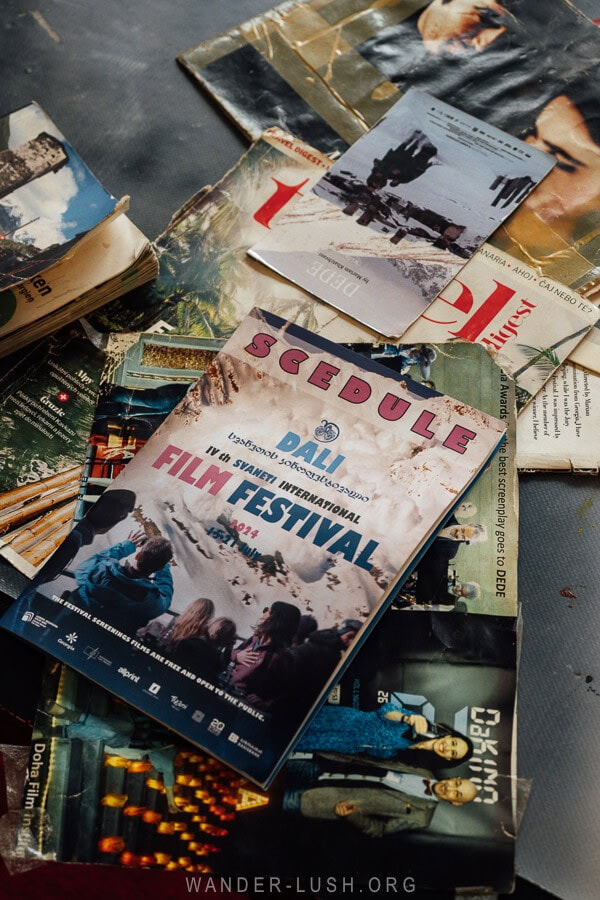

You might have heard that Mestia has its own one-film cinema. Located on Tamar Mepe Street, Pub & Cinema Dede is a tiny bar and screening room that plays the same Svaneti-made film on a loop throughout the day.
Released in 2017, Dede is the feature debut of Mariam Khatchvani, who was born and raised in Ushguli. Set in Svaneti in 1992 and inspired by the story of the director’s grandmother, it follows Dina, a young woman whose family has arranged for her to marry a soldier returning from war. When she falls in love with another man, her attempt to choose her own future comes into conflict with family honour, tradition, and the threat of a blood feud.
It is not exactly light holiday viewing, but it’s a valuable watch if you want to learn more about the customs and social dynamics in Svaneti.
The 97-minute film is shown in Svan and Georgian, with a choice of English or Russian subtitles. At the time of writing, summer screenings take place every day at 1pm, 3pm, 5pm, 7pm and 9pm. In winter, the schedule is normally reduced to three evening sessions at 5pm, 7pm and 9pm. Tickets cost 20 GEL, and you can order wine, beer, tea or coffee from the bar to take inside.
There is a second Cinema Dede in Ushguli. Watching it before travelling further into Svaneti – or afterwards, when you recognise some of the locations – is a great way to occupy yourself on a rainy day in Mestia.
9. Find the abandoned Hotel Ushba

If you’re into urbex, follow the opening stretch of the Mestia-Ushguli trail east out of town in the direction of Zhabeshi. After climbing above Mestia, the hiking route eventually turns off to the right. Continue straight instead and you will see a low, circular concrete structure emerging through the trees.
I asked several people in Mestia what the complex was, but no one seemed to know. Eventually I found it in a photograph from the National Archives of Georgia, identified as Mestia’s ‘tourist base’. The accompanying text notes that a cinema and Hotel Ushba were constructed here in 1977, with the same circular pavilion, long accommodation block and model Svan tower clearly visible.


The half-circle terrace of the main building is open to the wild, with a row of slender concrete pillars and empty frames where sheets of glass once enclosed the view. Inside, a peeling blue-and-gold ceiling painting exaggerates the building’s curves. There are traces of simple bathroom tiles at the back, but otherwise virtually nothing remains.
The adjoining three-storey hotel has similarly been reduced to a concrete shell. Its layout reminds me of the Soviet Writers’ House complex on Lake Sevan.
If you don’t want to walk, you can drive up via the rough road. We arrived in the early evening and were surprised when a small truck came rattling up and three men jumped out. After some commotion in the bushes, they emerged wrangling a wayward cow!
10. Soak in a hot tub with mountain views


If you’re in the mood for something a little bougier, A-Peak pairs a private wooden sauna with an outdoor hot tub overlooking Mestia and the mountains.
Located on the same road as the abandoned Hotel Ushba, the facilities here are new, spotless, and very well equipped, with towels, slippers and basic toiletries provided. The sauna sits below a pair of A-frame cottages, with a larger hotel and Deiphani restaurant next door.
The west-facing outdoor area is very exposed, so in summer, I recommend you book for sunset. This is also a great activity for winter.
A-Peak is far and away the friendliest sauna experience I have had in Mestia. After a particularly unpleasant attempt to book another well-known place in town, this is easily my top pick. Advance bookings should be made via Facebook.
11. Feast on Svan cuisine


Not unlike Kazbegi, Mestia has a surprisingly good food scene, and eating your way through the various local specialities is one of the great pleasures of spending a few days here.
Svan cuisine is rich and filling, with meat, potatoes, cheese and fragrant Svan salt appearing in various combinations. The essential dish is kubdari, bread stuffed with chopped meat, onions, garlic and spices. Tashmijabi is mashed potato beaten together with cheese until it becomes rich, glossy and comically stretchy, and petvraal is a Svan-style khachapuri made with cheese and millet flour.
My favourite places to eat include BBQ Garden, Twin Peaks and Zhuzhu’s Terrace, plus the classic Vichnashi. Find more suggestions in my dedicated Mestia restaurant guide (published soon).
Note that quite a few restaurants in Mestia are cash-only.
12. Relax on the terrace at Coffee Kor


Coffee Kor is my favourite place to start the day in Mestia. The coffee is excellent, but the real draw is the big terrace overlooking Seti Square.
Order downstairs first (it is self-service) then claim your sofa or table. Sandwiches, cakes and pastries, including cinnamon rolls – which are apparently now something of a speciality in Mestia – are also available.
For a proper sit-down breakfast, Erti Kava is just across the square. It serves speciality coffee along with a very taste full English Breakfast plus lighter options.
13. Shop for salt & other Svanetian souvenirs

There are several little shops along Tamar Mepe Street that sell a familiar collection of Svan souvenirs: Woollen socks, carved wooden keepsakes, and traditional round Svanuri kudi felt hats. The hats are handmade from sheep’s wool in its natural colours. Grey is traditionally worn every day, while black is reserved for mourning and white for celebrations.
Svan salt is the other obvious thing to take home. This aromatic mixture of salt, garlic, herbs and spices is used liberally in this region – and a pinch of the stuff makes everything taste better. Just be sure to double or triple wrap it before packing it in your luggage, otherwise the smell will permeate all your belongings!


For something more unique, look for Jaku Studio (pictured above). Opened in October 2025, this small independent art studio and shop creates posters, hoodies, postcards, ceramics and other design objects inspired by Svaneti, mountain life and travel. It also stocks work by other local artists and doubles as a creative space for workshops and community events.
14. Have a nightcap at KRK Bar

KRK is Mestia’s main après-hike bar: A tiny, low-lit cocktail bar where hiking attire and muddy boots are welcome, and the evening crowd always spills out onto the pavement.
In my experience, the local bartenders here are genuinely friendly, and the drinks are more polished than you might expect from somewhere this small. Cocktails, wine and craft beer are all available.
Hikes, viewpoints & short trips from Mestia
15. Hike to the Chalaadi Glacier


Chalaadi Glacier is the best short hike from Mestia in my opinion. In many ways, it is my idea of the perfect trail: Shaded for most of the way, not too steep, and with just enough scrambling over rocks towards the end to keep things interesting.
Chalaadi is one of the most accessible glaciers in Svaneti. Its ice tongue descends unusually low – to around 1,900 metres above sea level – at the head of the Mestiachala River Valley. The glacier is fed by the high slopes around Ushba, which explains the dramatic wall of rock and ice that comes into view at the end of the walk.
The trailhead is around a 20-minute drive from Mestia. Follow the paved road past the airport, then continue along the unsealed road to the small hydro dam and parking area. The final section is bumpy but manageable in a normal car in good conditions. Alternatively, taxis and shared transfers are readily available from Seti Square.


Cross the slightly rickety suspension bridge (carefully!), then turn right past Khevi Cafe and follow the marked trail into the forest. The path starts with a short ascent but soon levels out beside the river.
After roughly two kilometres through the trees, the terrain changes abruptly and the final approach crosses a moraine of loose stones, boulders and glacial rubble. We completed the six-ish kilometre hike in approximately 2.5 hours, including time at the viewpoint.
Chalaadi is actively melting, and falling rocks and chunks of ice are common – so don’t go any further than the rock marked STOP!
16. Spot planes at Queen Tamar Airport

The road to the Chalaadi Glacier passes directly beside Queen Tamar Airport, where the runway is squeezed into the narrow Mestiachala Valley. Watching one of the little propeller planes appear between the mountains and descend into Mestia is quite something – and easy to combine with the Chalaadi hike if you time it correctly.
Use this website to check the timetable: Flights to Mestia operate from both Natakhtari (near Mtskheta) and Kutaisi. For the Natakhtari service, you can add around an hour to the scheduled departure time to estimate when the plane will reach Mestia.


The airport’s tiny black-and-white terminal is a landmark in its own right. Designed by German firm J.Mayer.H (the same architects behind the Sarpi checkpoint and the tower sculpture in Anaklia) and completed in 2010, its angular form is a contemporary nod to Mestia’s Svan towers.
Construction of a new, much larger passenger terminal for Mestia is scheduled to begin in October 2026.
17. Get a view from The Cross Over Mestia

For a classic bird’s-eye view over town and some remarkable mountain views as well, head up to the Cross Over Mestia, a panoramic viewpoint perched around 700 metres above Seti Square. The cross is also known as the Jvari Viewpoint of Tskhakvzagari Pass, and marks the first major milestone on the longer hike to the Koruldi Lakes (see below).
A rough road to Koruldi passes directly beside the cross, so an alternative is to hire a local Delica driver to take you this far. You can enjoy the viewpoint and return to town by car, or use this transfer to bypass the toughest part of the ascent and continue to the lakes on foot.
Considering the complete Koruldi hike involves around 1,500 metres of climbing and takes at least seven hours, this is a happy compromise.
18. Trek or drive to the Koruldi Lakes


From the Cross Over Mestia, the trail continues along an exposed ridge to the Koruldi Lakes, a cluster of small alpine pools sitting at around 2,740 metres.
Having recently hiked to the Abudelauri Lakes in Khevsureti, our expectations were maybe a little too high. You do not make this journey for the lakes themselves – they are tiny, especially towards the end of summer – but rather for the mountain vistas along the way. On a clear, still day, you might also catch Ushba reflected in the water.
The full hike from Mestia is considerably more demanding than Chalaadi Glacier. The standard return route is just over 16 kilometres and takes at least seven hours. The forest climb to the cross is the steepest part; beyond that, the trail follows the broad ridge with increasingly dramatic views of Ushba, Tetnuldi and the Greater Caucasus. Find a detailed route description and GPS track on Caucasus Trekking.
19. Pose for a photo on the Flying Swing in Heshkili


Heshkili is a tiny hamlet in the hills south of Mestia, around a 15-minute drive from the centre. Its family-run Heshkili Huts has become famous for one particular feature: A wooden ‘flying swing’ positioned against a panorama of forest and snow-striped mountains.
The swing is shamelessly Instagrammy, and the carefully chosen camera angle makes the experience look way more daring than it actually is. You might also have to wait your turn during the busy summer months. Still, the setting is lovely, especially in clear weather when Ushba appears in the distance.
We drove up from Mestia via a smooth concrete road, took the obligatory photos, then moved on. We decided to skip the cafe after hearing mixed reviews. I would not make a special journey solely for the swing, but it is a fun stop if you are already heading up towards Hatsvali. And if the cable cars aren‘t running, this is a good alternative, with similar scenery.
20. Take a day trip to Mazeri for views of Mount Ushba
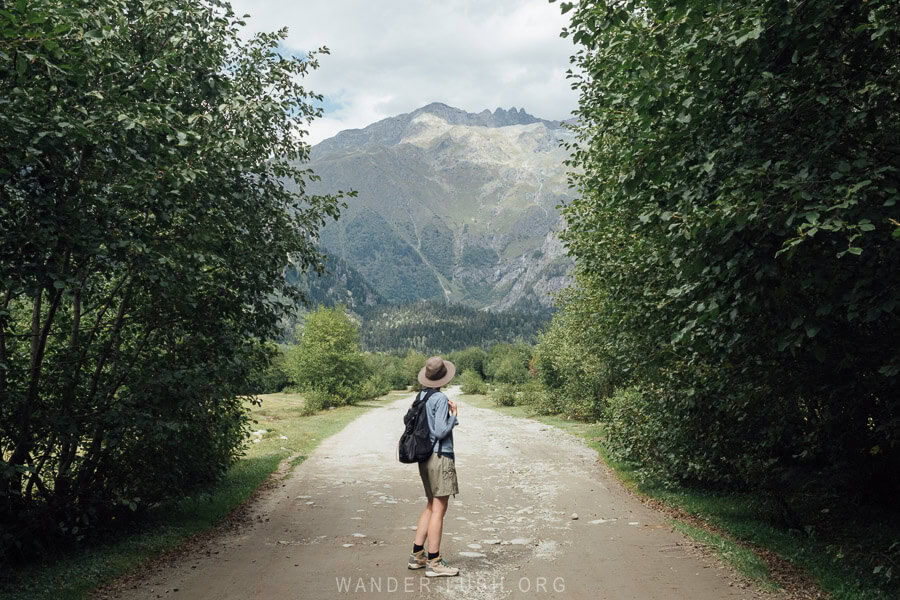
Mestia has its towers, but for the best close-range views of the iconic Mount Ushba, you should make the short journey down to Mazeri. This quiet village in the Becho community sits around 25 kilometres from Mestia at the entrance to the Dolra Valley, directly beneath Ushba’s distinctive double summit.
The thing to do here is the Shdugra Waterfall Hike. From the end of the sealed road, the trail follows the Dolra River through open meadows and coniferous forest, passing mineral springs and a border-police post before climbing towards the falls.
From this starting point, allow around 5-6 hours for the 13-15 kilometres return. Carry your passport/ID in case the border guards ask to see it.


For a much gentler alternative, walk the first section of the same trail as far as the Hikers Inn cafe. The speciality here is freshly caught trout baked inside bread dough with Svan salt, cooked in a wood-fired oven – it’s delicious! If you have a 4WD, it is possible to drive all the way to the cafe along the uneven dirt road, but I recommend walking if the weather is good.
Mazeri is around a 30-40-minute drive from Mestia. Private drivers are easy to organise in town, and shared day transfers are usually available in summer. Mestia Municipality also operates a public bus route between Mestia and the Becho-Tskhumari administrative areas for 3 GEL – check times locally.
21. Walk or drive to Ushguli
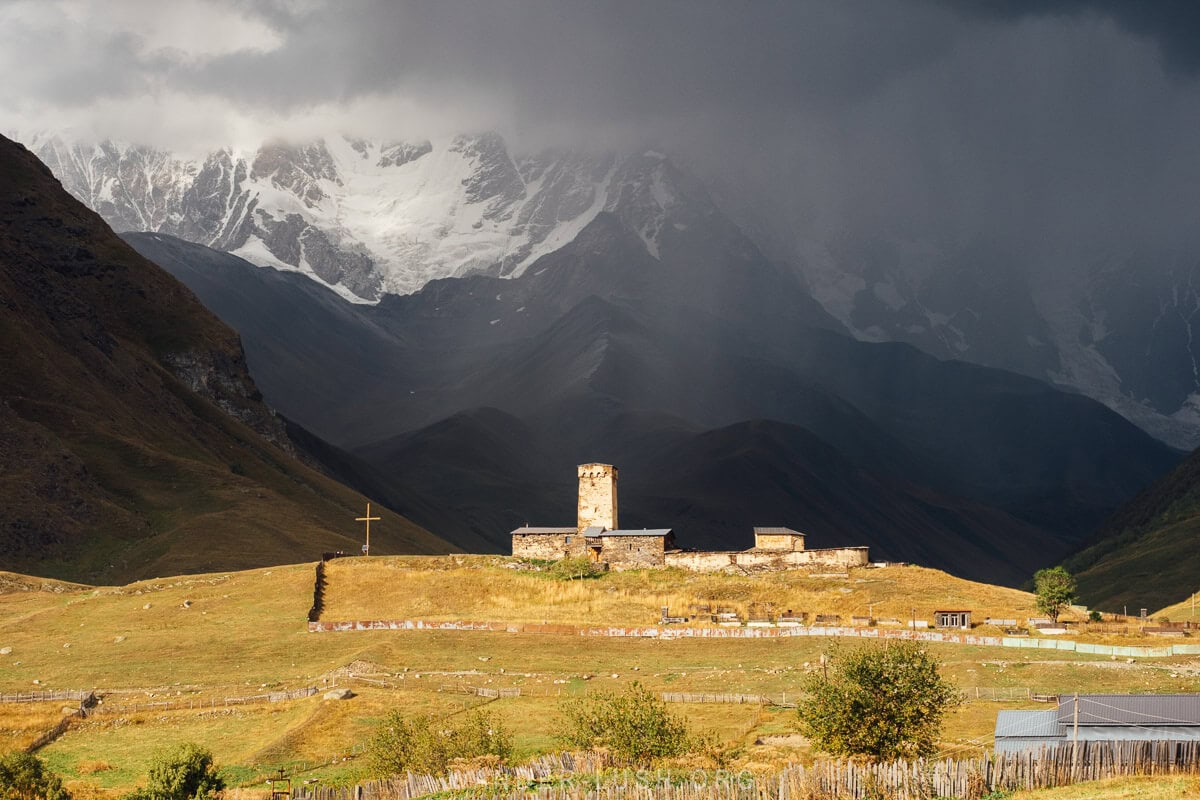
Ushguli is the most popular day trip from Mestia – and if that is all your itinerary allows for, it is still absolutely worth doing. The drive now takes around 90 minutes each way, which means more time to explore the villages and their UNESCO-Listed towers by foot.
That said, I strongly recommend spending at least one night in Ushguli. Once the day-trippers leave, the atmosphere changes completely, and staying overnight gives you time for the sunset and a slow morning.


The most epic way to reach Ushguli is of course via the four-day hike from Mestia. But even if you go by road, you can still visit some of the smaller hamlets between Svaneti’s two main tourist centres. Zhamushi, Zhabeshi, Chvabiani, Tsvirmi and Vichnashi all offer a quieter glimpse of village life, with towers, old stone houses, ancient churches, and mountain views along the way.
Rather than turning back to Mestia, you can then continue from Ushguli over the Zagari Pass through Lower Svaneti, completing a spectacular one-way journey to Kutaisi or Tbilisi. See my Svaneti Road Trip Itinerary for the full route and recommended stops.
Where to stay in Mestia
Boutique guesthouse: White House Nakani offers spacious, tastefully decorated rooms with private ensuites inside a house right in the centre of Mestia, close to Cinema Dede. The tasty breakfast spread is straight out of Pinterest and worth paying extra for. Lunchboxes can also be arranged.
Mid-range hotel: Family Hotel Kala has comfy rooms and a buffet breakfast. When we stayed here last year, we found the staff were very helpful. The location on the edge of Mestia is convenient if you are driving. Onsite parking is available.
Boutique hotel: Hotel Lahili is a 5-minute walk from the Ethnography Museum and cable car, with modern and stylish rooms, comfortable common spaces and a generous breakfast. We recently stayed here and loved it.
Cabin: If you’re looking for something more secluded, Bude Mestia Cottages offer gorgeous self-contained A-frame cabins set in the forest 3km from the main square.
How to get to Mestia
Zugdidi is the main gateway to Mestia, with marshrutka vans travelling up the mountain throughout the year. There are also direct vans and organised shared transfers from Tbilisi, Kutaisi and Batumi, while Vanilla Sky operates small propeller flights from Natakhtari and Kutaisi.

If you are driving, you can approach via the established Zugdidi-Mestia Road or, during the warmer months, take the newer and more scenic route from Kutaisi through Lentekhi and Ushguli.
See my detailed guides for getting to Mestia from Tbilisi and Mestia from Kutaisi for current schedules, fares, travel times and advice.
Georgia Essentials
Here are the websites and services I personally use and recommend for Georgia. Check out my full list of travel resources for more tips.
TRAVEL INSURANCE: Insurance is now mandatory for all travellers to Georgia. Insure your trip with HeyMondo, my preferred provider for single-trip and annual policies. Get 5% off when you book with my link.
AIRPORT TRANSFERS: Most flights into Georgia arrive in the early hours. Airport taxis should be avoided at all costs. For ease, pre-book a private transfer from Tbilisi Airport to your hotel or from Kutaisi Airport to Tbilisi with my partners at GoTrip.ge.
SIM CARD: Magti is my preferred provider, with prices from 10 GEL/week for unlimited data. See this guide for all the details about buying a Georgian SIM card.
ACCOMMODATION: Booking.com is the most widely used platform in Georgia. Use it to find family guesthouses, private apartments, hostels and hotels around the country.
CAR HIRE: Find a great deal on a rental car in Georgia – use the Local Rent website to book through a local agent (prices start from $30/day).
PRIVATE TRANSFERS: GoTrip.ge is a terrific service for booking a private professional driver and car for the day. Use it for A-to-B transfers, a customised round-trip itinerary, or a multi-day trip. You can stop wherever you like for as long as you like without the fixed price going up.
DAY TRIPS & CITY TOURS: Use Viator or Get Your Guide to browse a range of day trips and city tours. For alternative itineraries with expert guides, I recommend Friendly.ge. Use the promocode wanderlush for 10% off.
WINE TOURS: For in-depth day trips to Georgia’s wine regions, I recommend Eat This! Tours. Use the promo code wanderlush for 5% off.
You might also be interested in…
- The ultimate Georgia itinerary: Four detailed & custom-designed itineraries
- Georgia Travel Guide: All of my 200+ posts plus my top travel tips
- Georgia travel tips: 25 essential things to know before you go
- Places to visit in Georgia: 50+ unique & underrated destinations around the country
- The best things to do in Tbilisi: Favourites, hidden gems & local picks
- 35+ best restaurants in Tbilisi: Where to eat Georgian food
- 15 best day trips from Tbilisi: With detailed transport instructions
- The best time to visit Georgia: Month-by-month guide to weather, festivals & events
All comments are moderated and may take a little while to appear. If you’ve submitted your comment, I’ve got it!