The phrase ‘hidden gem’ gets thrown around far too often in Tbilisi. As much as I dislike it, I really can’t think of a better way to describe the Tbilisi State Academy of Arts – especially since this place quite literally shimmers!

You would be forgiven for thinking these photos were taken at the Golestan Palace in Tehran or maybe at the Khan’s winter residence in Sheki.
In fact these incredible Qajar-style Mirror Halls and Iranian miniatures are located in Georgia, just a short stroll from one of Tbilisi’s busiest avenues.
For years I thought that the State Academy of Arts was closed to the public. When I discovered that you can visit the Mirror Halls, I had to go and see this incredible piece of architecture for myself.
I’ve tried to gather as much information as I can find about the Mirror Halls, the Arts Academy, and the history of the building and its previous owner. Here is what I discovered, plus my advice for planning a visit.
Important note: The State Academy of Arts is closed for summer break from August 12 until September 4, 2024.
Please note: This post contains affiliate links, meaning I may earn a commission if you make a purchase by clicking a link (at no extra cost to you). Learn more.
About the Tbilisi State Academy of Arts
The Tbilisi State Academy of Arts is located on Alexander Griboedov Street, which runs parallel to Rustaveli Avenue in central Tbilisi. The institute accepted its first enrolments in March 1922, making it the first higher education institute for the arts in the Caucasus region, and one of only three art academies at the time in the Soviet Union.
Back then, the academy had four faculties – painting, sculpture, architecture and graphic arts – and attracted many notable professors, including Georgian national artists Lado Gudiashvili and Kutaisi-born David Kakabadze.
Today the academy is still functioning and alongside its teaching program, it hosts a number of cultural projects including the UNESCO-backed Lurji Supra which aims to revive the ancient art of Georgia’s blue tablecloths.


As usual, it’s the history of the building itself that I find most compelling.
The main building of the Arts Academy was first constructed as a private residence. Most sources use the term ‘palace’ to describe the lavish house. Its owner, Vardan Astvatsatryan Arshakuni, was a merchant of Armenian heritage who earned his fortune in the fishing industry, farming caviar in Azerbaijan’s Salyan rayon.
A philanthropist and a politician, Arshakuni was an honorary citizen of Tbilisi and even served as the city’s mayor for two years from 1858-60.
Side note: If you look through the list of Tbilisi mayors, you’ll notice that almost every mayor from 1840 until 1905 has an Armenian surname. This reflects Tbilisi’s ethnic makeup at the time (until the 19th century, Armenians constituted the largest ethnic group in Tbilisi, outnumbering Georgians), and the high standing of the city’s merchant and business class.

As was customary in Tbilisi, Arshakuni spared no expense when designing his sumptuous digs. He called on city architect Grigory Ivanov (Ivanyan), also of Armenian extraction, for the design.
While the facade is typical Tbilisi, Arshakuni desired something slightly different for the interior: A house that resembled a Persian palace. Master craftsmen from Iran were brought to Georgia to complete the decorations, including a set of splendid Mirror Halls (more on those in a minute).

Very sadly, Arshakuni died in 1862 and never got to see his house finished. He left part of his fortune to charity and bestowed his house on Griboedov Street to the public – a Tbilisi tradition that many of Arshakuni’s peers also embraced (the Writers’ House in Sololaki, built as a private house for brandy baron David Sarajishvili, being another example).
From 1869-86, the house was used by public servants’ club The Tiflis Circle to host balls and events. Eventually the house came to be owned by Princess Nino Kobulashvili. In 1902, it was rehabilitated by the architect Simon Kldiashvili who added his own Art Nouveau, Islamic and Baroque twists. In 1922, the building was handed down to the State Academy of Arts.
The Mirror Halls
The most impressive and culturally valuable part of Arshakuni House has to be the Mirror Halls. Preserved throughout the different restorations and recently rehabilitated by members of the Art Academy’s restoration cohort, these rooms perfectly represent the blending of European and Oriental traditions that makes Tbilisi so Tbilisi.
There are several sections: A small entry vestibule with a mirrored fireplace opens onto two larger halls with street-facing windows. The second hall has another (stucco) fireplace in the corner. Through the rear archway you can see another room, a huge hall with a decorated roof. At the time of my visit, this section was blocked off.

All of the rooms are quite literally decked out from ceiling to floor with intricate mirror work. Some parts have shards of glass arranged in geometric patterns, while the longer walls have one big sheet of mirror overlaid with a web of white stucco.


The mirrors are angled in such a way that you can never fully catch your own reflection. I don’t think this design feature is at all meant for vanity – the glass pulls in colours and light from the windows and grand chandeliers and throws it all back at you in a truly dazzling display.
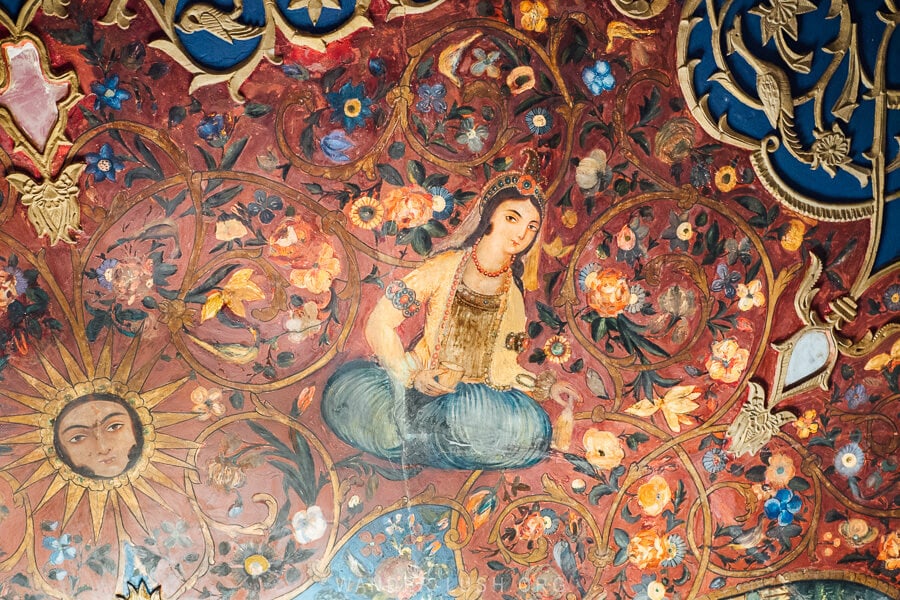
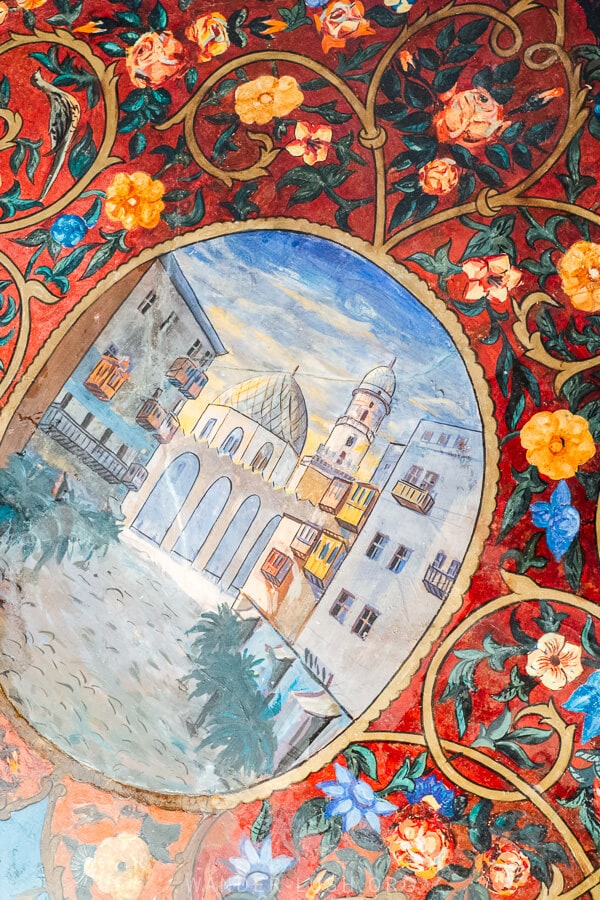
The cornices and some of the ceilings are covered with equally beautiful miniature paintings and honeycomb-like muqarnas plaster. I particularly love the designs in the second hall, which depict mosques, far-flung landscapes, cross-legged women with Persian features and costumes, and sun symbols that probably reference Zoroastrianism. Roses and other flowers feature heavily in the imagery too.

You can also see several Islamic-style mashrabiya windows decorated with coloured glass. Every little detail has been thought out, right down to the window sills that are inlaid with different wood grains in a star formation.
In the 1920s and 30s, the Mirror Halls were used as a rehearsal space for Maria Perini’s ballet studio. You can just imagine tutu-ed girls throwing pirouettes across the floor or raising pointed toes up to the window mantle.


This style of mirror work decoration and miniature painting is not at all typically Georgian, it’s very Persian. Dating back to the middle of the 16th century, these techniques are known as ‘Qajar-style’ because they peaked during the Qajar period.
The Mirror Hall (Talar e Aineh) inside the Golestan Palace in Tehran is considered the pinnacle of this aesthetic. This kind of mirror work was done first by sketching a design out on paper then transferring it to the walls using special needles. Cut pieces of mirrored glass were then applied one by one and further ornamented with stucco and inscriptions.
Mirror work is most often used in royal architecture and for religious buildings. Why would anyone go to so much trouble and expense to decorate their private house this way? Impressing visitors and advertising social clout was obviously part of the reason. But I was interested to read that the use of mirrors has a deeper symbolism. According to one source, “The mirror reflects the sky, water and every colour and is a symbol of light and life.”
In Iran, such mirror work can also be found in private merchant houses in Yazd. Apparently it was commonly used to decorate the home’s winter quarters, and in this sense the mirrors served a practical purpose to increase light and literally brighten up the residents’ day during the cloudy, colder months!
I would love to know if Arshakuni had a direct connection to Yazd, but I haven’t been able to find any solid information. Perhaps he was invited into the home of a fellow merchant and was so inspired by his style, he decided to replicate something similar in Tbilisi.

Arshakuni did have very close ties to Azerbaijan through his fishing business. Today the idea of an Armenian merchant doing business in Azerbaijan and building a Persian-style house in Tbilisi seems extremely far-fetched (impossible, even) – but at the time, it was totally normal.
I’m fascinated by the stories of Tbilisi’s Armenian merchants – men like Arshakuni, Mantashev and Aramyants who gave the city some of its most beautiful buildings. This is definitely a topic I want to delve deeper into in the future.
How to visit the Tbilisi State Academy of Arts
The Mirror Halls are open to the public under the auspices of the Tbilisi State Academy of Arts Museum. You can visit on weekdays (Monday to Friday) from 11am until 5.40pm. Staff told me that these times are approximate and they might close early – to be safe, I would recommend going in the middle of the day/early afternoon.
Every year, the Academy closes for summer holidays (approximately from the second week of August until the first week of September) and during the examination period in July/August.
Entrance costs 12 GEL and payment by card is preferred.
This prestigious institution has its own special entryway: the Academy of Arts Stairs, which start from Rustaveli Avenue near the Merani Mall, the Brutalist-Constructivist building on Rustaveli Avenue. A couple of years ago, the risers were decorated with hand-painted tiles made by local studio Ceramic Room. Each tiny tile has a different ornament.
When you reach Griboedov Street, you’ll see the main academy building straight ahead. The main entrance might be open, in which case you will see this staircase. Follow it to the top, then arc around to the left. You will see the first room with the fireplace on your right. Proceed inside, and the ticket desk is inside the second room.

If the main door is closed, walk further down the street and you will see a big double gate. If that is also locked, there should be an open door to the right of the main gate that you can walk through to enter the courtyard.
Once you’re inside the courtyard, turn the corner to the right and you will see a four-storey building with long verandahs. The second building with rounded balconies and peaked windows is the one you want.


There are no signs for the museum – so the first time I visited, I had absolutely no clue where I was going. I just followed my nose inside and up two sets of stairs. After trying a couple of different doors, I somehow stumbled upon the entry to the Mirror Halls.
This sort of thing happens all the time in Georgia – it’s very easy to fly under the radar and invite yourself into all kinds of public and private spaces. I hate feeling as if I might be trespassing, so I always get nervous in these situations.
I sheepishly took a few steps into the first Mirror Hall and – thinking this might be as far as I would get – snapped a few sneaky photos before briskly walking back in the opposite direction. The university term had just started, so there were only a few students around. I finally got someone’s attention, but when I asked for the museum they had no idea what I was on about.
Eventually I gave up and walked back into the Mirror Hall. Low and behold, in the second room I came upon an elderly woman sitting behind a wooden school desk reading a newspaper. She must not have heard me calling out from the other side. I walked right up to her and asked, ‘Muzeumi?’, and she gestured for me to wander around at will. Ha!
Note that they have since introduced an entrance fee of 12 GEL, so it’s a bit more formal now.
Free to explore by myself and take photos, I spent a good half hour in the halls before thanking the caretaker and wandering back out into the stairway. The other sections of this building are definitely more austere – there are a couple of ghostly busts, interesting wallpapers, and bronze sculptures that were obviously added much later.


The inlaid stone floor is probably original, and so are the balustrades. I’m not sure how old the sculpture of the lion with its shield is, but it’s quite grand!


Feeling more confident, I had a good look around the rest of the campus. The balconies on this building and the adjoining one are very, very beautiful – walk up the staircase under the tree for a nice view. At the top of the stairs there are more buildings with artist studios and lecture halls. I also saw a set of brick ruins – perhaps an old bathhouse? – lurking round the back.
Back in the main entry courtyard, you can get a great view of Ananov House on the opposite side of Griboedov Street and the large-scale mural ‘Seraphite’ by Case Maclaim.
Have you been to the State Academy of Arts? What ‘hidden gems’ in Tbilisi would you recommend visiting?
More Tbilisi posts you’ll love
- Georgia Travel Guide – all my 200+ posts for Georgia
- 25 Tbilisi travel tips – essential reading for first-timers
- The ultimate Georgia itinerary – the best of Tbilisi & beyond in 1-4 weeks
- How to plan your Caucasus travel itinerary – discover Georgia, Armenia & Azerbaijan
- What to pack for a trip to Georgia – and what to wear in Tbilisi
- How to get from Tbilisi airport to the city – 5 best transport options
- The best things to do in Tbilisi – the ultimate insider’s city guide
- Where to stay in Tbilisi – best neighbourhoods & accommodations
- The best restaurants in Tbilisi – where to find the best Georgian food
- The best cafes in Tbilisi – for coworking, coffee & more
- The best breakfasts in Tbilisi – cafes that open early
- The best gift shops in Tbilisi – where to buy authentic souvenirs
- The best walking tours in Tbilisi – discover the city by foot
- Tbilisi’s best walking streets – architecture, people-watching & street photography
- The best boutique hotels in Tbilisi – art hotels, wine hotels & more
- The best hostels in Tbilisi – accommodation on a budget
- Visiting Gulo’s Spa – the best sulfur bath in Tbilisi
- Visiting the Dezerter Bazaar – Tbilisi’s incredible green market
Hi Emily. We tried to visit here today (13 Jan 2025). There is a sign saying the museum is closed and I couldn’t get any info from the security guard about when it will reopen. Is there a way to find out? Thanks!
Hi Siobhan, the museum closes during the holiday period – it should reopen when the university semester resumes next month.
I found this before I read the information you posted, but the information helped me understand what I had seen. I appreciate it. No fee the day I was there, though I’d have happily paid it.
Thanks for the update, Tom! Glad you got to visit.
After reading your review I did go to visit today .. it is beautiful but now they charge a 12 lari fee for 10 minutes.
Thanks Nabiha, I found this out yesterday too! I have updated the info. Hope you enjoyed your visit.
Dear Emily – thanks so much for this piece. I visited a couple of times since you posted it and was dazzled.
Last week I took a visiting pal there. A 12GEL entry fee has now been introduced. Payment by card preferred.
Thanks Penelope, just found this out yesterday myself! I stumbled on the lurji supra workshop while I was there – have you visited? Thanks for your comment and the update!
Hello! Just to let you know that they are now charging 12lari to visit the mirrored rooms. This is as of April 2023.
I discovered this too when I went back to visit yesterday. I have updated the entrance fee and opening hours. Thank you very much for the info!
The museum now has a sign on it that it is closed to the public until 18 June.
Many thanks Lois for the update!
Hidden indeed, but I made it, thanks very much! The open door was the second to the right of the main gate. Lots of students there. I was lucky… came at 4pm, and the lady locked the section straight after my exit.
Terrific Harald! Glad you made it!
Thanks for this tip, it was terrific! I just followed all the students in.
Good strategy, Stephanie! Glad you enjoyed it!