A detailed Tbilisi neighbourhood guide to help you decide where to stay in Tbilisi based on your interests, preferences and budget.
Tbilisi is a small city by most measures. Yet there is a huge degree of difference between the different districts and neighbourhoods.
Having lived in almost every area of Tbilisi for 1-4 months on average, I’ve come to understand the city’s districts – their pluses and minuses – fairly well.
This guide to the different Tbilisi neighbourhoods is primarily designed for short-term visitors to Georgia. But if you’re planning to move to Tbilisi, it might come in handy when deciding where to live. I always recommend trying out a few different neighbourhoods to see which one is a good fit for you.
Please note: This post contains affiliate links, meaning I may earn a commission if you make a purchase by clicking a link (at no extra cost to you). Learn more.
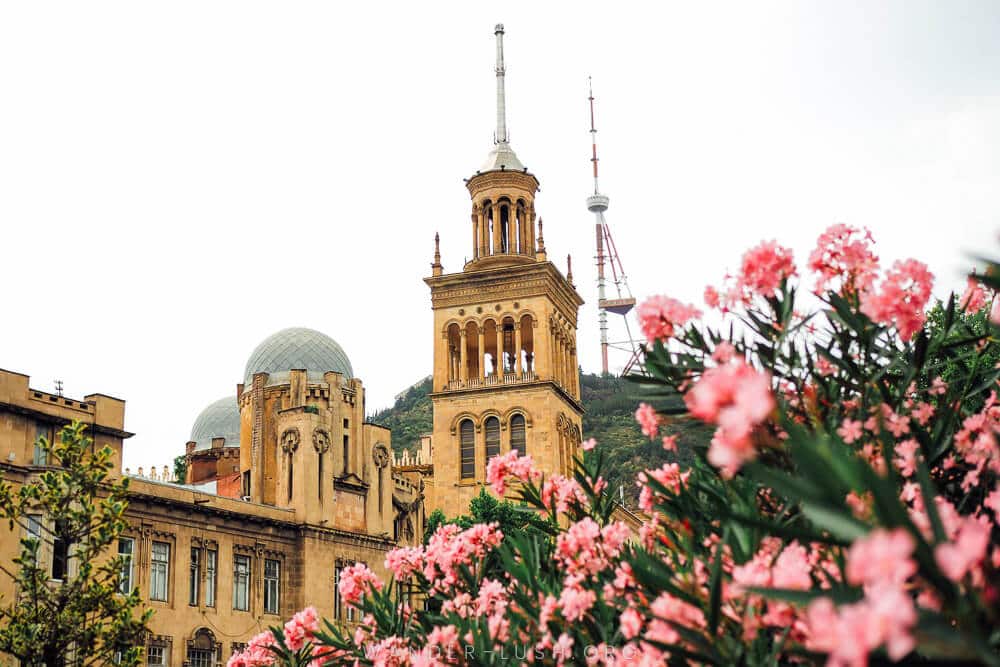
Quick links: Top accommodations in Tbilisi
- Hostel: Pushkin 10
- Budget: Salve
- Mid-range: Graphica Hotel
- Near the train station: TM Apart Hotel
- Boutique: Communal Plekhanovi
- High-end: Stamba
- Apartment: Ateshgah Residence
→ Also see my separate guides to the best boutique hotels, hostels and Airbnbs in Tbilisi.
Tbilisi neighbourhoods & districts
Drawing boundaries around the different neighbourhoods in Tbilisi is not an easy task. While the 10 administrative districts (raions) are fairly clear, within those 10 there are dozens of ‘micro-districts’ that sometimes overlap and intersect, plus informal historic neighbourhoods that people refer to by different names. Then there are nicknames on top of that, often based on the nearest avenue or metro station.
An example: I once lived in an apartment a few steps off Rustaveli Avenue. Officially it was part of Mtatsminda district, but it was right on the border, and since my street continued into the next neighbourhood, many people insisted that I actually lived in Vera neighbourhood. But my neighbours knew those few city blocks as Zemeli – an old name that comes from the local pharmacy that was on the corner until the 1930s. Confusing!
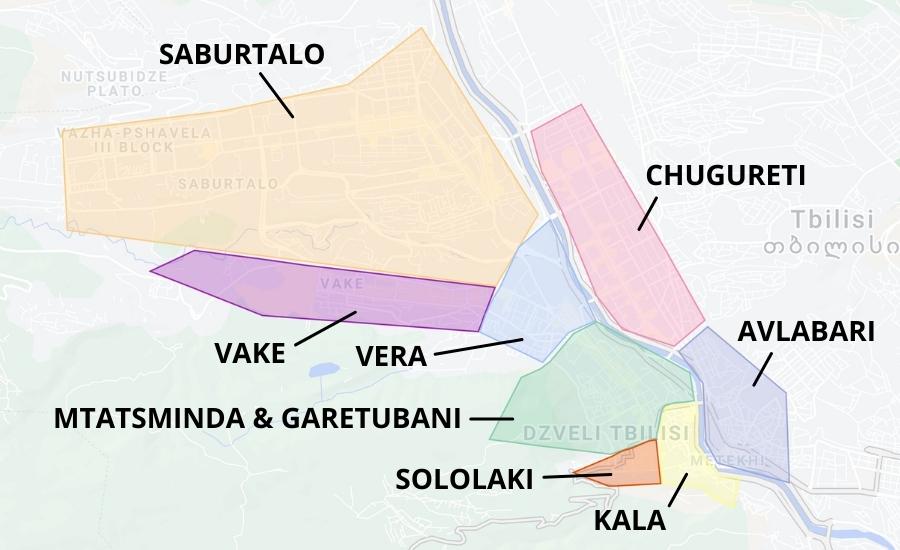
All this to say: please take these designations with a pinch of salt and note that the boundaries drawn up on the map below are not at all official or definitive.

In this guide, I cover 8 neighbourhoods/districts:
- Kala (Old Town)
- Sololaki
- Avlabari
- Chugureti (Marjanishvili)
- Mtatsminda & Garetubani
- Vera
- Vake
- Saburtalo
Map of Tbilisi neighbourhoods
1. Kala (Old Town)
The name ‘Old Tbilisi’ (Dzveli Tbilisi) refers to the oldest part of the city, which is in fact most of the downtown area. Old Tbilisi covers more than 30 districts and mico-districts over both sides of the Mtkvari River and encompasses many of the Tbilisi suburbs mentioned here.
For the purposes of this guide, I’m referring to the inner core of Old Tbilisi by its historic title, Kala (meaning ‘Castle’ district). This name of course comes from the 5th-century Narikala Fortress, which dominates Old Tbilisi. Kala covers Leghvatakhevi, Historic Betlemi Quarter, Sioni, the old Meidan area and Afkhazi Street. It also includes the tangle of winding streets behind the old city walls that lead through to Freedom Square.
Kala is a fascinating tapestry of different architectural styles and monuments from across the ages. I like to think of this area as ‘Silk Road Tbilisi’ – the place where merchants traded in open-air markets, prayed in their different churches, mosques and synagogues, drank tea in chaikhanas, and fell asleep in caravanserais (there was even an inn on the spot where Freedom Square stands today).
One of the most recognisable landmarks within this area is Abanotubani district, where up to 65 Persian-style bath houses were erected atop natural hot springs. About a dozen domed baths remain.
Historic Betlemi Quarter (Kldisubani) rises up above the sulfur baths, leading you to viewpoints, a series of beautiful churches, and the Ateshgah Zoroastrian Fire Temple, one of the oldest surviving buildings in Tbilisi. The Betlemi Street Stairs continue all the way up Narikala Hill to the Mother of Georgia statue, the fortress and National Botanical Garden.
Some of Tbilisi’s most popular attractions are located at the bottom of the hill near the river: the Old Meidan marketplace, Abkhazi Street and the Cotton Rows (now swarming with restaurants and bars), Sioni Cathedral, Anchiskhati Basilica (the city’s oldest Orthodox church), and the Gabriadze Theatre and Clock Tower. The streets within the old walls are a maze of ramshackle houses and courtyards, all beautiful in their disarray.
Overall, Kala is enchanting and a great place to explore, but it’s not the best area to stay in my opinion. Accommodation options are limited and the prices here are the highest in the city. It tends to feel claustrophobic when there are lots of tourists around, and with the proliferation of street sellers, you’re more likely to get hassled in this area.
In addition, most hotel rooms are small and boxy, and the narrow streets in this area make it difficult to get a taxi to/from your door. The quality of restaurants and bars is quite poor relative to the price.
- Location: 5/5 – this is the heart of Tbilisi
- Transport: 4/5 – a few minutes’ walk to Liberty Square metro station & buses on Rustaveli Avenue
- Restaurants & bars: 2/5 – a lot on offer, but most are overpriced
Where to stay in Kala
There’s something for every budget in Kala district, though as mentioned prices here are still high compared to other parts of the city.
- Boutique: The Blue Fox Hotel (read my review here)
- Boutique: Silver 39 Boutique Hotel & Terrace
- Mid-range: Le Caucase
- Mid-range: Check Point Hotel
- Luxury apartment: Ateshgah Residence
- Mid-range apartment: Pomegranate in Old Tbilisi
- Courtyard apartment: Tiflis Family House
- Budget: Guest House Rampa
- Hostel: Envoy Hostel
2. Sololaki
Sololaki is considered Tbilisi’s oldest ‘neighbourhood’ – that is, the oldest planned residential area in the city. It stretches out to the west of Freedom Square up towards Mtatsminda and is easily distinguished from the inner part of Old Tbilisi because of its neatly gridded streets.
Sololaki was developed in the 19th century when Tbilisi expanded under the Russian Empire and outgrew its walled confines. Then known as Avanantkhevi, it was an area where dignitaries built lush gardens. Later in the 19th and early 20th centuries, Sololaki became a sought-after suburb where the city’s wealthiest merchants and businessmen built their European-style mansions. You can find some very fine examples of Art Nouveau and neo-Moorish architecture in this area. In fact, every facade and entryway in Sololaki is a work of art.
The name Sololaki has Arabic and Turkish roots. It comes from the word Sulu-Lah, referring to an irrigation system that was erected here for the nearby fortress gardens. All that water coursing under the streets has caused serious structural damage, which is why you see many buildings literally collapsing in on themselves. Trendy Georgian restaurants, bars and specialty coffee shops have taken up residence in these forgotten apartments, breathing new life into Sololaki.
Overall, it’s both atmospheric and convenient, with the metro station at Liberty Square and several supermarkets and malls (including Galleria) close by. One downside is that it’s still quite touristy and can feel crowded during the summer months.
Keep in mind that older buildings in Sololaki often lack natural light and have plumbing issues due to their age. Some have been carved up into apartments with walls and ceilings that are the polar opposite of sound-proof.
- Location: 5/5 – walking distance to Old Town, Rustaveli Ave & most major landmarks
- Transport: 5/5 – walking distance from Liberty Square metro station & buses on Rustaveli Ave
- Restaurants & bars: 5/5 – nice variety of venues & prices are lower than in the Old Town
Where to stay in Sololaki
Because so many buildings are heritage listed, accommodation options in Sololaki proper are mostly limited to boutique and boutique-esque hotels.
- Boutique: Communal Hotel Sololaki
- Boutique: IOTA Hotel
- Boutique: Writers’ House Residency
- Mid-range: Galaktioni 22
- Mid-range: Guest House Lile
- Apartment: Chonkadze 11 Flat
3. Mtatsminda & Garetubani
Mtatsminda is another large district in central Tbilisi. It starts from Freedom Square and continues north-west along the river, with Shota Rustaveli Avenue as its main artery. Mtatsminda covers the streets to the west that run up Mtatsminda (‘Holy Mountain’) towards the Tbilisi TV Tower, while the sloping streets to the east that run down to the river’s edge are known as Garetubani (‘Outer District’).
Rustaveli Avenue, Tbilisi’s main avenue, is where most of the city’s prestigious museums and galleries are located, along with the parliament and the Opera Theatre. The streets to the west are relatively quiet and suburban, while towards the river, popular attractions such as Orbeliani Square, the Atoneli Street precinct and the Dry Bridge Market give lower Mtatsminda more of a buzz.
There are several very nice parks and river walks nearby, including the newly renovated Dedaena Park, plus lots of cafes and restaurants. Accommodations range from luxury hotels such as the Biltmore and the Radisson Blu Iveria through to small apartments.
Keep in mind that the streets behind parliament are very steep so if you have mobility issues, this is not the best area for you.
- Location: 5/5 – walking distance to Old Town, Rustaveli Ave & Vera
- Transport: 5/5 – Rustaveli metro station & city buses along Rustaveli Ave
- Restaurants & bars: 4/5 – good selection of cafes and restaurants (but avoid eating on Rustaveli Avenue as some places are tourist traps)
Where to stay in Mtatsminda & Garetubani
Because it’s so central, Mtatsminda can be quite pricey.
- High-end: Radisson Blu Iveria
- Boutique: Zorba & Bond
- Boutique: Octava Boutique Hotel
- Boutique: Museum Hotel Orbeliani
- Boutique: Taberne Boutique Hotel
- Boutique: Bazzar Boutique Hotel (read my review of Bazzar Hotel here)
- Mid-range: Hotello
- Apartment: Funicular Inn Apartments
- Budget: Salve
- Hostel: Gallery Hostel
4. Avlabari
Located on the other side of the river on the Left Embankment, directly opposite Abanotubani, Avlabari was traditionally Tbilisi’s Armenian quarter. It’s elevated from the river and reached via Wine Rise, the steep street that runs up the hill from Rike Park. This makes it very convenient to the centre of Tbilisi (just a short walk over Metekhi Bridge or the Bridge of Peace). It also has its own metro station.
Sameba Cathedral, Georgia’s biggest Orthodox church, dominates Avlabari and overshadows the many lovely Armenian Apostolic churches. The streets here are filled with very old houses – it has a nostalgic feel that some people might find a bit depressing.
But this area is changing fast, with new parks and squares, a fresh metro station, and new several large apartment complexes and dining precincts that are set to open in the coming years.
Other attractions in Avlabari include Metekhi bridge and church, Queen Darejan’s Palace, and the Underground Printing House Museum where a young Stalin produced propaganda materials.
Overall, Avlabari is local and quite budget-friendly while still being extremely central. The biggest downside is the lack of restaurants: there are very few options aside from shawarma kebabs. There is a small Carrefour supermarket and plenty of local grocery shops and open markets, so it’s well suited to anyone who cooks at home.
- Overall location: 5/5 – walking distance from Abanotubani
- Transport: 4/5 – Avlabari metro station
- Restaurants & bars: 1/5 – seriously lacking food options!
Where to stay in Avlabari
Avlabari has plenty of budget-friendly options as well as a couple of boutique hotels. I recommend staying as close to Rike Park and the metro station as possible.
- Boutique: Vinotel Boutique Hotel
- Mid-range: Graphica Hotel
- Mid-range: Hotel Livin
- Apartment: SaBa Apartments in Old Tbilisi
- Apartment: Apartment Paysage
- Apartment: JAKO Old Tbilisi
- Hostel: Sheni Hostel
5. Chugureti
Also called Marjanishvili, Vorontsovi or Plekhanovi, Chugureti is another historic neighbourhood on Tbilisi’s Left Embankment. The name comes from the Turkish word Chugur and means ‘deep plateau’ or ‘pit’ in Georgian. Chugureti is part of the larger Didube-Chugureti district, which extends all the way north to Didube Bus Station, the city’s main marshrutka hub.
This part of Tbilisi was originally a German colony called Neu Tiflis before it was absorbed into the city in the 1820s. It contains several micro-districts including Okrosubani, Plekhanovi and Vorontsov, each with very unique architecture. Chugureti is one of my favourite areas – it’s both beautiful and a bit edgy.
Chugureti is perhaps best known for being home to Fabrika, a hub for Tbilisi’s creative and nightlife scene. Agmashenebeli Avenue runs through the centre of Chugureti and boasts some of the city’s most beautiful restored facades. The pedestrianised part of the avenue is very touristy and a known hotspot for scams, so I suggest you steer clear. This whole area has a strong Turkish and Arabic influence, so you’ll find lots of Middle Eastern restaurants and shisha lounges around.
At the northern end, Tbilisi Central Station is the departure point for domestic and international trains. Other points of interest include the State Silk Museum, Dinamo Stadium and the sprawling Dezerter Bazaar food market. This area is a bit of an up-and-comer with several outstanding new restaurants having opened in the past 12 months.
Overall, Chugureti is further from the centre of Old Tbilisi but has lots of character. It’s great for nightlife, coworking and socialising. Some parts can be a bit seedy, especially near Station Square, although this seems to be slowly changing as gentrification ramps up.
- Overall location: 3/5 – metro/bus/taxi required to get to the centre
- Transport: 5/5 – two metro stations, Marjanishvili & Station Square, plus buses
- Restaurants & bars: 5/5 – some of my favourite restaurants are here, including swanky Ninia’s Garden right through to Mapshalia, Tbilisi’s best budget restaurant
Where to stay in Chugureti
Chugureti has a wide range of accommodations for different budgets. Some of the nicest boutique hotels in Tbilisi are located in historic buildings in this district.
- Hostel: Fabrika Hostel & Suites
- Boutique: Communal Plekhanovi
- Boutique: Unfound Door Design Hotel
- High-end: Moxy Tbilisi by Marriott
- Mid-range: Hotel Art Nebula
- Mid-range: Tea for Two
- Apartment: Chugureti by Picnic
6. Vera
Vera is a historic residential area on the west bank of the river. It starts from the top of Rustaveli (where the avenue turns into Kostava Street) and runs along the river and up the hill towards Vake. Formerly known as Skvireti, the new name comes from the Vera river that runs along the neighbourhood’s northern periphery. It used to be much bigger, but is just a fraction of its former size due to be subdivided over the years.
In the 18th century, an important caravan route to Kartli region ran through Vera and the main road was guarded by a special detachment called ‘the Guard of Vera Gorge’. Points of interest include Vera Park (currently being refurbished), the Blue Monastery and Laguna Vera, an abandoned Soviet-era sports complex.
The inner part of Vera around Melikishvili Street is cafe after cafe, wine bar after wine bar, with stacks of boutique shops, fashion ateliers, artisanal bakeries and coworking spaces in between. It culminates with Wine Factory N1, one of the city’s best dining precincts.
Overall, Vera is quite up-market and trendy. Accommodation can be more expensive as a result. The closest metro station is Rustaveli, a 5-10 minute walk away. Lower Vera (the bottom part, closer to the avenue) is more convenient for accessing public transport.
- Overall location: 4/5 – walking distance to Rustaveli Ave & the Old Town
- Transport: 4/5 – metro & buses nearby on Rustaveli Ave
- Restaurants & bars: 5/5 – fantastic wine bars, specialty coffee & contemporary Georgian restaurants
Where to stay in Vera
Vera is home to Rooms and Stamba, two of Tbilisi’s most popular hotels. Self-contained apartments and a limited number of mid-range hotels are set back from Kostava Street.
- High end: Stamba Hotel
- High end: Rooms Hotel
- Mid-range: Lowell Hotel
- Apartment: BFG Suites
- Budget: Gutsa Artists Mini-Hotel
7. Vake
Among locals, Vake is known as Tbilisi’s ‘posh’ suburb. It’s one of the most expensive places to live in the city. Vake and Avlabari, for example, are like night and day. The suburb runs east-west from Vera and unlike other districts, it’s almost completely flat (the name Vake means a ‘fallen’ or ‘low’ place). After being incorporated into Tbilisi at the turn of the century, most buildings were constructed in the 1920s – hence the grander scale and better condition of most apartment blocks.
Vake feels well planned. There’s Chavchavadze Avenue, with its wide footpaths, and there are multiple leafy green spaces including Mziuri Park. This, along with the international and local schools, makes it a popular choice for families. There are dozens of breakfast cafes, restaurants and bars in Vake, including many that cater to students from the nearby universities.
The crowning glory is Vake Park (formerly Victory Park), which opened in 1946. The massive green space has walking and cycling paths and a large Soviet-style memorial. There are lots of sports complexes, gyms and indoor swimming pools around, making Vake a good choice if you like to stay active (this is one of the few places where people don’t stare at you while you’re jogging). Urban hiking trails are available near Turtle Lake.
Overall, Vake is very pleasant and liveable with parks, modern apartments, and a nice variety of food options for different budgets. On the downside, the metro doesn’t service this area so you have to rely on buses to get around. It’s quite far from the centre, a 30-40 minute walk from Rustaveli Avenue, and traffic can be very heavy as well.
- Overall location: 3/5 – mid-way from the centre, walking distance to Vera but bus/taxi required to get to the Old Town
- Transport: 2/5 – no metro line, limited to buses
- Restaurants & bars: 4/5 – excellent cafes & coffee in particular
Where to stay in Vake
There are a limited number of hotels in Vake so it’s better to go with a self-contained apartment.
- Mid-range: Tribu Express Hotel
- Apartment: Round Garden Apartment
- Apartment: MAK Apartment Vake Park
8. Saburtalo
Saburtalo is the sprawling residential district that sits above Vake and forms the north-eastern border of Tbilisi. It incorporates several neighbourhoods including Delisi, Vedzisi and Bakhtrioni, and it has its own metro line which makes it very easy to get around.
Saburtalo is different to the rest of Tbilisi. Most buildings were constructed during the Soviet era and the landscape is completely dominated by concrete (although there are parks, street art and sidewalk cafes to soften the edges). It’s very easy to find a good apartment here, making Saburtalo popular among international students and expats. Generally buildings are better designed for natural light and ventilation, and because it’s further from the centre (~5-10km from Freedom Square), prices tend to be a bit lower.
However, because Saburtalo is so far out, you do feel disconnected from the ‘centre’ of the city at times. The traffic is horrendous so it’s essential to use public transport (the metro) rather than taxis during peak hour. There are some great local restaurants, including Amra and Shin-Aura, some really interesting buildings, including the famous Tbilisi Sky Bridge, plus tons of supermarkets and cheap bakeries.
Overall, Saburtalo is a great budget-friendly choice but it’s better suited to longer stays. If you’re just in the city for a couple of days and your main priority is sightseeing, then you’ll want to keep closer to the centre.
- Overall location: 2/5 – far from the centre
- Transport: 3/5 – metro line & buses (but traffic is an issue)
- Restaurants & bars: 4/5 – higher-end cafes, international restaurants, plus plenty of local & student-friendly options
Where to stay in Saburtalo
There are virtually no hotels in Saburtalo but there are a few self-contained apartments plus a bucket load of Airbnb listings.
- Apartment: Eco Residence
- Apartment: New Tiflis Apartments Saburtalo
- Apartment: Green Budapest
Where is the best place to stay in Tbilisi? Best neighbourhoods for visitors
In conclusion, here are my top five neighbourhoods in Tbilisi for visitors:
- Sololaki: For atmosphere, architecture & boutique hotels
- Mtatsminda/Garetubani: For dining, sightseeing & luxury hotels
- Vera: For cool cafes, wine bars & a range of accommodations
- Chugureti (Marjanishvili): For nightlife, coworking & hostels
- Avlabari: For local vibes, access to the city & budget-friendly accommodation
Where is the best place to live in Tbilisi? Best neighbourhoods for a longer stay
And my top three neighbourhoods to live in Tbilisi:
- Vake: For green space & mod cons
- Saburtalo: For a bigger apartment & budget-friendly lifestyle
- Chugureti: For coworking & socialising
More Tbilisi posts you’ll love
- Georgia Travel Guide – all my 200+ posts for Georgia
- 25 Tbilisi travel tips – essential reading for first-timers
- The ultimate Georgia itinerary – the best of Tbilisi & beyond in 1-4 weeks
- How to plan your Caucasus travel itinerary – discover Georgia, Armenia & Azerbaijan
- What to pack for a trip to Georgia – and what to wear in Tbilisi
- How to get from Tbilisi airport to the city – 5 best transport options
- The best things to do in Tbilisi – the ultimate insider’s city guide
- Where to stay in Tbilisi – best neighbourhoods & accommodations
- The best restaurants in Tbilisi – where to find the best Georgian food
- The best cafes in Tbilisi – for coworking, coffee & more
- The best breakfasts in Tbilisi – cafes that open early
- The best gift shops in Tbilisi – where to buy authentic souvenirs
- The best walking tours in Tbilisi – discover the city by foot
- Tbilisi’s best walking streets – architecture, people-watching & street photography
- The best boutique hotels in Tbilisi – art hotels, wine hotels & more
- The best hostels in Tbilisi – accommodation on a budget
- Visiting Gulo’s Spa – the best sulfur bath in Tbilisi
- Visiting the Dezerter Bazaar – Tbilisi’s incredible green market
Hello Emily,
May I know if any protest is still going on in Tbilisi? I don’t see anything on news though. And if it is still on, which area can be avoided for booking hotel?
Hi Ankit, you don’t really need to factor this into your decision but if you prefer to be away from the Rustaveli Avenue area, I would avoid booking a place near Parliament.
Hello Emily,
I’ll be in Tbilisi for 4 nights with my wife and 2 daughters (4 year old and 10 month old). I have the option to stay at the Holiday Inn or Holiday Inn Express. I’m having a hard time deciding which would be better for us. I would love your opinion
Hi Mark – the Express is a much better location for visitors as you can walk across Metekhi Bridge into the Old Town.
I found your site yesterday cause I’m moving from Balkans to Tbilisi, or at least going to check it out for a month (and maybe just staying, since I’ve got a year). Today I had another query and put it in Google, again your site came up. I think I’ll just skip Google from now on as the answer is likely here!
Thanks Adam, happy to help!
Hi. Just wondering what your experiences of renting an apartment in Tbilisi have been like because I just signed a 6-month lease and now days after, the real estate agent is just randomly dropping texts about extra costs that I have to pay like a building fee to the owner of the building and a monthly elevator fee if I want to use the elevator. These extra expenses were not listed in my lease, nor were they communicated to me when I viewed the apartment so I’m wondering what to do now – ride out the 6 months and pay or try to dispute this?
Hi Shane – unfortunately this sort of thing is not uncommon. If it continues to be an issue, I would consult a local lawyer to figure out your options.