The first time I visited Gori, I did what most tourists do – I spent most of my short stay inside the Stalin Museum and neglected the rest of the city. Little did I know, there are plenty of other things to do in Gori that have nothing to do with Stalin.
Second time around, I was determined to learn more about the city that’s overlooked or underestimated by most tourists. I budgeted three whole days for exploring Gori on foot and one afternoon, I enlisted the help of local guide, Zhana Odiashvili, to show me around.
Turns out there is indeed a Gori beyond the Stalin Museum… It’s a friendly, green city with fabulous old town architecture, a distinctive fortress, a vibrant local market, several important churches, and a synagogue.
There’s local cuisine to taste, breezy outdoor cafes to kick back in, and lots of opportunities to learn about other chapters in Gori’s history through alternative museums and street art.
Gori is just 1.5 hours’ by marshrutka or shared taxi from the capital, so you can easily visit on a day trip from Tbilisi. However, I think it’s worth spending at least one night here.
As you’ll see, there’s plenty enough to keep you occupied for 2 full days, especially if you add a side trip to Uplistsikhe cave city.
I hope this list of 20+ things to do in Gori will convince you to stay a little longer and explore Gori beyond the Stalin Museum!
Please note: This post contains affiliate links, meaning I may earn a commission if you make a purchase by clicking a link (at no extra cost to you). Learn more.

About Gori
Gori is Georgia’s seventh-largest city by population and serves as the administrative capital for the Shida Kartli (Middle Kartli) region. Located between Tbilisi and Kutaisi, it served as an important waypoint on east-west trading routes (including the Silk Road) for centuries.
The name ‘Gori’ comes from the Georgian word gora meaning ‘heap’ or ‘hill’. As you approach Gori by road or train, you can immediately see where the inspiration for the name comes from: A huge flat-topped sandstone hill rises up from the pancake-flat plain in the centre of the city, not far from where the Mtkvari and Liakhvi rivers meet.
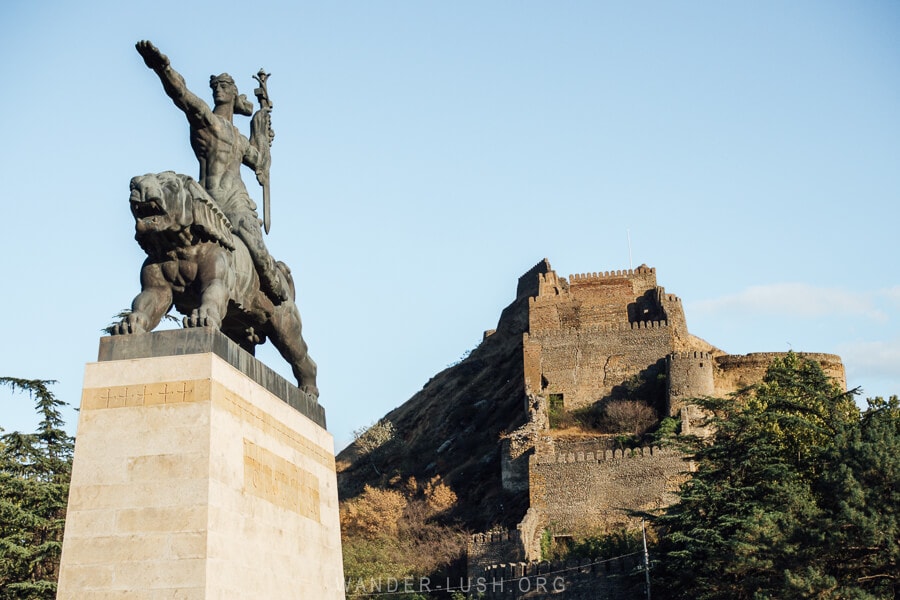
In medieval times, Gori was an important military stronghold. Gori Fortress, the city’s distinctive tiered castle, cascades down the hill’s north-western side, forming stone terraces and lookout points. It’s from here that soldiers attempted to deflect a succession of assaults unleashed by Mongol, Ottoman and Persian forces.
Gori also has an interesting contemporary history. In 1920, an earthquake struck near the city. Just as Gyumri in neighbouring Armenia was almost completely destroyed by tremors 60 years later, Gori’s centre was all but flattened. The fortress sustained significant damage and restorations are still underway.

Looking at the map of Georgia, you’ll notice that Gori sits uncomfortably close to the dotted line that designates the Georgian-Ossetian conflict zone. Tskhinvali, capital of the South Ossetia (Tskhinvali/Samachablo) breakaway republic, is less than an hour’s drive away.
In 2008, when the Russo-Georgian War unfolded, this put Gori directly in the firing line. The city came under attack from airstrikes and was occupied by ground troops. According to Human Rights Watch, scores of civilians were killed by cluster bombs. The so-called ‘Five Day War’ left a massive scar on Gori, both physically and psychologically.
‘Border creep’ and the threat of gradual invasion still hangs like a cloud over this part of Georgia. Along with Abkhazia, South Ossetia constitutes the 20% of Georgia’s territory that is controlled by Russia. Needless to say, it’s strictly off-limits to tourists.

Gori today
Its recent history might have been characterised by natural disasters, war and border conflict, but the Gori of today is a very beautiful little city indeed.
My enduring memories of Gori from my first visit in 2017 are of sun-drenched suburbs with wide streets and bountiful vines strung from arbours in front of each and every home.
When I returned in 2020, the trellises weren’t heavy with wine grapes as I remembered, but in the process of being trimmed back in preparation for incoming spring weather. Since moving to Kutaisi, I’ve since been back to Gori in the middle of winter (seeing Stalin’s train carriage sitting in the snow was interesting!) and in early autumn, when the grape harvest was about to begin.
No matter the season, strolling through Gori’s peaceful streets, I always feel an overwhelming sense of ease.
There’s just one more thing to note about Gori. Both inside Georgia and around the world, the city is best known for being the birthplace of Ioseb Jugashvili, AKA Joseph Stalin. I’ll bet this is what first put Gori on your radar – indeed, it’s the reason I first wanted to visit.
Stalin was born in Gori in 1878, reportedly inside the small wooden cottage that now sits under a stone portico in the centre of the city. This monument is one part of the Stalin Museum complex, which also includes his private railway carriage and a two-story memorial hall dedicated to the leader, mostly covering the earliest chapters of his life in Gori and Tbilisi, where he set up an illegal propaganda printing press.
There’s a still a cult of personality surrounding the former dictator, but it’s important to acknowledge that not everyone in Gori loves Stalin (far from it). Stalin Museum, Stalin Park, Stalin Avenue – it’s difficult to avoid reminders of the dictator. But try not to let that colour your experience of Gori.
Should you visit the Stalin Museum?
While this post is all about things to do in Gori besides the Stalin Museum, that doesn’t mean I would discourage you from visiting. It is Gori’s main attraction, after all.
I still believe it’s worthwhile to see the museum, provided you take the guided tour (since there is so little information in English, it’s not worth it otherwise).
Just be aware of what you’re entering into, and know that the exhibits and some of the guides are quite biased towards portraying a rose-coloured-glasses version of history (well, that’s putting it mildly).
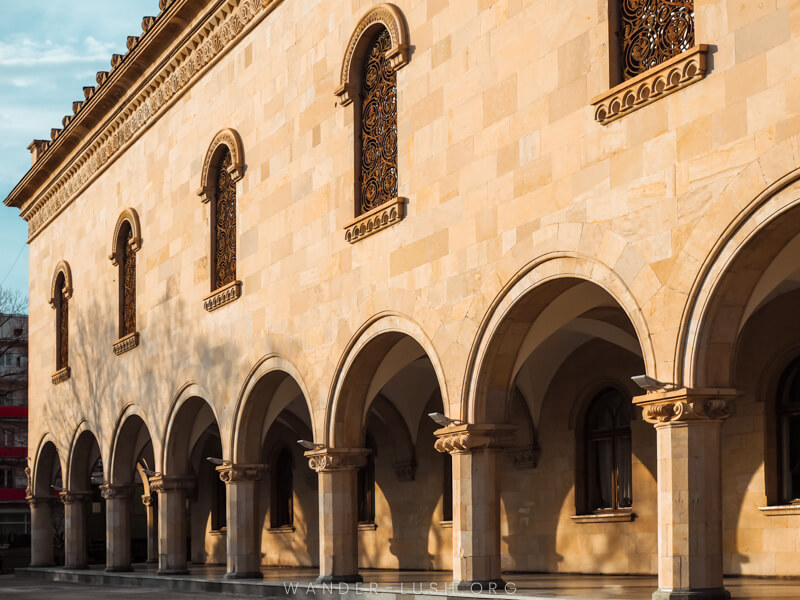

My tip: Don’t make this the first or only thing you do in Gori. Take some time to explore the city (using my tips below) and get a feel for the ‘real Gori’ before you go immersing yourself in the world of Stalin. Everything in balance.
If you do plan on visiting the State Museum of Joseph Stalin, here is my guide to the museum and some clues on what to expect from the guided tour.
Gori often gets billed as a ‘dark tourism’ destination, and I think that’s a huge shame. As you’ll see, there’s so much more to Gori than just its association with Stalin.
Where to stay in Gori
There aren’t a huge number of hotels in Gori, but there are plenty of comfortable family run guesthouses set up in local homes to accommodate travellers.
Top Choice: Nitsa Guest House
My top choice in Gori is Nitsa Guest House. The location close to the Stalin Museum and centre of town is perfect. Rooms are cosy, shared bathrooms, kitchen and laundry are all spick and span, and there’s plenty of comfy common spaces to relax.
Most importantly, host Lia is a wonderful person who will absolutely overwhelm you with her generous hospitality and helpfulness. We stayed with Lia for 3 nights on our most recent visit and loved getting to know her (especially when she plied us with homemade wine and taught us a series of traditional Georgian dances!).
In the cooler months, ask for a room at the back of the house – these ones catch the afternoon sunlight. Soon two more rooms will be available in a new building located in her garden. Definitely opt in for the traditional breakfast.
Check prices and availability on Booking.com.
Nukri Guest House
The first time we visited Gori, we stayed at Nukri Guest House. It’s another solid choice, but the location across the river (near the Railway Station) is less desirable and requires a bit more walking to get into town.
The hosts, Nukri and his wife, speak Russian and Georgian – even if you can’t communicate, they are warm people who will go out of their way to ensure you have a good time. During our stay, Nukri gave us the grand tour of Gori in his Lada!
Check prices and availability on Booking.com.
Hotel Continental
If you’re looking for something with a bit more privacy, Hotel Continental offers tidy self-contained apartments with kitchenettes and washing machines. The location 800m from the Stalin Museum is ideal.
I haven’t stayed here personally, but the hotel has high reviews from other guests (9.7 out of 10 on Booking.com).
Check prices and availability on Booking.com.
20 awesome things to do in Gori, Georgia
For a city of its size, Gori has a lot to offer visitors. You can easily fill two slow-paced days with the activities listed below, more if you plan on exploring the surrounding countryside.
All of these places can be visited on foot with the exception of St. George’s Church, which is a bit far to walk and requires a car.
Here are all the best things to do in Gori, Georgia.
1. Join the Gori Free Walking Tour with Zhana

If you want to get to the heart of Gori and experience a city few tourists take the time for, sign up for the Gori Free Walking Tour. It departs daily at 12 midday (advance bookings are required) and lasts for about 3 hours, visiting most of the city’s main attractions, including two alternative museums, the bazaar, and the fortress.
Free walking tours are typically reserved for larger cities like Tbilisi and Batumi, so it’s a real treat to be able to see Gori through a local’s eyes. This is a passion project (and a one-woman show) started by Zhana Odiashvili, who’s on a mission to show visitors that her home city had a history before (and after) Stalin.
Zhana knows everything there is to know about Gori, and no question is off limits.
One of the most interesting stories she told us was the one about the Stalin statue. Up until 2010, an imposing statue of Stalin stood in front of Gori’s main government building. One night, at around 2am, it was torn from its plinth and relocated to a small village outside town.
Gori’s local communist party was furious and petitioned the state government (the ones responsible for moving the statue) to reinstate it. The response from Gori’s residents was mixed – some wanted to see the statue returned, others were glad to see the back of it.
The way Zhana tells the story, it’s obviously a motif for ongoing tensions in Gori.
2. Climb to the top of Gori Fortress

Gori’s most distinguished landmark dates back to the 7th century when a fortified castle was built atop the city’s only hill. It was designed to house a garrison to safeguard the land and water trading routes that passed through the city. When the capital was being raided, kings Rostom of Kartli and Erekle II sought refuge here.
I had no idea that Gori was located on a tributary of the ancient Silk Road. Relics discovered during digs (and unearthed of their own accord in the 1920 earthquake) include Arabic coins from Gori’s days as an important trading post.
Some of these are now housed at the Ethnographic Museum.


The fortress has an unusual tiered profile quite unlike anything I’ve ever seen before. The stone walls that spill down one side of Gori hill originally connected the castle directly to the river so that soldiers could source fresh water via a tunnel.
The best view of the castle is from the western side, standing in the park near the Lomchabuki statue dedicated to Shota Rustaveli’s Knight in the Pather’s Skin.
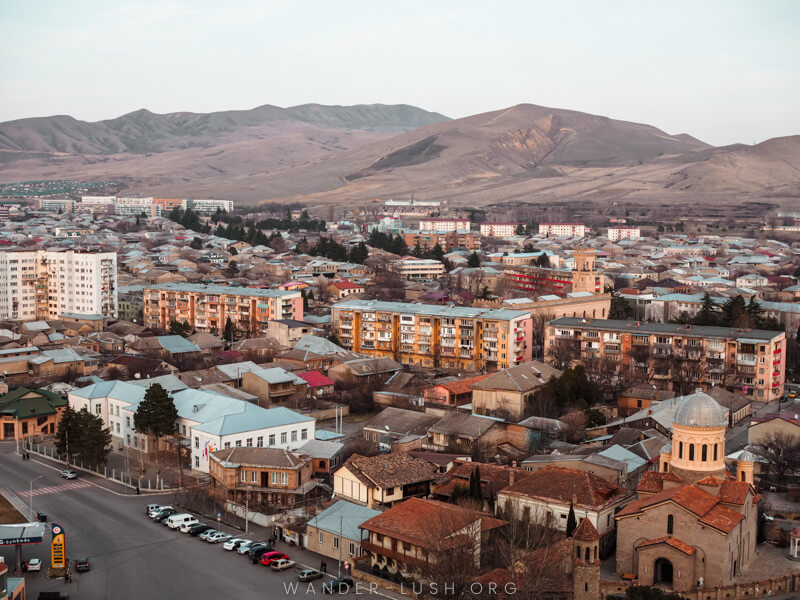
The city recently received funding to restore the Gori Fortress walls and construct an underground castle museum. It’s an ongoing project. For now, visitors can still hike up the hill to wander around the open castle green and climb the walls and turrets for wonderful city views. Some are crumbling and fenced off for safety, so take care and watch your step.
A word of warning: I have never had issues here myself, but recently I have heard several reports of aggressive dogs inside the fortress.
Entrance to Gori Fortress is free, and the area is open 24/7.
3. The Memorial of Georgian War Heroes

There are a number of different paths that wind their way up to Gori Fortress. On the eastern side of the hill, the pathway that starts behind the Church of the Holy Archangels features an interesting sculptural park at its foot.
The Memorial of Georgian War Heroes is the work of Georgian sculptor Giorgi Ochiauri. It was originally erected in the 1980s in Vake Park in Tbilisi before being relocated to Gori in 2009.

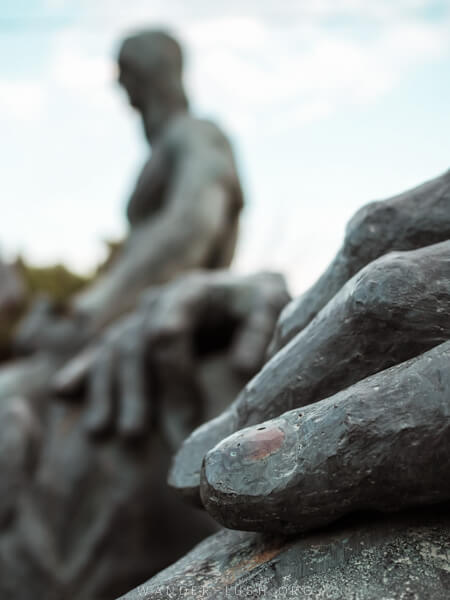
It consists of eight larger-than-life soldiers arranged in a ring formation, each seated on a stone block. Some are limbless. One brandishes a partially shattered sword. Others are faceless, perhaps a tribute to the unknown solider.
None are whole; each one is broken in some way. It’s a stirring memorial to lives lost and forever changed by war, which is especially apt for Gori.
4. Admire the heritage architecture in Gori old town

I certainly wasn’t expecting to find heritage architecture in Gori, so I was taken aback when our guesthouse host, Lia, pointed out Gori old town on her city map.
Located at the southern end of the fortress, the old town takes in the cobbled parts of Kristopher Castel Street and Akaki Tsereteli Street. My favourite facade, the corner building on the right below, is located at 9 Akaki Tsereteli Street.
Here, you can wander through row upon row of beautiful houses and warehouse-like brick buildings. Similar architecture exists in Telavi in Kakheti. Admire the intricate patterns in the brickwork, the details of the aged wooden doors, and don’t forget to look up at the gorgeous Georgian-style latticed balconies.
A few of the buildings feature cupola windows along the roofline, similar to architecture I’ve seen in the Marjanishvili suburb of Tbilisi.


I wish I knew more about the area’s history and who sponsored the restorations (if you have any information, please let me know!). All I can tell you is that several dozen of the buildings have been recently refurbished inside and out, some turned into shopfronts.
Many sit vacant, but quite a few are being used as second-hand shops and sell pre-loved clothing and shoes. If you’re into rummaging for a bargain, this will probably be your idea of heaven.
5. Browse the Gori Bazaar

I’ve never met a market in the Caucasus I didn’t love. Gori’s sprawling fresh produce market stands up among the best and is every bit as interesting as Tbilisi’s Dezerter Bazaar or the GUM Market in Yerevan.
On our first walk around Gori, we stumbled on a flea market on the end of Kartli Street near the Public Services Hall. Here, vendors sell pretty hand-knitted socks and puri bread from the back of their vans. When we returned the next day with Zhana, she led us to the main part of the market, which is actually located on the opposite bank of the river and accessed via a metal bridge just off 26 May Embankment, near the statue.
Gori’s bazaar is a maze of outdoor stalls selling spices, preserves, and all matter of fresh fruit and veg. One lady sold us the most succulent, delicious churchkhela I think I’ve ever tasted!
The undercover part of the market trades in beeswax candles and rounds of farm-fresh cheese. On the far left-hand wall, you’ll find Gori’s go-to pickle vendor. According to Zhana, her small mountains of brightly coloured cabbage, jonjoli and gherkins are unrivalled.
6. Visit the ‘Unofficial Stalin Museum’ on a Soviet Tour of Gori
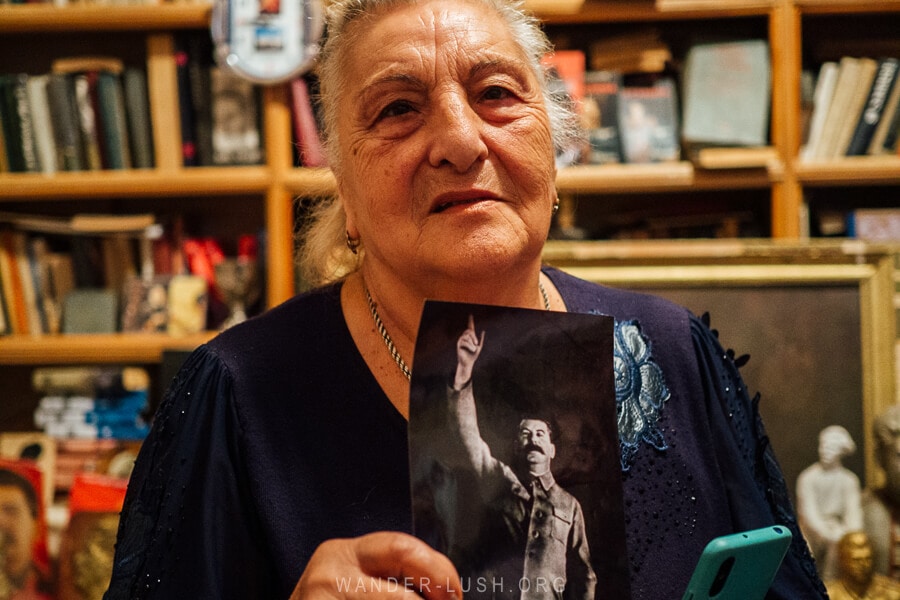
As I mentioned earlier, Stalin’s cult of personality lives on in the hearts of some Gorians – particularly the older generation who look back on the ‘good old days’ of the late Soviet period with a sense of nostalgia.
One Gori local, Nazi – a card-carrying member of the Communist Party since 1968 – has created an unofficial Stalin Museum in one of the bedrooms of her suburban home. She’ll gladly guide you through some of the hundreds of photos, books, documents, medals and Stalin knickknacks she’s collected over the years. She even has a framed effigy of ‘Saint Stalin’ on the dresser alongside her other Orthodox icons.
You can visit Nazi’s home as part of the Gori Soviet Tour, a new itinerary that Zhana of Gori Free Walking Tours has designed. You’ll travel around the city by Lada, with driver Iuri at the wheel, searching for Soviet-era mosaics and bas-reliefs, monuments, historic buildings, and other memories of the Soviet period.

As with her other tour, Zhana aims to offer guests an alternative perspective on Soviet history and a more well-rounded look at Gori. It’s a terrific program and I highly recommend it – Zhana is one of a kind, and you won’t find a tour like this anywhere else in Georgia.
Bookings are essential. Contact Zhana through her Instagram page to save your spot.
Update: Very sadly, Nazi passed away in early 2024. While it is no longer possible to visit her house-museum, Zhana continues to hold her Gori Soviet Tour with plenty of other interesting stops.
7. Scout for retro architecture in Kombinati & Samepo Street

A far cry from the charming brick architecture in the Old Town, there are two more neighbourhoods in Gori that I find particularly interesting to walk around and photograph.
The first, Kombinati, is the old factory district on the western side of the river. Wander down the tree-lined Mshvidoba Avenue, past row upon row of two-storey pink tuff stone buildings. This was clearly a purpose-built workers district with plenty of socialist-style architecture and a very austere Concert Hall.
Apparently there are a lot of abandoned buildings in this district – if you want to explore deeper. You’ll also find one of Gori’s coolest cafes, KeandRa, on this side of the river.
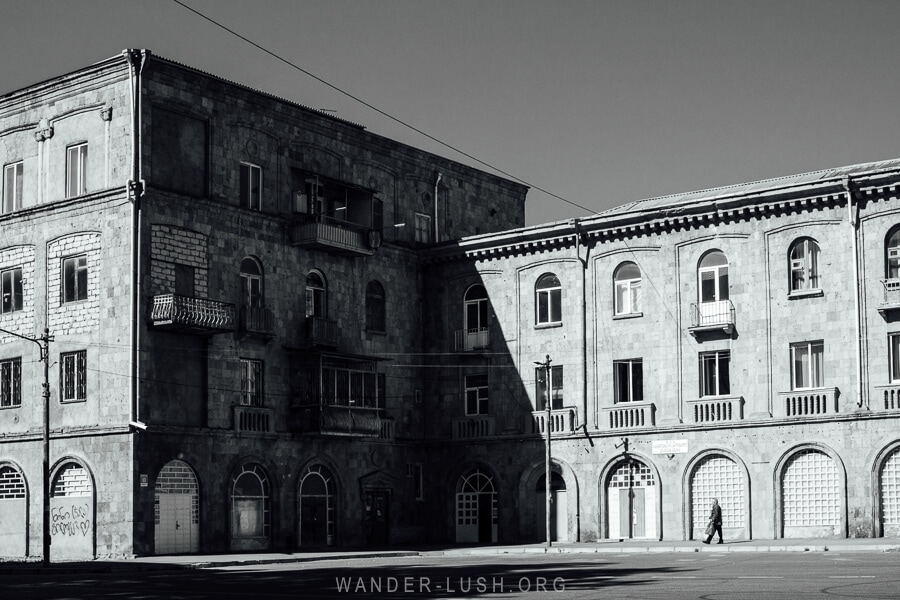
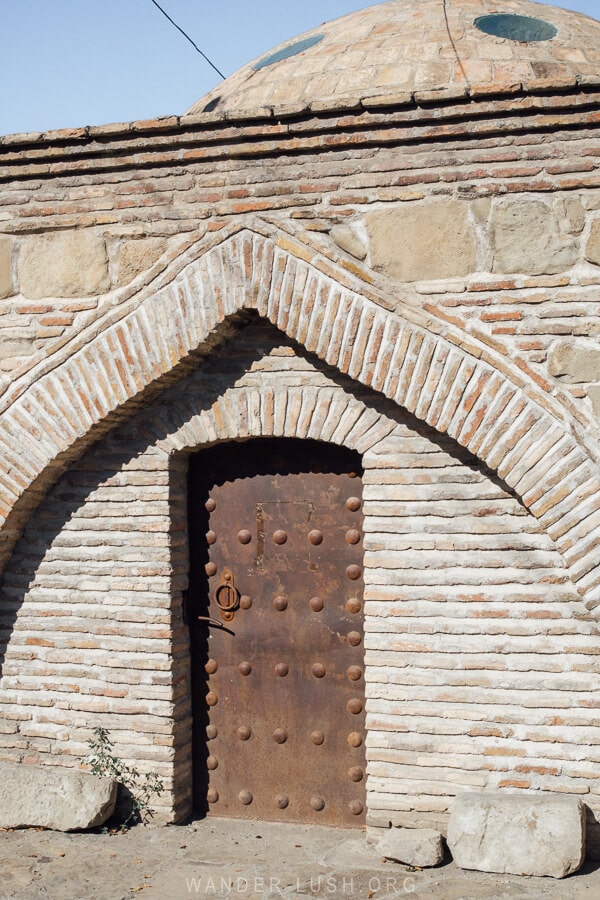
The second district I really love is located directly opposite Kombinati behind the stadium. I highly recommend walking down Samepo Street, stopping to see the old Theological Seminary, the 17th-century Erekle Baths (a bit of Persian architecture in Gori!), and the many intriguing facades.
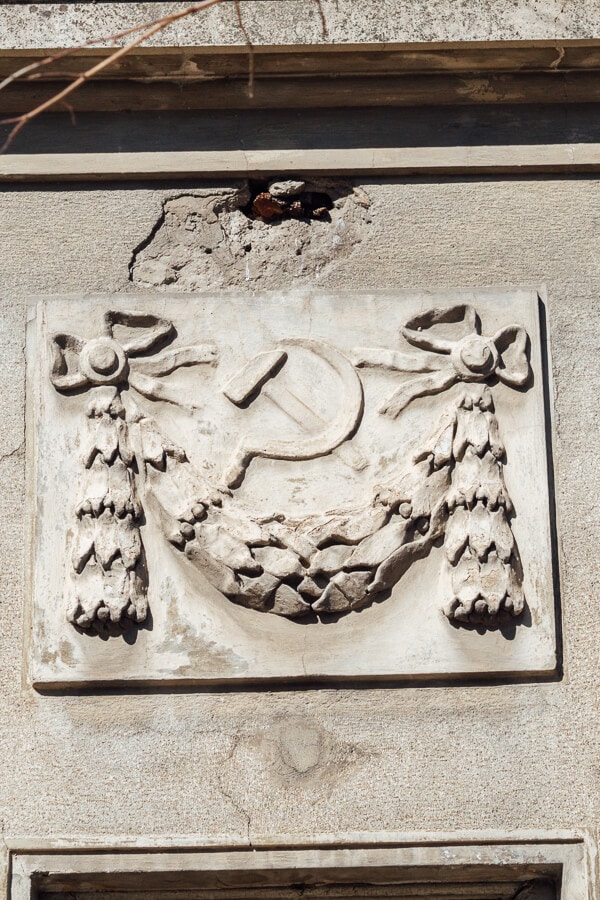
One stone house I saw was a school at some point, but is well and truly abandoned now. It features a delightful combination of ribbon bows and hammer-and-sickle insignia on the facade.
As you walk back towards the fortress, you’ll also see retro apartment blocks, old-fashioned barber shops and newsstands, the abandoned Restaurant Kartli with its original wireframe sign, and a beautiful antique marquee sign that reads ‘Kartli’ in Georgian on one side and Russian on the other.
8. Check out Gori’s street art

There are a few great street art pieces in Gori, including this mural by Tbilisi-based artist Gagosh. Taking up the entire side wall of a building on the corner of Chavchavadze Street and Stalin Avenue, it shows a man and his granddaughter standing under an apple tree and looking out over a barbed-wire fence.
The artwork memorialises the ‘border creep’ that’s currently occurring north of Gori, whereby residents often wake up to find the boundary line that marks occupied South Ossetia has inched a little bit further into their backyard.
Further up the wall, the artist has painted an outline of Georgia and the words ‘The Price of Independence’. There’s also a tiny aircraft dropping shells. Notice that the painter’s canvas is riddled with real bullet holes left from the 2008 occupation.
9. Count the 1001 Georgian Ornaments

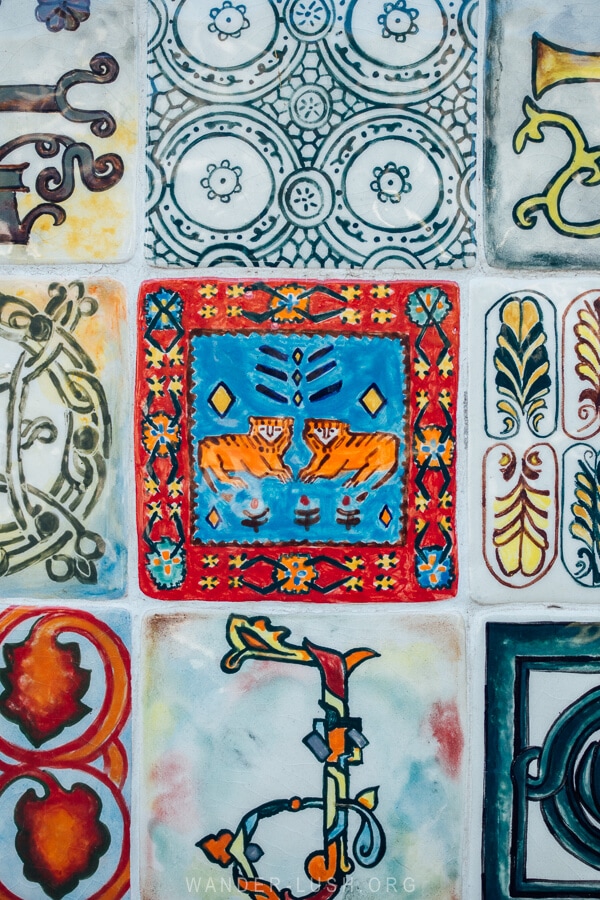
This incredible installation on the outside of the Gori Sports School was created in 2021 by local artist Irina Shotadze. With the help of a USAID Zrda grant, Irina purchased a new firing kiln for the project – and boy did she certainly put it to good use!
Each of the hand-painted tiles – all 1001 of them – is decorated with a different symbol related to Georgian history or culture. Some have stylised letters of the alphabet, others bear images of religious icons or lurji supra ornaments. My personal favourite is the one with the pair of lions, a common motif in Kakhetian wool carpets.
AdLooking for the best online services?
Explore top-rated platforms and secure your discount before it expires.
Irina’s studio, Keramos Georgia, often appears at pop-up markets in Tbilisi.
10. Shop for Gori pottery at Giorgi Tatulashvili Ceramics Studio

Giorgi Tatulashvili is widely considered Gori’s premier ceramics artist – you can see his works at the Ethnography Museum, and find them sold at gift shops in Tbilisi, including Craft Shop.
Giorgi specialises in yellow, purple and blue glazed ceramics, a style that is particular to Gori and very different to pottery traditions in Western Georgia. Wine jugs and tableware are inspired by old drinking vessels and other objects from antiquity. Giorgi is well-known for his deer, a symbol of Gori that references pre-Christian pagan beliefs (the antlers brought you closer to heaven!).
Giorgi works from his family home in the centre of Gori, throwing clay on a small wheel and using his grandfather’s 19th-century kiln to fire off the finished product. The studio is open to visitors by appointment. For those who are interested, Giorgi also hosts pottery masterclasses. You can shop ceramics here too, with prices ranging from 15-300 GEL for larger pieces.
11. See a contemporary exhibition at Art House

Art House is a contemporary gallery and installation space run by the Gori Photographers Club. The venue, the distinctive curved building at the foot of Gori Fortress, right by the monument, served as the Castle Museum during the Soviet period.
The building was abandoned and wrecked a-la Tskaltubo. After months of hard work, staff turned the walls from grimy to gallery white, and Gori finally had a place for young and emerging artists and photographers to display their works.
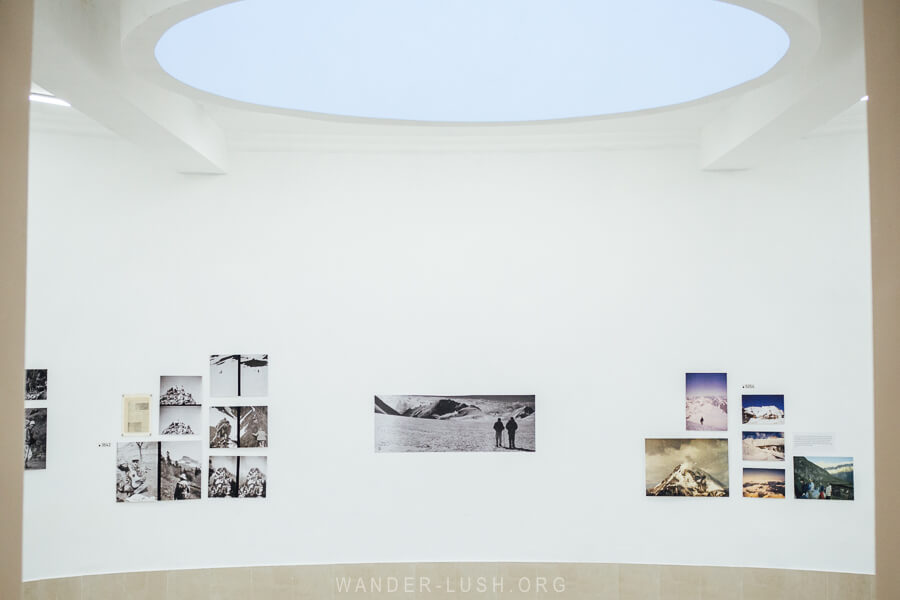
At the time of my visit, there was a photography exhibit about the Gori Mountaineers and Travelers Club on show. Art House regularly hosts installations and special events in the evenings, so keep an eye on their Facebook page for announcements.
Art House is open from midday until 7pm daily with free entry (donations are welcome).
12. Visit an alternative museum

Aside from the Stalin Museum, there are several other institutions in Gori that document lesser-known chapters of the city’s history.
The first is the Great Patriotic War Museum. Dedicated to WWII and the Red Army Victory, it displays war medals, Nazi memorabilia, and artillery. Of course there are some Stalin references here too: A statue, some banners, and most curiously a Stalin profile carved from a giant block of white sugar.
The most interesting exhibit is a collection of photos taken in Gori during the so-called Five Day War. You can even see what’s left of several bombs that were dropped on Gori during the conflict.
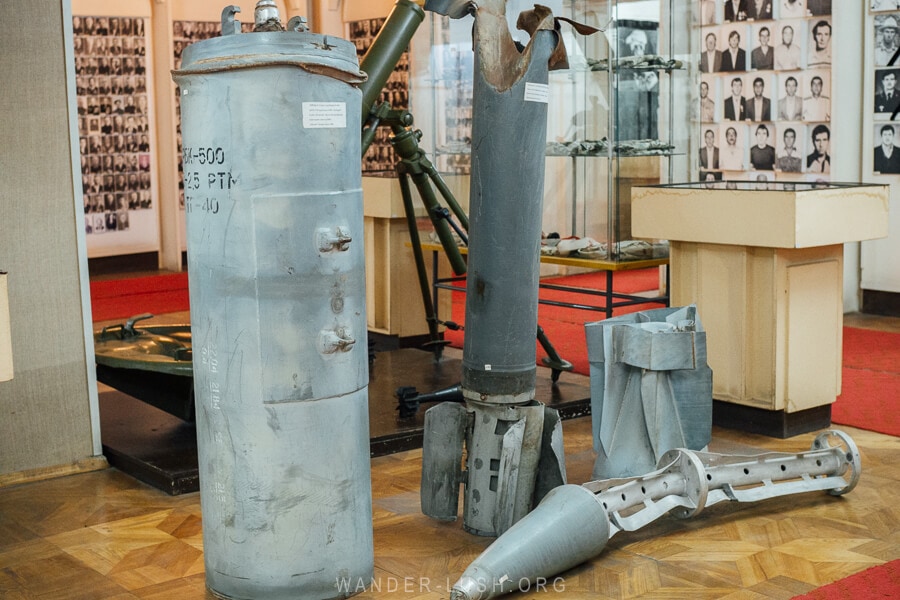
The second museum, the Gori Ethnographic Museum (also known as the Sergi Makalatia Museum) houses a collection of pottery, textiles and other relics salvaged from the fortress and found in the countryside around Gori. The numismatics exhibit, which was funded by USAID, is very well curated and definitely worth seeing.
The Great Patriotic War Museum is open Tuesday to Sunday (closed Mondays) from 10am until 5pm and costs 3 GEL. The Ethnographic Museum is open from 9.30am-5.30pm Tuesday to Saturday (closed Sundays and Mondays) and costs 10 GEL.
13. Step inside Gori’s Virgin Mary Cathedral


Built in 1810 at the foot of the hill, Gori’s most important church was heavily damaged in the 1920 earthquake, but has since been restored. At dusk, the cupola shimmers on the city’s skyline.
The Virgin Mary Cathedral is a functioning Orthodox church, with daily masses and a constant stream of lone worshippers moving through the yard to light candles.
It’s worth popping in to see the interior, which is a lot brighter than most Orthodox churches in Tbilisi. Vivid frescoes line every wall and are currently being restored.
14. Track down Gori’s secret synagogue

If you join Zhana for the Free Walking Tour, put in a special request to visit Gori Synagogue. You can only go inside as part of the tour and if you call ahead.
This is truly one of Gori’s most unique attractions. The tiny synagogue is hidden inside a suburban house on a quiet road beneath the fortress. Looking at the house and gate from the street, you would never guess what’s inside.
Georgian Jews have a long (2,600-year-plus) history, but with only a few thousand believers left in the country, the Jewish community is largely hidden from view. Unlike in Kutaisi, Oni or Akhaltsikhe, there are still enough Jewish families here to keep the synagogue running.
Gori’s only Jewish assembly hall can accommodate up to 100 worshippers (interestingly, women sit separately from the men in an upper gallery). With no rabbi, members of the community take on the duties. No one can read or write Hebrew, so the Torah is written out phonetically in Georgian characters.

Underneath the house, there’s a second decommissioned synagogue with a much smaller hall. A piece of ancient-looking machinery used to make matzo bread sits forlornly in the corner, covered in cobwebs. This was once the epicentre of matzo bread production for the entire region, but the hand-operated machine has been out of commission for a while.
Speaking to a few members of the synagogue through Zhana, it seems the future of the prayer hall is unknown. It’s really quite remarkable that they’ve managed to keep it running for all these years without a rabbi – and inside a private residence, no less.
Please note: The synagogue is not accepting guests at this time.
15. Drive (or hike) to St. George’s Church for a magnificent view

Perched 600 metres above the city on the opposite bank of the Mtkvari river, St. George’s is the most impressive house of worship in Gori.
The church itself is modest (and usually locked up anyway), but like Gergeti Trinity in Kazbegi and Jvari in Mtskheta, it’s all about the views. From the yard, you get an incredible 360-degree panorama of Gori and the river basin.
St. George’s was originally built in the 12th century but was razed by the Ottomans during an invasion. The 1920 earthquake wiped it off the map for a second time, then a third church, the one that endures today, was built in the 1980s.
It’s a revered site. Twice a year, locals make a pilgrimage up the hill to pay their respects to the nation’s patron, St. George.

To get there, you can either walk 5km from the centre of town (the final ascent is a steep incline up a totally exposed hill), or take a taxi from outside Chinebuli restaurant. Drivers charge around 25 GEL to go up and back with a long pause at the top.
At the bottom of the hill, the village of Gorijvari is home to several sodium mineral water springs. In the season, you can stop off for a therapeutic bath!
16. Pop into Gori Railway Station

Gori’s railway station is an important hub on the cross-country train line. Every day, dozens of Soviet-era locomotives and newer trains chug through the station.
What makes this station famous, though, is the Stalin statue in the waiting room. Remember the statue that was removed from the front of the government building? Well, this isn’t it – but it’s one of many other Stalin effigies you can find around the city (there’s also one made from sandstone in front of the Stalin Museum).
The waiting room is now barricaded off with a big ‘NO ENTRY’ sign – probably to keep tourists like me out. You can snap a photo through the glass door if you wish. When you sign up for Zhana’s Soviet Tour, you get to go inside.
While I wouldn’t go out of my way to visit Gori Railway Station, if you happen to be on the other side of the river, it’s worth a peek.
17. Grab an iced coffee on the avenue
A favourite pastime in Gori is grabbing an iced coffee (and maybe a slice of cake) on the main avenue. Cafes with French-inspired names (L’Avenue, Champs-Elysees) line the eastern side of the street, looking out over the long park that runs through the city centre.
Cafe 22 is my personal favourite. They serve great coffee and a good local breakfast, and there’s a pastry shop attached to the front of the cafe.
An interesting side note: A few years ago, Zhana was part of a group of young people who petitioned to have Gori’s main street (Stalin Avenue) renamed. They were unsuccessful. So for now, if you’re a Gori local, you still rendezvous with your friends on Stalin Avenue.
18. Try Gorian cutleti, a local food specialty

Cutleti is served in restaurants all over Georgia (including in Tbilisi and Kutaisi). Here in Gori, it’s a regional specialty, and chefs take it to the next level.
If you’re not familiar with this meatball-like creation, it’s essentially a croquette made from minced beef and pork. Gori cutleti are pointed at both ends and are served in large portions with mashed or fried potato and a delicious homemade spiced tomato sauce called pamidvris satsebeli on the side.
This is real comfort food – it’s spicy, oily, filling, and usually very cheap. If you’ve eaten at Bikentina’s Kebabery in Kutaisi, you’ll find many places in Gori have a similar no-frills ‘worker’s lunch’ feel.
My favourite Gori cutleti is served at – wait for it – Dzmobis Duqani or Gori Cutlet, a humble, dimly lit restaurant on Tsamebuli Street that specialises in the dish.
Berikoni in the old town and Chinebuli, Gori’s most popular restaurant located opposite the Stalin Museum, also serve good cutleti.
19. Eat a home-cooked meal at Shin da Gori
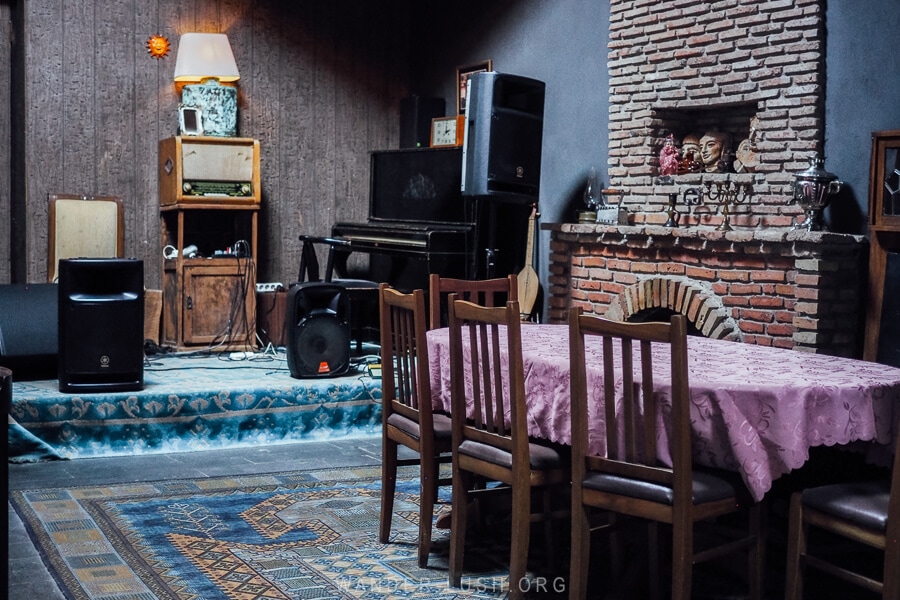
Apart from cutleti joints, Gori has a few good Georgian restaurants that you should save some room for. Shin da Gori is absolutely my favourite – it has a really unique atmosphere.
The obscure location down a quiet suburban street makes it feel like a real hidden gem, although it was quite crowded with local families on the night we visited. (It can be tricky to spot, follow the sign from the main street down the alleyway.) In summer, you can sit in the outdoor area with an open view to the kitchen. In winter, there’s a cosy dining room furnished with beautiful antiques.
The ambiance is really special, particularly if there’s live music on. Food is hearty and home-cooked – we especially loved the barbecue pork (mtsvadi).
20. Catch a show at the Eristavi Theater

When it opened, George Eristavi Gori State Drama Theater was the first professional theatre in all of Georgia. During the occupation, the theatre continued to stage Georgian language productions, thus playing an important role in keeping the culture alive.
Today, the theatre still hosts regular shows, including an annual comedy festival and a few contemporary productions (Zhana told us about one play where a German tourist and a guide at the Stalin Museum end up getting into a fight over the Soviet leader’s height).
If you’re interested in seeing a show, you can view the schedule on the theatre Facebook Page or just buy tickets directly from the theatre box office.
If there’s nothing on, it’s still worth going inside to see the interior, with its lime-green moulding and plum seats (interestingly, the colour scheme mirrors the waiting room at the railway station). There’s also a small museum dedicated to the decorated actors and actresses who have graced the stage over the years.
BONUS: Take a side trip to Uplistsikhe Cave Town & Khidistavi wine region
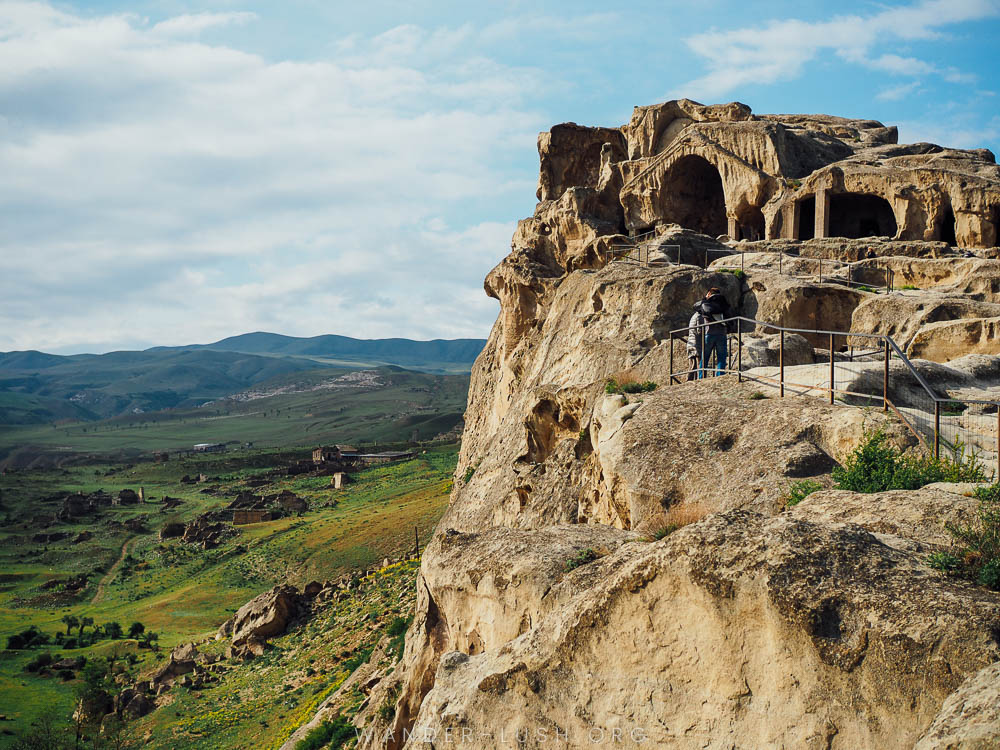
I’m calling this a ‘bonus’ because these two spots are not technically located within Gori, but rather a short 20-minute drive from town.
Along with Vardzia and David Gareja Monastery, Uplistsikhe is one of several ‘Cave Towns’ in Georgia. At its peak, up to 20,000 people lived in the chambers hewn from the rocky cliff.
A taxi from Gori to Uplistsikhe and back costs around 50 GEL including wait time. It takes around 60-90 minutes to see Uplistsikhe. The complex is open every day (including Mondays) from 10am until 6pm. Entrance costs 15 GEL per person. I recommend taking the optional audio guide for 15 GEL.
Check out my guide to visiting Uplistsikhe for more helpful tips.

A good place to stop on the way back from Uplistsikhe is Khidistavi, where there are a number of vineyards. My top pick for a Kartli-style wine tasting is Gogi Dvalishvili Wine Cellar. Host Tengo offers a wonderful family cellar experience – interestingly, marani in this part of Georgia are located inside the house, different to the outdoor cellars used in Kakheti.
If you visit in early autumn (usually the first few weeks of October), you can take part in the Rtveli grape harvest, which always happens a few weeks later here than in the east of Georgia.
Gori map

Click here to open the interactive Google Map.
How to get to Gori from Tbilisi
Gori is connected to Tbilisi, Kutaisi and several other towns and cities in Georgia by marshrutka minivan and rail. The most convenient and comfortable way to travel is by private GoTrip transfer or shared taxi from Didube.
Tbilisi to Gori by marshrutka or shared taxi
Marshrutka vans to Gori depart from Tbilisi’s Didube Bus Station approximately every 15-20 minutes between 7.30am and 7.30pm. Tickets cost 5 GEL, and travel time averages 60-75 minutes.
Gori vans leave from a different part of Didube that can be tricky to locate. Once you alight the metro at Didube, exit from the underpass to face the market then immediately take a hard right down the alleyway alongside the train tracks.
This will bring you to the Gori bus terminal area. The exact location is here and for reference, it looks like this:

Purchase a ticket from the cash desk (note that the price has increased since I took this photo):


And the attendant will direct you to the next available van.
Once in Gori, most drivers no longer stop at the Stalin Museum or old bus station – they terminate at Gori Bus Station, which is located 2.5 km north of the centre (a 2-3 GEL taxi ride). For this reason, I recommend you take a shared taxi from Didube instead.
Shared taxis cost 7 GEL per person and also depart from Didube. You’ll see them as soon as you exit the metro, directly in front of this Aversi pharmacy:

You will have to wait for the car to fill up, but this is a popular route so it shouldn’t take long. Travel time to Gori is the same (or slightly faster) and once there, the driver can drop you off right in front of the Stalin Museum or at any other address in the centre of the city.
Private transfer from Tbilisi to Gori with GoTrip
If you prefer the comfort and safety of a private vehicle, a car and driver booked through GoTrip costs around 120 GEL. The fare is about the same whether you travel one-way or return to Tbilisi. You can add on a stop at Uplistsikhe or even a stop in Mtskheta for a few extra GEL. The price is fixed, payable in cash to the driver, and you can make extra photo stops along the way without the fare changing.
If you want to visit both Gori and the cave city and/or Mtskheta Jvari in a day, GoTrip is by far the most convenient option.
Train from Tbilisi to Gori
There are at least two trains from Central Railway Station in Tbilisi (Tbilisi-pass) that stop in Gori, including the morning trains to Ozurgeti and Kutaisi. The ride takes 1 hour and 20 minutes, and tickets cost 8-12 GEL. Use TKT.GE to search timetables and buy your tickets online.
Gori Railway Station is on the opposite side of the river in the southern part of town, around 30 minutes by foot from the Stalin Museum.
A taxi should cost 2-4 GEL. You can use the Bolt app in Gori, but there are limited drivers so you might need to download an alternative app (Maxim) as a backup or flag down a regular taxi instead. Make sure you negotiate the fare before you set off.
Tbilisi to Gori day tour
If you only have time for a quick visit to Gori, an organised day tour from Tbilisi is another option. Most companies only visit the Stalin Museum – so of course this will limit how much of Gori you get to see.
If you do decide to join a tour, my preferred provider is Friendly.ge. They have wonderful guides, good cars, and their itineraries are well-paced. Check out their private tour to Mtskheta, Uplistsikhe and the Stalin Museum and use the promocode wanderlush to get 10% off.
Returning to Tbilisi from Gori
To get back to Tbilisi from Gori by road, take a marshrutka van or shared taxi from Gori’s main bus station in the north of the city (location here). To get to the station from the centre, take a Bolt taxi for 2-3 GEL. You might also be able to find shared transport from the old bus station area in the carpark near the Public Service Hall (location here).
The fare and travel time back to Tbilisi is the same. For safety reasons, you should avoid travelling on the road after dark.
If you plan to visit Mtskheta next, you have the option to jump out of the van on the highway before Tbilisi. You’ll then need to take a taxi the rest of the way to town. Your driver will assist you with this.
If you’re staying in Gori, your guesthouse host will be able to organise a shared taxi or private car for you if you prefer. You can also book a one-way GoTrip transfer back to Tbilisi for around 120 GEL.
There are at least two trains that stop in Gori on their way to Tbilisi, usually departing around 4pm. Check times and buy tickets (8-12 GEL) on TKT.GE.

Georgia Essentials
Here are the websites and services I personally use and recommend for Georgia. Check out my full list of travel resources for more tips.
TRAVEL INSURANCE: Insurance is now mandatory for all travellers to Georgia. Insure your trip with HeyMondo, my preferred provider for single-trip and annual policies. Get 5% off when you book with my link.
AIRPORT TRANSFERS: Most flights into Georgia arrive in the early hours. Airport taxis should be avoided at all costs. For ease, pre-book a private transfer from Tbilisi Airport to your hotel or from Kutaisi Airport to Tbilisi with my partners at GoTrip.ge.
SIM CARD: Magti is my preferred provider, with prices from 10 GEL/week for unlimited data. See this guide for all the details about buying a Georgian SIM card.
ACCOMMODATION: Booking.com is the most widely used platform in Georgia. Use it to find family guesthouses, private apartments, hostels and hotels around the country.
CAR HIRE: Find a great deal on a rental car in Georgia – use the Local Rent website to book through a local agent (prices start from $30/day).
PRIVATE TRANSFERS: GoTrip.ge is a terrific service for booking a private professional driver and car for the day. Use it for A-to-B transfers, a customised round-trip itinerary, or a multi-day trip. You can stop wherever you like for as long as you like without the fixed price going up.
DAY TRIPS & CITY TOURS: Use Viator or Get Your Guide to browse a range of day trips and city tours. For alternative itineraries with expert guides, I recommend Friendly.ge. Use the promocode wanderlush for 10% off.
WINE TOURS: For in-depth day trips to Georgia’s wine regions, I recommend Eat This! Tours. Use the promo code wanderlush for 5% off.
Things to do in Gori, Georgia: Bookmark it


You might also be interested in…
- The ultimate Georgia itinerary: Four detailed & custom-designed itineraries
- Georgia Travel Guide: All of my 200+ posts plus my top travel tips
- Georgia travel tips: 25 essential things to know before you go
- Places to visit in Georgia: 50+ unique & underrated destinations around the country
- The best things to do in Tbilisi: Favourites, hidden gems & local picks
- 35+ best restaurants in Tbilisi: Where to eat Georgian food
- 15 best day trips from Tbilisi: With detailed transport instructions
- The best time to visit Georgia: Month-by-month guide to weather, festivals & events
hi Emily
we visited the Gori Fortress today 24 Sept 25 and the only dog we encountered was a very calm sleeping dog just outside the guards box inside the fortress.
amazing views!
Thanks Cindy for the update! Perhaps someone has encouraged the problematic dogs to move on. I’m glad you enjoyed it!
Gori fortress. I highly recommend you leave a warning on this post about the dangerous dogs here. I was bitten and have been told it is a common occurrence. Recommend you don’t go inside, and stay away especially if you have children.
I’m so sorry to hear that, Curtis. I hope you are okay! I have added a bolded note in the post. Thank you for the important update.
Hi Emily,
Thanks for the great guides, they helped a lot with planning our trip.
I have one question, do you know of a luggage storage place in Gori, there is not much available online?
Thanks in advance.
Elena
Hi Elena, your best bet would be the railway station.
Hello Emily,
I have great fun by reading your guides in Georgia. I will be travelling to Georgia in Feb 2024 with my family of four. We are planning to drive by our own from Tbilisi to Gori, Georgian Military Highway to Kazbegi and then to Sighnaghi in 14 days. But it seems like mostly tourists are travelling either by shared taxi or private driver. The guiding apps that we are using is Google Map, and my question is Google Map workable in Georgia’s road? Of course, it’s winter time, so we will keep off the road before dark.
Hi Rachel, sounds like a great trip! Google Maps is perfectly fine for navigating, that is what I always use myself.
Hi Emily, this is our first visit to Georgia and your information has been fantastic thank you! I am looking to stay in Gori for a few days, but can’t find any information about how to then get from Gori to Kutaisi. Do you know if there is a marshrutka, or should I get the train? Unfortunately we don’t have the budget for private transfer. Thanks Zillah
Hi Zillah, thanks for your comment! There are definitely direct vans from Gori to Kutaisi, I don’t know how many or at what time, but you can check at the bus station when you arrive.
Hi, Emily, great post.
I have read in oter web that to go from Kutaisi to Gori buses left you at the motorway, not in the city center.
Is it still true? there is no way to go to Gori’s center from Kutaisi by bus ?
Then, from Gori to Tblisi, are there buses from city center?
Thanks
Hi Carmen, I believe there is one van that goes to Gori Bus Station at around midday. Otherwise yes, you have to disembark on the highway (I have done it before, usually there are other passengers so it’s fairly easy to figure out).
I highly recommend taking the train from Rioni instead, though – it stops at Gori Railway Station which is more conveniently located compared to the bus station out of town or the highway. From Gori, buses depart from the bus station.
Thanks, Emily
Rioni is a city? I didn’t find it
Rioni is the name of the railway station, it is around 15 minutes south of Kutaisi near Geguti village.
Hi Emily, we have come From Kutiasi to Gori until the autoroute, as you se¡aid.
Now, to go to Tblisi, Minibuses part from central Bus Station in Central Bus Station, in Chavchavadze Avenue, Gori?
Because I see ther are other bus station at 2436+74F Gori Bus Station, Tskhinvali Highway, Gori.
Thanks
Hi Carmen – the station on Chavchavadze has closed. There might be a few vans there for Tbilisi, but otherwise you will need to go to the main bus station.
Hi Emily. I´m planning to go the opposite direction as described in your reply to this comment, but I am struggling to figure out what will be the best way to travel. What is the most conveniant way to go from Gori to Kutaisi if you travel on a budget?
Hi Anders – just go to the bus station in Gori and ask around. There will be marshrutka vans to Kutaisi throughout the day.
Hi Emily,
Thanks for all your posts! They have been so useful in planning my upcoming trip to Georgia. I am wondering the best way to get in touch with Giorgi Tatulashvili to arrange a studio visit? The email I have found online bounced back.
Thanks!
Hi Annick, the best option is to send him a message on Facebook (his page is called ‘George Tatulashvili Ceramics’), or if you are doing either of the tours with Zhana, mention it to her and I’m sure she will be happy to give him a call.
Enjoy your visit to Gori!
‘
Hi, love your blog! I am visiting Georgia in May and am probably going to use Go Trip most of the time. I am a pretty quick traveller and don’t mind early starts and long days, and don’t usually stop for lunch. I just like to see as much as possible.
Do you think it’s possible therefore to do the following in one day using Go Trip (given opening times etc.):
– pick-up in Tbilisi hotel
– Uplistsikhe for opening time
– Stalin museum
– Mgimevi convent
– Chiatura cable car
– Katshki column
– Arrive in Kutaisi hotel
All advice is appreciated
Hi Ella, thanks for your comment!
It is definitely a lot to fit in, but I think it’s possible.
Uplistsikhe opens at 10am and takes around 1.5 hours to see, the Stalin Museum around 45-60 minutes, then the drive to Chiatura takes around 1.5 hours if your driver takes the new road through Sachkhere. Chiatura, Mgimevi and Katskhi are all fairly quick stops. Remember most of the old cable cars in Chiatura have been dismantled but you can ride the new ones.
I hope this helps. Have an amazing trip!
Hello
W.r.t. transportation, in September 2022, I paid 7 lari for a shared taxi from Tbilisi, and 5 lari for a mashrutka back to Tbilisi.
People should ask *before* paying for the ticket for the Stalin museum whether there is a tour in English that day, I made the mistake of asking after and there was none…(and the museum is really useless without a guide)
Thank you for your blog which helped me a lot to plan my trip in Georgia. Thanks to Zhana for her tour and to you for mentioning her.
That’s strange – as the guide is included in the ticket price now, I thought every visitor had to be accompanied by a guide. We didn’t think to ask on my last visit, we just had a guide assigned to us. What time of day did you visit the museum?
Thanks very much for the information!
Thank you, Emily “Wander-lush,” for a thoroughly wonderful review of all that Gori has to offer. And thanks, too, for featuring Zhana Odiashvili. She is a caring, committed, knowledgeable guide with the perspective of a Gori native who was there during her city’s darkest hour. I have taken Zhana’s one-day tour and now you have given me many more reasons to return to Gori!
I couldn’t agree with you more, David – Zhana is a very special person and I’m so glad you got to meet. I hope you do manage to return to Gori! Enjoy the rest of your time in Georgia!
Hi Emily, (and Kendra)
Shin da Gori is indeed still in business, ate there yesterday. Nice place to sit outside, side note vegan options available.
The central bus station in Gori looks closed at the moment (June 2022): cited text “To get back to Tbilisi from Gori by road, take a marshrutka van or shared taxi from Central Bus Station in the centre.” So we took a Bolt taxi (2,3 lari) to the Gori bus station which is more north of the city. From there you’ll find plenty of Marshrutas to Tbilisi (3 lari a person). Maybe useful information to add: we went to Mtscheta from Gori. You take the marshruta to Tbilisi, but you can ask the driver to drop you off at “Mtscheta steps”, a place along the highway to Tbilisi. From there you can take a (Bolt) taxi to the town centre.
Thank you for the great website with tips and tricks. Makes our trip in Georgia way more comfortable and fun.
Thank you so much for the transport tips, Maurits! I have updated this information in the post.
Hey! Just got to Gori and have really found your guide helpful. Unfortunately, the restaurants you mentioned are closed and look like they’ve been closed for quite some time. Tried Shin da Gori tonight and it was abandoned. 🙁
Hi Kendra! Glad to hear that!
I try to update these guides regularly – that’s unusual because Shin da Gori is definitely open (I just confirmed with them on Facebook and also with a friend who lives in Gori). It looks like they had live music last night based on their posts… Maybe give it another try today?