‘Urban revitalisation’ has a special meaning in Tbilisi, where scores of old factories, printing houses, subdivided palaces and cavernous warehouses lay in wait for a loving touch to turn them back into useful spaces.
There are some terrific examples of forgotten real estate reclaimed and returned to the public – as art spaces, dining precincts, museums, hotels, or maybe even as a nightclub!
While it’s true that virtually every building in Tbilisi has a fascinating backstory (including most landmarks on Rustaveli Avenue), there are some that stand out amongst the restored and revived. Most are survivors of the Soviet period or remnants of the Russian Empire.
Here are 13 fascinating reclaimed spaces in Tbilisi that are open to the public, with their brief histories and the reasons why they are worth visiting today.
If you know of any spaces I’ve missed, please drop me a note in the comments below!
Please note: This post contains affiliate links, meaning I may earn a commission if you make a purchase by clicking a link (at no extra cost to you). Learn more.
Fabrika: A Soviet sewing factory turned hostel & creative hub
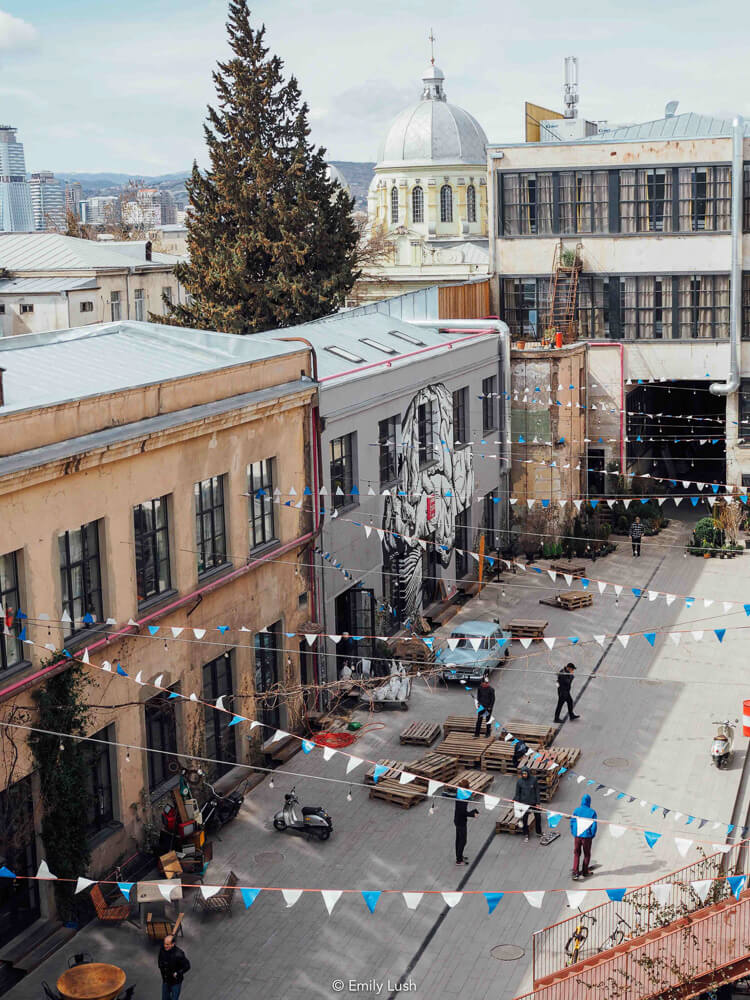

Tbilisi’s most famous hipster hangout, Fabrika kick-started the trend of repurposing old buildings when it opened its doors back in 2018.
The multi-storey factory in Chugureti district was a clothing factory back in the Soviet era. Half-painted turquoise walls, framed archival photos and an impressive astrological-themed bas-relief above the front door survive as reminders of the past, while the rest of the interior has been completely transformed with the help of colourful carpets and retro furniture.

Fabrika is a multi-purpose creative space with a hostel-hotel on the upper levels, and a lounge-style bar and cafe on the ground floor. Out back, the Fabrika Courtyard houses a bevy of cool boutiques, specialty coffee shops and bars, a ramen shop, a barber, and a board games club.
One of the residents, Flying Painter, even sold a capsule collection of dresses sewn in the old factory and recovered during the renovations.
Fabrika regularly hosts film screenings, special events and pop-up markets, including one of Tbilisi’s Christmas fairs.
Satburi: An orangery transformed into a nightlife precinct

Located on the edge of Mushtahid Garden, Satburi (‘Greenhouse’) is a new dining-creative precinct on Tbilisi’s Left Embankment.
The park has been in constant use since the 1950s, with a very-Soviet children’s railway, a performance theatre, and the Caucasian Sericulture Station located on its territory. The main building, designed by Alexander Szymkiewicz in 1892, is now the State Silk Museum, one of Tbilisi’s must-visit museums.
In 2022, a set of lifeless orangeries at the north-west corner of the park were rehabilitated and a new crop of restaurants, bars and artists were invited to inhabit the beautiful glass A-frames.
Mushtahid park was first established in the 1830s by Mir-Fatah-Agha, a Shia cleric and respected member of Tbilisi’s Muslim community who hailed from Tabriz. The garden fell under state control in 1853 and became an agricultural farm before it was opened to the public five years later.
Wine Factory N1: From bottling vino to mixing cocktails
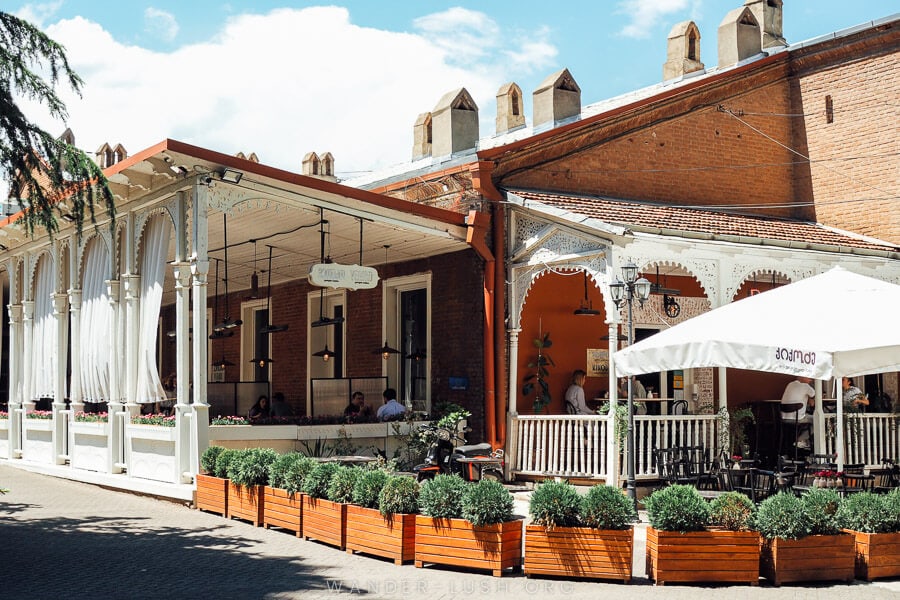
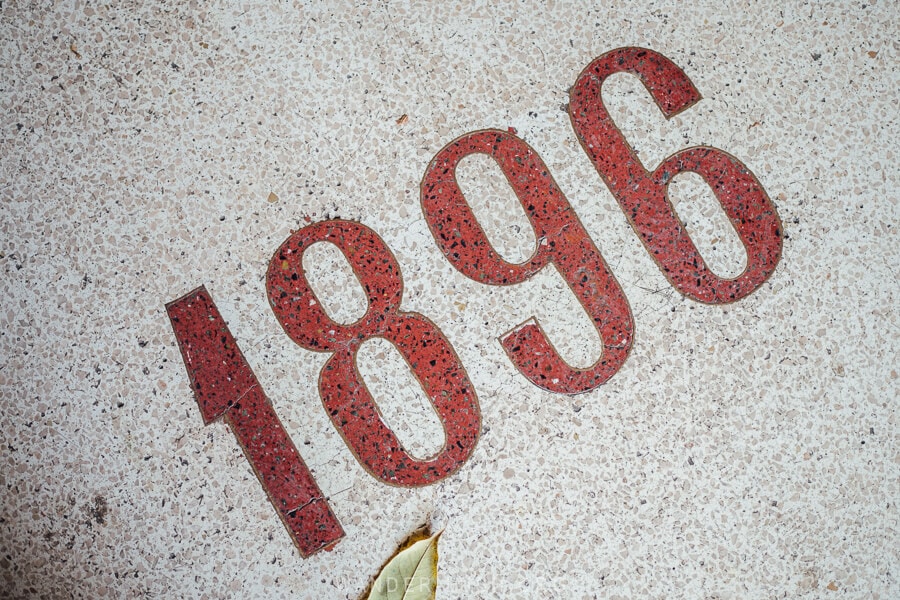
Designed in 1894-96 by Russian architect Alexander Ozerov and financed by Georgian brandy baron and philanthropist David Sarajishvili, Wine Factory N1 (AKA Ghvinis Karkhana) was a major centre of wine production when Georgia was part of the Russian Empire and Soviet Union.
After sitting abandoned for decades then changing hands a dozen times, the building – a designated Cultural Heritage Monument – finally reopened to the public in 2017 as a dining and entertainment destination.
As well as a collection of wine bars, Wine Factory has classy cocktail lounges, a slew of excellent contemporary Georgian restaurants – my top picks are Shushabandi and Holy – and a cooking school.
Reminders of Wine Factory’s past – old wine barrels repurposed as pop-up bars, preserved Soviet-era mosaics and beautiful embossed metal doors – dot the grounds. Be sure to have a walk around and see what other treasures you can find.
The Writers’ House of Georgia: A private mansion co-opted into a literary hub, cafe & museum for the people
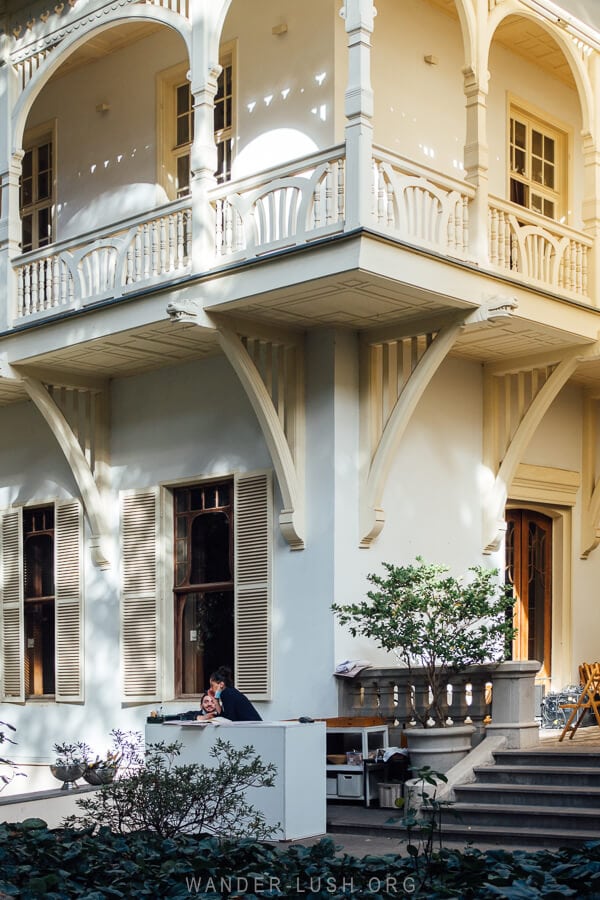
Also connected to David Sarajashvili, this Sololaki stunner was built in 1905 as a private residence. On February 28, 1921, just three days after the Georgian Soviet Socialist Republic was established, the owner bestowed the Art Nouveau house to the city’s writers and artists.
Since 2008 it has been known as The Writers’ House of Georgia, an open institution and coalition of authors and artists charged with popularising local literature. The building has meeting rooms, a Museum of Repressed Writers, and the popular courtyard Cafe Littera.
Five guest rooms named after different authors connected to Georgia can be rented by the night.
Stamba: A boutique hotel, cafe & photography gallery inside a Soviet-era printing house
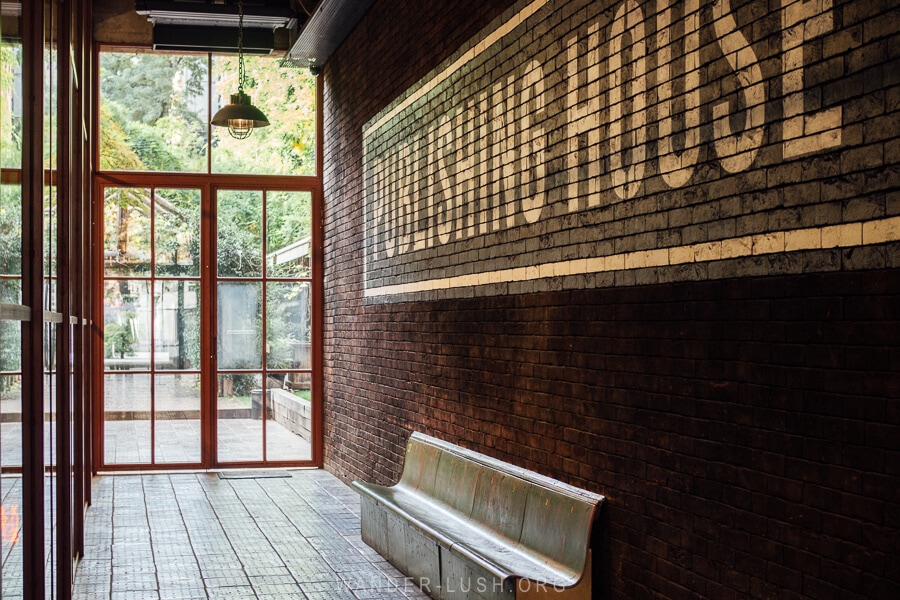
The same team behind Fabrika (and Rooms Kazbegi, among other projects across Georgia) took over this gigantic building on Merab Kostava Street in 2018.
In a previous life, the creative-commercial complex was a Soviet publishing house (Georgia’s first state newspaper was printed here). The Brutalist five-storey lobby retains its original concrete drying beams and suspended printing equipment.

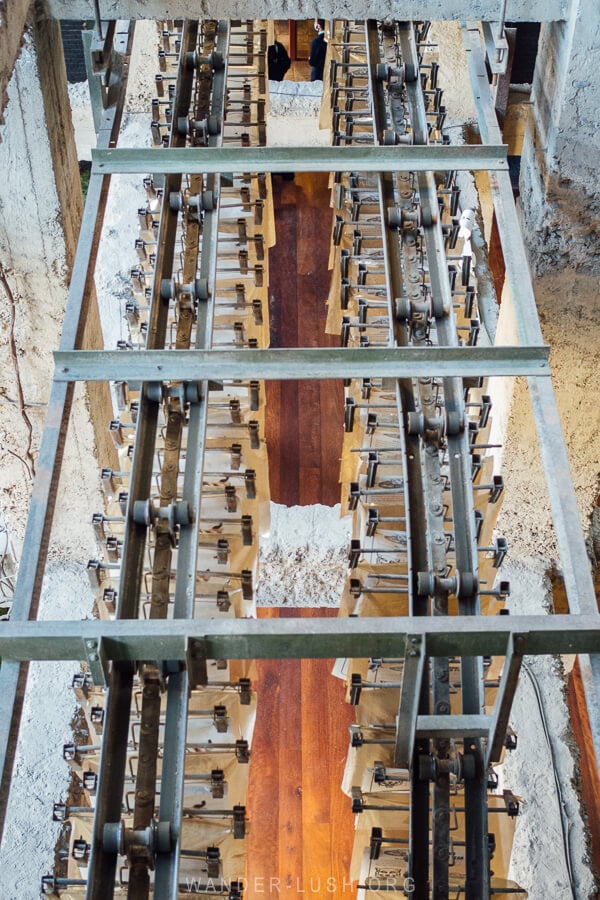
As well as the boutique-luxury Stamba Hotel and older sister property, Rooms Hotel, the building hosts several bars, restaurants and shops, plus the Tbilisi Photography and Multimedia Museum, live-in artist studios, events spaces, courtyards, and an amphitheatre.
Radio City: A radio factory retrofitted as a live music venue & coworking space


The latest Adjara Group project in Tbilisi, Radio City comes from the same team behind Stamba and Fabrika (see above). Once a vast industrial complex where radios were manufactured, this factory on the outskirts of the city has been revitalised as a venue live music venue and event space.
As well as the main hall, which as a capacity of 10,000 people, Radio City features a branch of the D-Block coworking space also found at Stamba, plus offices, creative spaces, and leisure zones (including outdoor paddle board courts).

This project is a huge boon for Gldani District and Tbilisi’s outer northern residential suburbs.
An onside restaurant, Diner, is open to the public daily and serves American diner-style fare such as chicken waffles and cherry pie.
Bazari Orbeliani: A historic marketplace reborn as a modern food hall
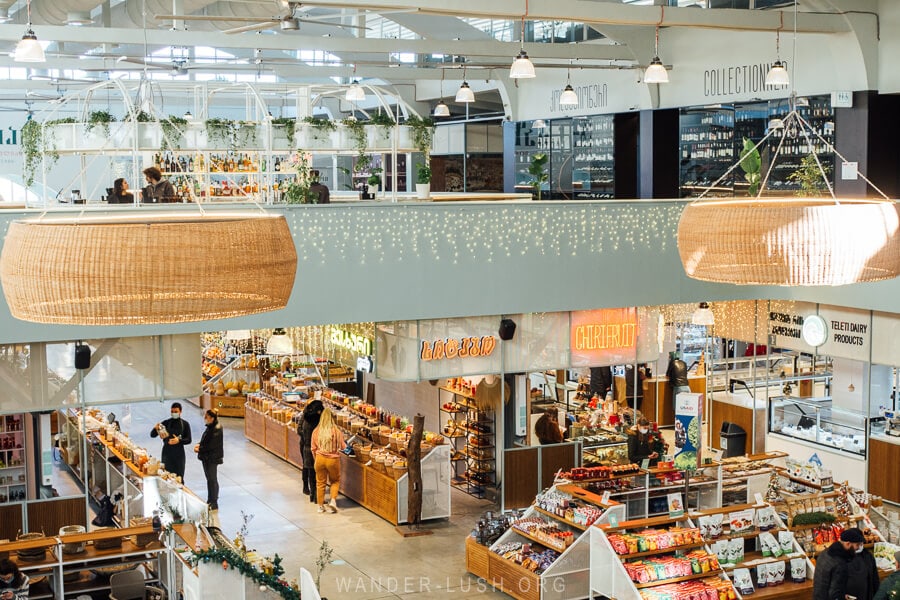
Tbilisi’s answer to the Time Out Market, the newly re-launched Bazari Orbeliani is a covered produce market and ‘fancy food court’ on historic Orbeliani Square. The building dates back to 1886 and has operated as a market hall for generations.
If you’re searching for edible souvenirs or gifts, this is a great place to shop for high-quality, artisanal food products from more than 35 local producers.
Upstairs, the dining zone sports a few dozen bars, breakfast cafes and restaurants, with both Georgian and international cuisines represented.
Tbilelis Karvasla: Museums & shops inside a Silk Road caravanserai

Built next to Sioni Cathedral in 1912 atop the ruins of an older inn, the unique Art Nouveau-styled Arzruni Caravanserai was one of the largest buildings in Tbilisi at the time of its completion. It has since undergone multiple reconstructions and today, Tbilelis Karvasla houses a wine bar, rows of curated shops, two museums and a restaurant.
On the upper level, the Tbilisi History Museum has a wonderful collection of archival photos and miniature houses modelled on traditional Georgian dwellings.
Downstairs, the Tbilisi Wine Museum offers one of the best guided tours in the city, if not the whole country. It’s very cool to travel through the brick belly of the caravanserai and the adjoining palace basement for an up-close look at the Old Tbilisi Underworld.
Unfound Door: A design hotel & wine bar-restaurant inside a bourgeois mansion

Unfound Door Design Hotel is one of the most talked about boutique accommodations in Tbilisi. Recently the owners added a complimentary bar-dining space to the ensemble, opening their doors to non-guests to experience their secret treasures.
I visited this building long before the hotel opened, when it was still a set of private apartments in fairly run-down condition. The painted entryway is utterly splendid and has been partially restored as part of the works.
The Swimming Pool Project: An abandoned pool repurposed as an open-air stage
Created for the Tbilisi Architecture Biennial in 2020 and nominated for a Mies van Der Rohe Award the following year, the Swimming Pool Project is one of the most original repurposed spaces in Tbilisi.
Designers Nikoloz Lomidze and Alexander Gharibashvili took an abandoned olympic-size swimming pool (part of a larger complex of forgotten buildings on the riverside) and with the help of some concrete and blue paint, converted it into an 8-storey terraced amphitheatre.
Aiming to create a ‘free recreational space, accessible for everyone’, the venue regularly hosts music performances and cultural events. If you want to test out the acoustics for yourself, you can check out the program here.
Cube in Context: A gallery inside a defunct cable car station
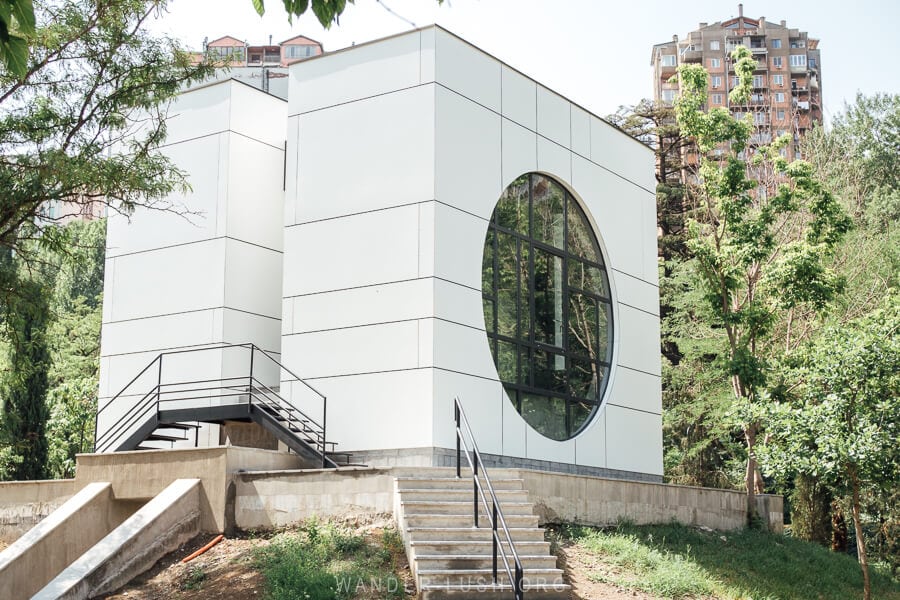
When I first visited Tbilisi, I passed by this derelict concrete cube in the middle of Mziuri Park and wondered to myself, ‘What on earth is that!?’ Turns out it was one of Georgia’s many disused ropeway stations, built for a cable car line that was never fully realised.
Back then, it was plastered in graffiti. A few years ago, entrepreneur Ana Goguadze (who is also responsible for Cafe Mziuri and the rehabilitation of the children’s park) spearheaded renovations that saw it transformed into a gallery and community arts space.
The modern, Cubist structure so perfectly suits its newfound purpose – you’d almost think it was destined to become an arts space from the very beginning.
Cube in Context is mainly geared for children and their parents, but there are occasional exhibitions and workshops that anyone can attend.
Silk Factory Studio: A film studio inside a tobacco/silk factory
Hidden away beneath the flyover near Heroes Square, this colossal industrial complex is easy to overlook. Built in 1856, it functioned as a tobacco factory before it was turned into a silk factory during the Soviet period, when Georgia was the Soviet Union’s leading producer of silk cocoons and threads.
Silk Factory Studio is now one of the leading companies of its kind in the region, housing a film production studio, equipment and costume rental service, and post-production facilities. Quite a few Georgian films, series and TV ads have been produced here in recent years.
Occasionally the Silk Factory Studio Pavilion – a cavernous warehouse space with polished concrete floors – throws its massive doors open to the public for fashion shows, performances and dance workshops. Keep an eye on their Facebook page for upcoming events.
CCA Tbilisi: A disused power station renewed as Tbilisi’s leading contemporary art centre
The Center of Contemporary Art – Tbilisi is the city’s leading independent, non-profit arts organisation. I have a soft spot for their venue on the riverside in Chugureti because in my home city of Brisbane, we have something very similar called the Powerhouse.
This venue too was a power station in a previous life. Constructed in the wake of WWII when Tbilisi faced an energy crisis, it supplied the entire city first with power, then later with hot water. After the fall of the USSR, the station was abandoned and ransacked.
The CCA has exhibition spaces, a Social Innovation Lab, and a 2000-book library that is open to the public. The complex is still under renovation. At the moment it also houses a nightclub called TES.
BONUS: The old Mikhailov Hospital becomes a Pompidou-style museum (coming soon)
Located just around the corner on David Aghmashenebeli Avenue, the old Mikhailov Hospital is also on the brink of big changes.
After many failed attempts to auction the property off, it finally sold in summer 2022 to Georgian businessman Shalva Breus, who plans to open a Pompidou-inspired museum and sculpture garden on the site.
The museum will be based around Breus’ private art collection, but with a twist: “I choose the Art Center to be absolutely free from all kinds of bureaucracy,” he said in an interview. It will be interesting to see how this one pans out!
Georgia Essentials
Here are the websites and services I personally use and recommend for Georgia. Check out my full list of travel resources for more tips.
TRAVEL INSURANCE: Insurance is now mandatory for all travellers to Georgia. Insure your trip with HeyMondo, my preferred provider for single-trip and annual policies. Get 5% off when you book with my link.
AIRPORT TRANSFERS: Most flights into Georgia arrive in the early hours. Airport taxis should be avoided at all costs. For ease, pre-book a private transfer from Tbilisi Airport to your hotel or from Kutaisi Airport to Tbilisi with my partners at GoTrip.ge.
SIM CARD: Magti is my preferred provider, with prices from 10 GEL/week for unlimited data. See this guide for all the details about buying a Georgian SIM card.
ACCOMMODATION: Booking.com is the most widely used platform in Georgia. Use it to find family guesthouses, private apartments, hostels and hotels around the country.
CAR HIRE: Find a great deal on a rental car in Georgia – use the Local Rent website to book through a local agent (prices start from $30/day).
PRIVATE TRANSFERS: GoTrip.ge is a terrific service for booking a private professional driver and car for the day. Use it for A-to-B transfers, a customised round-trip itinerary, or a multi-day trip. You can stop wherever you like for as long as you like without the fixed price going up.
DAY TRIPS & CITY TOURS: Use Viator or Get Your Guide to browse a range of day trips and city tours. For alternative itineraries with expert guides, I recommend Friendly.ge. Use the promocode wanderlush for 10% off.
WINE TOURS: For in-depth day trips to Georgia’s wine regions, I recommend Eat This! Tours. Use the promo code wanderlush for 5% off.
More Tbilisi posts you’ll love
- Georgia Travel Guide – all my 200+ posts for Georgia
- 25 Tbilisi travel tips – essential reading for first-timers
- The ultimate Georgia itinerary – the best of Tbilisi & beyond in 1-4 weeks
- How to plan your Caucasus travel itinerary – discover Georgia, Armenia & Azerbaijan
- What to pack for a trip to Georgia – and what to wear in Tbilisi
- How to get from Tbilisi airport to the city – 5 best transport options
- The best things to do in Tbilisi – the ultimate insider’s city guide
- Where to stay in Tbilisi – best neighbourhoods & accommodations
- The best restaurants in Tbilisi – where to find the best Georgian food
- The best cafes in Tbilisi – for coworking, coffee & more
- The best breakfasts in Tbilisi – cafes that open early
- The best gift shops in Tbilisi – where to buy authentic souvenirs
- The best walking tours in Tbilisi – discover the city by foot
- Tbilisi’s best walking streets – architecture, people-watching & street photography
- The best boutique hotels in Tbilisi – art hotels, wine hotels & more
- The best hostels in Tbilisi – accommodation on a budget
- Visiting Gulo’s Spa – the best sulfur bath in Tbilisi
- Visiting the Dezerter Bazaar – Tbilisi’s incredible green market
All comments are moderated and may take a little while to appear. If you’ve submitted your comment, I’ve got it!