The Stalin Underground Printing House Museum (AKA Stalin’s Printing Press or the Museum of Avlabari) is one of Tbilisi’s quirkiest attractions and a must-visit if you’re interested in Soviet history.
→ Also read: The best museums & galleries in Tbilisi
I first learned about the existence of the illegal printing press during a tour of the Stalin Museum in Gori, where they keep a scale model as part of the exhibition on Stalin’s early life.
In 2012, administration of the museum was officially handed to the National Parliamentary Library of Georgia. But I’m sure it is somehow still linked to the Georgian Communist Party.
It’s difficult to find reliable information online, and for that reason, I’ve avoided trying to visit. It’s taken me almost five years, but I’m glad I finally got to see it in person.

Like too many things in Georgia, the printing press is rusting away. Without Soso – the self-styled warden of the Tbilisi Printing House Museum who lives in a tiny room on the grounds – we wouldn’t be able to see this piece of macabre but important history. Soso is a diehard Communist. One of the highlights of visiting the museum is the chance to meet him.
In this blog, I’ll briefly run through the history and significance of the printing press before sharing my experience visiting the museum. At the end, I’ve included everything you need to know to plan a visit, including opening hours and ticket prices.
This guide was written after my visit to the Underground Printing House Museum in late December 2021. As with all my Tbilisi guides I am aiming to keep it updated and accurate, and will return to amend any details if and when they change.
Please note: This post contains affiliate links, meaning I may earn a commission if you make a purchase by clicking a link (at no extra cost to you). Learn more.
A quick history of the Stalin Underground Printing House
The history of Stalin’s printing press goes back to the turn of the century when Georgia was part of the Russian Empire. While his brother was receiving tuberculosis treatment at Abastumani, a few hundred kilometres away in Tbilisi, the movement to overthrow Tsar Nicholas II was gaining traction.
A young Lenin supporter, Iosif Jugashvili – AKA Joseph Stalin – who was born in the nearby city of Gori, was already making a name for himself as a revolutionary. In 1903, he took it upon himself to set up a typographic press in Tbilisi to print off pamphlets and proclamations calling for the removal of the Tsar.
This had to be done in secret of course, so along with a group of supporters, he carved out a secret chamber 15 metres beneath a nondescript wooden house in Avlabari district. The printing room was accessed via a well, with a series of unauthorised escape tunnels and secret shafts added.

Thousands of propaganda materials were printed in Georgian, Russian and Armenian then distributed across the region by train.
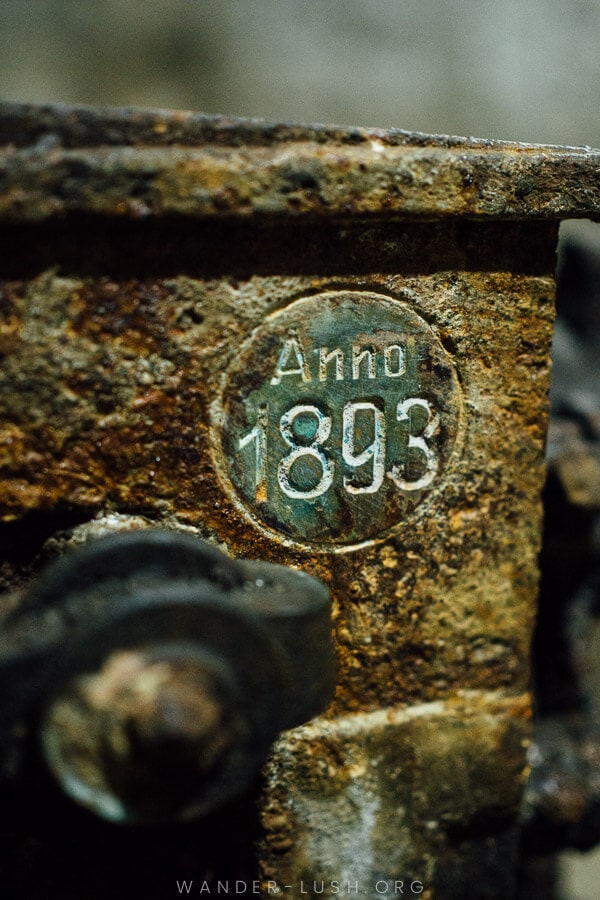
To keep up with demand, the original press was replaced with a larger model, purchased in Augsburg, Germany in 1893 at the request of Lenin himself.

The printing and distribution was partially funded by Jugashvili’s criminal activities – to say he was on the Gendarmerie’s radar is a bit of an understatement. In 1906, the printing press was finally discovered and destroyed.
As the story goes, a suspicious officer entered the house, lit a piece of paper on fire, and dropped it down the well. It was sucked sideways into the horizontal passageway, revealing the existence of the secret chamber below. The well was filled with soil and the house destroyed.
Decades later when Stalin came to power, the printing press was restored and reopened as a museum. It was a popular pilgrimage spot for tourists from around the USSR and other Communist countries, especially China where the legend of the printing press is still taught in schools. (My husband teaches online and when he mentions Tbilisi to his students, many of them immediately start talking about the printing press.)


The museum fell into disrepair in the 1990s before reopening a few years ago.
Our visit to the Stalin Underground Printing House Museum
We arrived at the mid-century brick building that encloses the museum yard just as another pair of tourists were leaving. Our timing was spot on – had they not been outside conversing with Soso, we would have seen the padlocked gate and assumed the museum was closed.
I’m sure that receiving two groups of tourists back to back on a chilly morning in December is quite a rarity. Soso was happy to see us and walked us inside.

As I mentioned, Soso is a member of the Communist Party and a true believer. We introduced ourselves, explaining that we are from Australia, and he immediately raised a clenched first whilst muttering something derogatory about ‘the British’, landed one military boot on the concrete with a thud, then proceeded to grind an invisible insect into oblivion.
We smiled and nodded enthusiastically. I think I actually raised a boot too and made a little halfhearted kick. What else could we do?
Under normal circumstances, Soso will play guide and show you around the museum himself – provided you speak Georgian or Russian. At the time of our visit, Soso was suffering from a nasty cough, so instead he gave us an A4 sheet of paper with information about the museum in English, pointed the way to several different buildings, then retired to his room.
I looked down at the paper, which begins ‘Dear Guests!’ with an exclamation point. Perfect. The stage was set.
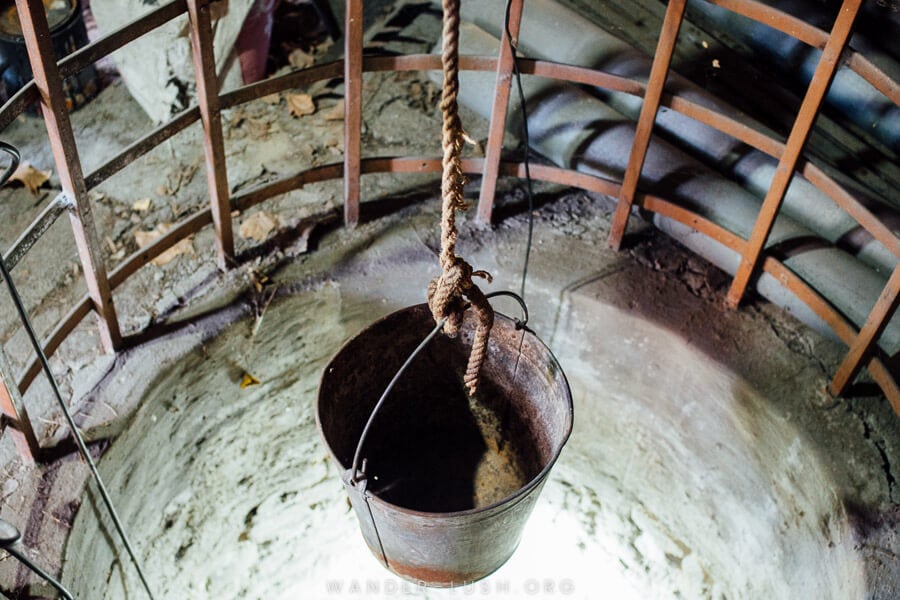
We entered the first building where the famous well is housed. Amidst the rubble and piles of building materials, the shaft is illuminated with a warm glow, an empty bucket hanging from a rope at the top. We also saw a diagram of the tunnel arrangement mounted on the wall.
We then ducked our heads and went under the main house, where a newish spiral staircase led us deep down to the chamber where the original typographic press sits.
As we learned at the Stalin Museum, the machine was illegally smuggled into Georgia in pieces then painstakingly reassembled like a particularly nasty item of Ikea furniture.
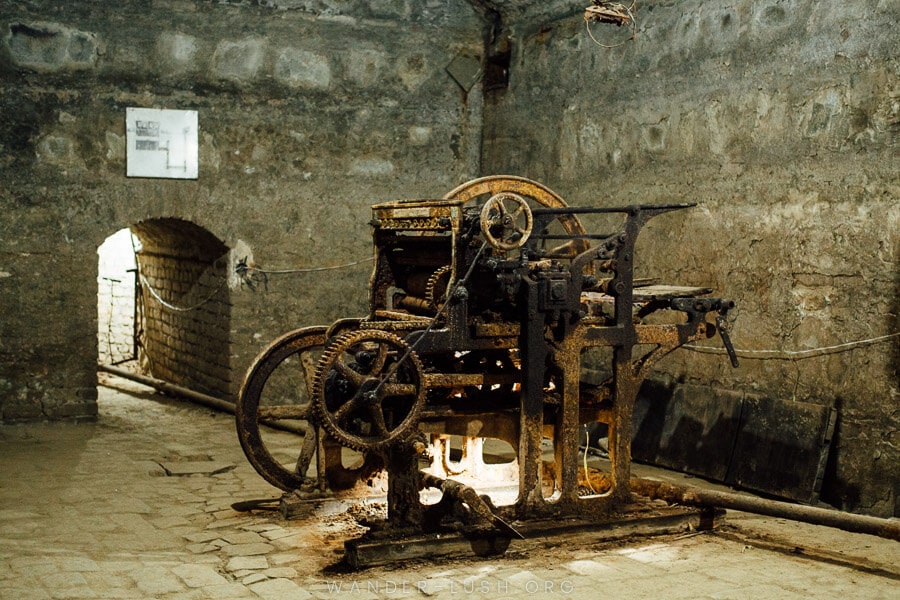
Cobwebbed and caked in rust, the press sits forlornly under a bare lightbulb. The only parts of the machine that have been cleaned up are where the year 1893 and the name Augsburg are embossed on the metal.

A few sheets of A4 paper in plastic sleeves are mounted to the brick wall, examples of Georgian and Armenian language propaganda. There’s also a little tunnel where you can look out to the well and imagine how this clandestine arrangement must have operated.
The final section of the museum is the original wooden house, directly above the underground chamber. You can just imagine lookouts pacing the porch, ready to sound the alarm and signal the printers to hit the off switch whenever a policeman stuck his head over the front fence.

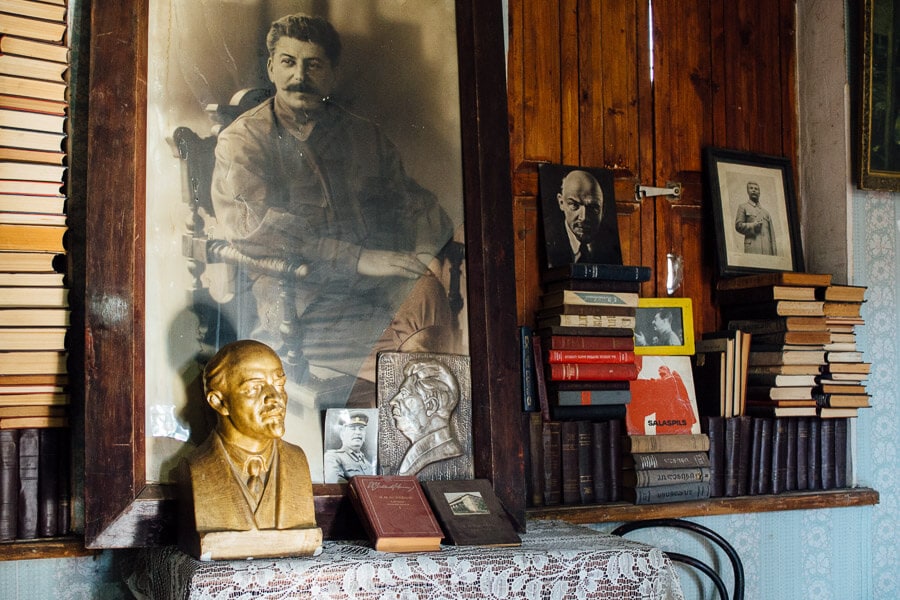
The two rooms contain old furniture, posters, photos, portraits of Lenin and Stalin, and bookcases lined with Russian and Georgian books. There are also a few pieces of ‘contemporary’ Communist Party memorabilia, including a CCCP baseball cap.
The original smaller typographic machine is set up here, along with a scale model of a second printing press, Nina Printing House in Baku, Azerbaijan, where the illegal Georgian language newspaper Brdzola was produced.


Later, we realised that we had accidentally skipped the ‘museum’ part of the museum, a big exhibition room with photos and newspaper clippings. For reference, it’s located at the front of the complex behind the red-and-black double doors.
Perhaps Soso assumed we weren’t interested because we wouldn’t be able to read the didactics. Or perhaps he didn’t feel like showing us around because he was unwell. We snapped a photo together before saying goodbye.
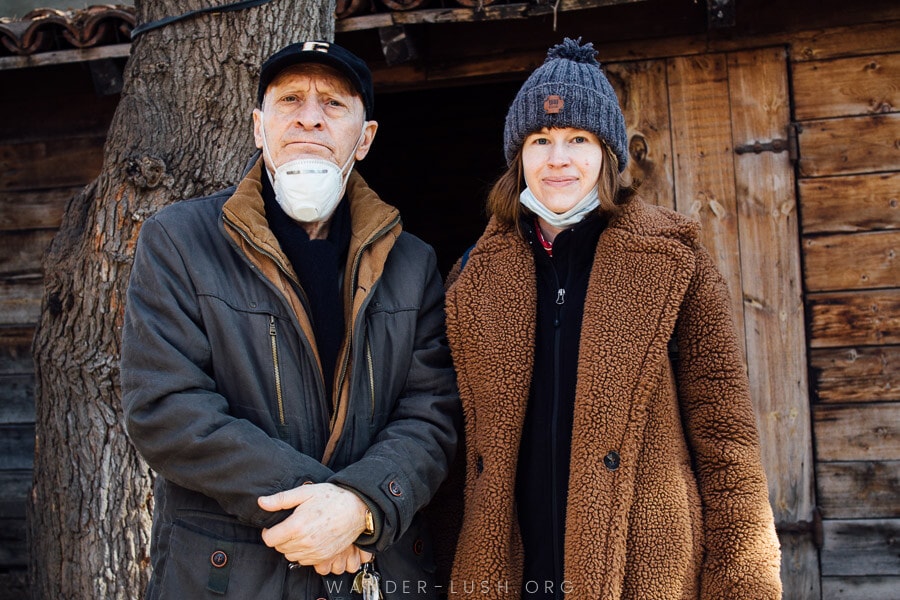
Georgia’s relationship with Stalin is complicated. So many places in Georgia claim to have some connection to the leader – from Stalin’s dacha in Shovi, Racha (which he apparently never visited), to his private bath in Tskaltubo, his suite at the old Military Sanatorium, and another summer house on the hill (again, the connections are tenuous).
The Printing House Museum, however, is written into the history books. It feels more real. However uncomfortable you are with the ideology, however squirly the whole thing makes you feel, there’s no denying that this is a fascinating and important part of world history. And despite being in the centre of Tbilisi, most people overlook it.
I think it’s one of the most unique museum experiences in Georgia and very much worth a visit.
Museum hours, tickets & visitor’s info
Museum opening hours
We used Google Translate to gather the following information from Soso.
The Stalin Underground Printing House Museum is open between 10am and 6pm on weekdays (closed on Saturdays and Sundays). Soso’s mobile phone number is displayed at the door, so if you don’t see anyone around, give him a call – or just yell out towards the yard through the locked gate.
To be safe, I would suggest visiting no earlier than 11am and no later than 4pm. If you speak Georgian or Russian, you might like to give him a bell in advance.
Ticket price
Entrance costs 10 GEL per person. Cash only.
How to get to the Stalin Underground Printing House Museum
The museum is located on Kaspi Street in Avlabari district, around 3km from Freedom Square on the opposite side of the river. The easiest way to get there is by taxi, which costs between 4-6 GEL from Freedom Square when booked on the Bolt app.
Alternatively, take the metro to 300 Aragveli Metro Station (2 stops on the red line travelling in the direction of Varketili) then walk three blocks (600 metres; 10 minutes).
There isn’t much else to see in the immediate vicinity, but you could combine a visit to the museum with Sameba Holy Trinity Cathedral (Georgia’s largest Orthodox church) and a walk around Old Avlabari, visiting Queen Darejan’s Palace, Metekhi, and the abandoned Karmir Avetaran Armenian Church. Collectively these are some of my favourite churches in Tbilisi.
Or you could continue in the opposite direction to visit Navtlugi, one of the largest open-air markets in Tbilisi (around 30 minutes by foot from the museum). To get back to the centre from there, jump on the metro at Isani-Samgori.
If you prefer to visit the museum with a guide, there are a number of walking tours that include it in the itinerary. My top pick is the Soviet Tour of Tbilisi organised by Tbilisi Free Walking Tours.
Have you visited the Stalin Underground Printing House Museum in Tbilisi? What were your impressions? If you have any questions about visiting the museum, leave me a note below and I’ll do my best to help.
More Tbilisi posts you’ll love
- Georgia Travel Guide – all my 200+ posts for Georgia
- 25 Tbilisi travel tips – essential reading for first-timers
- The ultimate Georgia itinerary – the best of Tbilisi & beyond in 1-4 weeks
- How to plan your Caucasus travel itinerary – discover Georgia, Armenia & Azerbaijan
- What to pack for a trip to Georgia – and what to wear in Tbilisi
- How to get from Tbilisi airport to the city – 5 best transport options
- The best things to do in Tbilisi – the ultimate insider’s city guide
- Where to stay in Tbilisi – best neighbourhoods & accommodations
- The best restaurants in Tbilisi – where to find the best Georgian food
- The best cafes in Tbilisi – for coworking, coffee & more
- The best breakfasts in Tbilisi – cafes that open early
- The best gift shops in Tbilisi – where to buy authentic souvenirs
- The best walking tours in Tbilisi – discover the city by foot
- Tbilisi’s best walking streets – architecture, people-watching & street photography
- The best boutique hotels in Tbilisi – art hotels, wine hotels & more
- The best hostels in Tbilisi – accommodation on a budget
- Visiting Gulo’s Spa – the best sulfur bath in Tbilisi
- Visiting the Dezerter Bazaar – Tbilisi’s incredible green market
Is museum open now, August 2025??
Hi Michael – yes.
quick may 2025 update: the house is under renovation and the basement is flooded and cannot be visited. we could visit the small museum at the entrance and that was an experience anyway thanks to the man who accompanied us!
Oh no! I hadn’t heard. Thank you Marco for the update! I’m glad you were still able to visit.
We have just returned from a trip to Georgia, and we were so lucky to have been able to visit this museum. The guide is incredible! Getting his message across with the very bare minimum of English…he is so accommodating and his passion is evident. We were encouraged to take photos and he was happy for us to really interact with the site and its memorabilia. This was definitely one of the highlights of our trip. Thank you for being our ‘go-to’ reference for everything Georgia and the Caucuses region.
Thanks Melanie! Glad you got to experience the museum and enjoyed your time in Georgia. I hope you will get a chance to revisit soon!