From its generous visa-free policy to a wide range of affordable dining options, Georgia is one of the most budget-friendly travel destinations in the region.
It’s true that the cost of living has increased noticeably over the past four years. Even so, Georgia continues to represent excellent value for money for travellers. I deliberately avoid describing Georgia as ‘cheap’ – what stands out instead is how far your budget goes for the quality you receive.
Having lived in Georgia for six years, I’m reminded of this every time I travel elsewhere, particularly within Europe. Even in the capital, prices remain low by European standards, and in most cases the quality of accommodation and food is high for the price paid (service levels can vary, but the cooking rarely disappoints).
Your travel budget for Georgia will of course depend on what time of year you visit, where you go, and the decisions you make along the way. Backpackers can still get by on less than 100 GEL a day, while even luxury travellers will find Georgia affordable. Even if you stayed at boutique hotels, ate very well, and used private transfers, Georgia is still good value by European standards – though summer prices in popular regions are rising quickly.
In this guide, I’ll break down the costs of common expenses for 2026, and give you my tips for making your Georgia travel budget stretch further.
Please note: This post contains affiliate links, meaning I may earn a commission if you make a purchase by clicking a link (at no extra cost to you). Learn more.
2026 update: Is Georgia still a budget-friendly destination?
Georgia is often described as a $30-40 a day destination on some travel websites. While it’s still possible to travel on a tight budget here, official data paints a more nuanced picture of how most visitors travel today. On average, travellers now spend closer to 400 GEL per night.
Georgia is no longer a backpacker outlier in the way it once was. Instead, it’s increasingly a repeat-visit destination, where people tend to stay for shorter periods, spend more on food and accommodation, and travel with fewer compromises. Budget travel certainly exists – but it’s important to understand that this is no longer the dominant pattern shaping prices on the ground.
Like almost everywhere, Georgia continues to feel the impacts of inflation. By the end of 2022, the annual inflation rate was 11.6% – the highest in almost two decades. In 2025, it hovered at around 4-5%.
In the past 12 months, food and grocery prices rose more sharply – by around 8-12% year-on-year. Travellers are most likely to notice this when shopping at markets or supermarkets, but it has also fed through into restaurant prices.
ISET’s Khachapuri Index, an unofficial tool used to measure inflation based on the average cost of cooking an Imeretian Khachapuri, hit an all-time high of 7.30 GEL in October 2025. In 2014, when the Index launched, the cost was 3.35 GEL.
Food, alcohol, transport and accommodation prices are markedly higher than they once were. Intercity marshrutka fares all increased by an average of 20-40% in 2022 (prices have since stabilised), the same year the cost of public transport in Tbilisi doubled.
What does this mean for you? If you’re planning your first trip to Georgia in 2026, you might notice a discrepancy between prices listed online and real costs on the ground. If you’re returning to Georgia after a long break, you will definitely see an increase in your spending compared with your last trip.
Regardless, there’s no denying that Georgia is still an incredibly budget-friendly destination, especially when you consider what you get in return for your money.
As you’ll see, most things are still very affordable in Georgia, especially transport, food and drink.
Prices in Georgia for 2026
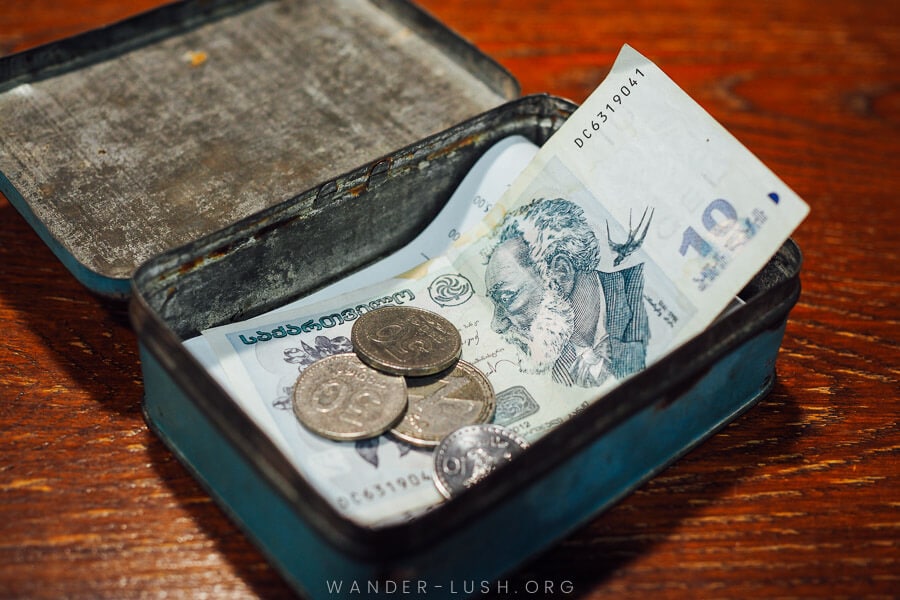
Georgia’s official currency is the lari, abbreviated as GEL. Georgia uses both bank notes and coins, called tetri. Hotels and tour companies often display pricing in USD or Euro, but GEL is the only legal tender in Georgia.
At the time of writing, 1 USD = 2.70 GEL. For official exchange rates, see the National Bank of Georgia website.
All prices below have been updated for 2026 and are based on my own experience living in and travelling around Georgia.
Cost of accommodation in Georgia
Accommodation is now the fastest-moving cost category in Georgia, so budget more if you’re travelling in July-August peak season.
Bed in a hostel dorm
- 8-15 USD
The hostel scene is well-developed in Tbilisi especially, where you’ll find plenty of nice boutique hostels with a high standard of comfort and cleanliness. Fabrika is by far the most popular, though it is a little pricier. On average, you can expect to pay between 8-14 USD for a dormitory bed in Tbilisi. Hostels in Kutaisi and Batumi are priced a little lower.
Private room in a guesthouse
- 30-50 USD
Outside of the big cities, I recommend budget travellers choose guesthouses over hostels. The price often works out to be the same, and guesthouses come with lots of added perks, including the chance to meet a local family and eat home-cooked meals.
Prices vary considerably, with guesthouses in popular areas – such as along the Mestia-Ushguli hiking route – costing up to 50 USD/night (with half board). In more remote areas, you can usually find a private room for 2 people with either a shared or private bathroom for 25-30 USD, while in popular regions and peak summer, 45-60 USD is increasingly common. Breakfast, lunch and dinner are usually provided at an extra cost, anywhere from 20-50 GEL per person per meal.
→ Here’s a list of my favourite guesthouses around Georgia.
Room in a 3-star hotel
- 55-75 USD
Three-star hotels are widely available in Tbilisi, Batumi, Kutaisi and other major towns. Prices usually start from around 60–70 USD per night, rising during summer and holiday periods. Outside peak season, it’s often possible to find very good value deals in this category, especially in Kutaisi and secondary cities.
Room in a boutique or 5-star hotel
- 150-220 USD
If you’re in the mood for a splurge, Georgia is a great place to do it. Despite gradual price increases over recent years (and a 10% YOY jump at the start of summer 2026…), Georgia still offers strong value for boutique and luxury hotels by regional standards. You can find some excellent deals on boutique and even 5-star accommodations in Tbilisi and around the country, especially during shoulder or low season. The further you book ahead, the better.
A few of my personal favourites are the Radisson Collection Tsinandali near Telavi in the wine region, Rooms Hotel Kazbegi in Stepantsminda, Tskaltubo Spa Resort in Tskaltubo, Communal Hotel in Kutaisi, and Kartuli in Batumi.
→ Here’s a list of my favourite boutique hotels in Tbilisi for 2026.
Airbnb (entire place)
- 65-100 USD
Airbnb is available across Georgia, even in small towns and mountain villages. The average nightly price for an Airbnb in Tbilisi or Batumi is around 65-100 USD. In Kutaisi, it’s closer to 35-50 USD.
When I first moved to Georgia, I booked all our long stays through Airbnb and spent 300-350 USD/month. Times have certainly changed: In 2026, an ‘entire place’ listing in Tbilisi averages 1,200 USD per month.
Cost of food & drink in Georgia
One Khinkali dumpling
- 1.50-3 GEL / ~0.5-1 USD
Whether you’re a budget backpacker or a high-end traveller, khinkali unites us all. Khinkali are priced per piece – a single dumpling costs between 1.50 GEL for a vegetarian filling up to 3 GEL for a specialty cheese or lamb filling. In Tbilisi, khinkali kalakuri (pork/beef) are usually priced at 2-2.50 GEL per dumpling.
Remember that most restaurants require a minimum order of five pieces of any one filling.
Meal for two at a mid-range Georgian restaurant
- 60-80 GEL / ~22-30 USD
City to city, town to town, there is less variation in the price of a restaurant meal than you might expect. Tavern-style restaurants serving standard Georgian fare are pretty consistently priced in big cities and smaller towns. Portion sizes are also similar. Tbilisi is a notable exception: Restaurant prices are higher in the capital across all categories aside from very local eateries.
On average, we tend to spend 60-80 GEL for a meal for the two of us. That includes three dishes (a salad, a meat dish and 10 khinkali, for example), plus bread and soft drinks or water. At a budget eatery, we could get away with spending as little as 40 GEL, while a fancier restaurant in Tbilisi might cost upwards of 150-200 GEL for two.
It’s difficult to nominate a price per person for food, as meals in Georgia are served family-style and always shared. But as a ballpark figure, you can expect to pay 30-45 GEL for a meal if you are a solo traveller (and you will almost always have leftovers to take home with you).
Generally speaking, international restaurants cost around 20-30% more.
Glass of Georgian wine or beer
- 5 GEL / ~2 USD (house wine) – 15 GEL / ~6 USD (bottled wine)
Travelling around the cradle of wine certainly has its perks: Booze is very affordable in Georgia, especially wine. Draught wine (house wine) is available at some local restaurants for as little as 3-5 GEL a glass. Expect to pay between 7-15 GEL for a glass of Saperavi or similar, or up to 20 GEL for a glass of high-quality Georgian wine. In a wine bar, you will always pay slightly more.
Note that free-pouring is standard practice and a glass of wine is often a lot more than one standard drink! Depending on the restaurant, wine may also be sold by the carafe, by the litre, or of course by the bottle.
Draught beer and craft beer are priced roughly the same, between 5-15 GEL. There are a number of great cocktail bars in Tbilisi now, too – a cocktail costs 20-25 GEL on average in Tbilisi.
Cappuccino
- 8-10 GEL / ~3-4 USD
The number of specialty coffee shops in Tbilisi is on the rise. You can expect to pay 8-10 GEL for a cappuccino or latte at a nice roastery-cafe such as Coffee LAB or Shavi Coffee Roasters, while local coffee shops such as Coffeesta have significantly lower prices, around 5-7 GEL. The most expensive price I’ve seen in Tbilisi is 12 GEL.
Black coffee (Americano) and Turkish coffee are always significantly cheaper than milk coffees. Some restaurants charge absurdly high prices for an espresso (I’ve seen 8 GEL espresso on a restaurant menu more than once), so watch out for that.
Bottle of water
- 1-3 GEL / ~0.40-1 USD
While it’s generally safe to drink the tap water in most parts of Georgia, bottled water is also very affordable. Much of it is sourced directly from natural springs. Popular mineral water brands include Borjomi (sparkling), Nabeghlavi, Sairme and Bakuriani.
Prices are low overall, though slightly higher at tourist attractions and convenience shops in busy areas.
Bakery snack
- 3-8 GEL / ~1-3 USD
Georgia’s bakeries are one of the cheapest and easiest ways to eat well on the go. A khachapuri, lobiani (bean-filled bread), or sweet pastry from a neighbourhood bakery usually costs just a few lari. One item is often enough for a quick breakfast or a light meal.
A baton of freshly baked shotis puri (plain white bread) costs 1.20-1.50 GEL depending on the neighbourhood.
Cost of transportation in Georgia
Private airport transfer
- From 60 GEL / ~22 USD
If you’re flying into Georgia, I highly recommend pre-organising an airport transfer to your accommodation. (There are city bus services at Tbilisi Airport, Kutaisi Airport and Batumi Airport, but a private terminal-to-door transfer is so affordable, I think it’s worth every extra cent – especially if you’re on a flight that arrives in the middle of the night, as is so often the case.)
A transfer from Tbilisi Airport to Tbilisi city or from Kutaisi Airport to Kutaisi city starts from 60 GEL when booked through GoTrip. You use this platform to arrange a transfer to any destination in Georgia. This is the service I always use – it is very reliable. Enter your flight details when you book and the driver will be there waiting when your flight lands.
Metro / city bus fare
- 1 GEL / ~40 cents
Tbilisi has an excellent public transport system. A rechargeable plastic MetroMoney transport card costs 2 GEL and can be used on buses, metro lines and cable cars in Tbilisi, as well as on public transport in Batumi. A newer subscription-based travel card (also 2 GEL) is available for Tbilisi only.
A single bus or metro ride in Tbilisi costs 1 GEL and is valid for 90 minutes. Unlimited travel passes are also available: 1 day (3 GEL), 1 week (20 GEL), 1 month (40 GEL), 3 months (100 GEL), 6 months (150 GEL) and 1 year (250 GEL).
In other cities, fares are even cheaper: Kutaisi buses cost 60 tetri, while Gori buses cost 50 tetri per ride.
Taxi fare
- 7-20 GEL / ~3-8 USD
Taxis in Georgia are unmetered, so it’s essential to use an app such as Bolt (a local alternative to Uber) to order cars. Bolt fares average roughly 1-2 GEL per kilometre, although short journeys cost proportionally more. Most journeys within central Tbilisi cost around 7-12 GEL, while longer rides across the city generally cost 15-20 GEL. Expect to pay 30-40 GEL to travel to or from Tbilisi Airport. You will always pay slightly more during peak hour or if there is inclement weather.
Prices are comparable in other cities where Bolt is available. In smaller cities and towns, you can try Maxim app, which works in more locations across the country.
If you do have to hail a taxi on the street, always negotiate the fare first before you get in. As a general rule of thumb, you should expect to pay a base fare of 4 GEL plus roughly 1.5-2 GEL per kilometre.
Do not take a taxi from the airport, train or bus station – this is when tourist scams are most likely to occur. See here for my recommendations on getting to the city from Tbilisi Airport.
Intercity marshrutka van ticket
- 10-25 GEL / ~4-9 USD
Marshrutka vans are the easiest way to travel around Georgia. (If you’re unfamiliar with them, here’s my guide to using marshrutky.) As mentioned, at the end of 2021 marshrutka fares went up across the board by around 20-40% and prices continued to rise throughout 2022 before stabilising in 2023/2024.
Marshrutka fares vary from 5 GEL for shorter trips such as Tbilisi to Gori, up to 15 GEL to get from Tbilisi to Kazbegi. The majority of intercity routes cost somewhere between 10 and 25 GEL. The most expensive marshrutka fares (from Tbilisi) are for Svaneti or the Black Sea coast (30-50 GEL).
As of spring 2026, rising fuel costs have pushed ticket prices up on some intercity routes, with certain marshrutka and coach bus fares increasing by around 5 GEL.
Train ticket
- 20-35 GEL / 8-13 USD
Train travel in Georgia is limited but comfortable on the routes where it does exist. Passenger services mainly operate in Western Georgia, with the primary line running between Tbilisi and Batumi on the Black Sea coast.
From this main corridor, regional trains also serve Kutaisi, Zugdidi and Poti. Services range from old-school electric trains (2 GEL) to modern Stadler trains (35 GEL).
Private driver for the day
- From 35 USD
If you’re concerned about road safety in Georgia or you just prefer to travel at your own pace, it can be very affordable to hire a car and driver for the day. My favourite service for this is GoTrip, an ‘intercity Uber’ you can use to book one-way transfers and round-trip day excursions.
Expect to pay around 35 USD for a short trip (e.g. Tbilisi to Mtskheta and back), up to 125 USD to travel across the country from Tbilisi to Batumi. A trip up the Military Highway to Kazbegi, one of the most scenic roads in Georgia, costs around 80 USD.
The best thing about GoTrip is that you can make as many stops as you like without the price increasing. Read my full review of GoTrip or use the GoTrip Trip Planner to book a car.
Car rental
- From 25 USD/day
Hiring a car in Georgia can be an affordable option if you go with a local agent rather than a big-name company. Vehicles will usually be older (and maybe not as spick and span as you’re used to), but on the plus side, comprehensive insurance is often included and there are rarely any extra fees. Most don’t even require a deposit.
I recommend using Local Rent to find local car rentals in Georgia. Prices start from as little as 25 USD/day including delivery and drop-off at a location of your choice. One-way fees and other charges are reasonable.
If you plan on driving in Georgia, it’s a good idea to familiarise yourself with the road rules and driving style first. Here are my tips for renting a car in Tbilisi and navigating the roads, and here is my recommended road trip itinerary for getting off the beaten path in Western Georgia.
Cost of activities & entertainment in Georgia
Museum ticket
- 5-20 GEL / ~2-7 USD
There is a huge price range for museums and galleries in Georgia. Smaller regional institutions and house museums (such as the Kutaisi History Museum, for example) usually cost 3-5 GEL, while more popular museums such as the Stalin Museum in Gori cost 15 GEL.
Most museums and galleries in Tbilisi have put their prices up considerably in recent years. Entrance to the Georgian National Museum in Tbilisi (home to the Soviet Occupation Hall) and the Art Museum of Georgia now cost 40 GEL. Entrance to the National Gallery also increased by 50%.
Entrance to a National Heritage Site / Protected Area
- 15-20 GEL / ~6-7 USD
Prices for Georgia’s National Heritage Sites have gone up in recent years. For example, the cave cities at Vardzia and Uplistsikhe now costs 15 GEL per adult (up from 7 GEL in 2020). Protected Areas such as Kinchkha Waterfall, Sataplia, Martvili Canyon and Okatse Canyon are priced higher at 20 GEL per person. The most expensive Protected Area I’ve visited is Prometheus Cave near Kutaisi, which costs 25 GEL. These places also have add-ons, charging extra for boat rides etc.
Like all churches and monasteries, entrance to National Parks in Georgia is free (with the exception of a handful of parks that charge an administration fee).
Seat at the opera, ballet or theatre
- From 30 GEL / ~11 USD
A night at the opera or ballet is a must in Tbilisi. The State Ballet of Georgia performs throughout the year at the Opera and Ballet Theatre on Rustaveli Avenue, while the National Ballet Sukhishvili (which famously combines classical Georgian and contemporary dance) often performs in Tbilisi and/or Batumi in the autumn months. Both are absolutely worth seeing – and for that price, why not.
The famous Rezo Gabriadze Theatre in Tbilisi holds adults-only puppet shows in autumn and winter. It is more expensive (50-70 GEL) and tickets always sell out so you have to get in early.
I use TKT.GE to find performances and to purchase tickets online. They also sell tickets for sporting events and train tickets.
Private room at the Tbilisi sulfur baths
- 130-200 GEL / ~50-75 USD per hour
One of the best things to do in Tbilisi is go for a scrub and a soak at the Abanotubani sulfur baths. Both public and private baths are available. Entrance to a communal (sex-segregated) bath costs less than 15 GEL, while a private room at the baths will set you back 130-200 GEL per hour on average depending on the size of the room and the facilities (up to 500 GEL for premium baths).
Gulo’s Spa and Chreli-Abano, my two top recommended bathhouses in Tbilisi, both offer beautiful rooms within this price range. Booking are essential. An exfoliating kisi scrub costs an extra 10-20 GEL depending on the bathhouse.
Day tour from Tbilisi
- 35-70 USD per person
There are plenty of DIY day trips from Tbilisi and excursions from Batumi or Kutaisi side trips that can be done with public transport. For longer journeys and some specific historical sites including Mtskheta, I suggest joining a group or private day tour. Some places require a car, and you’ll get a lot more out of the experience if you have a guide.
Day tours are incredibly well-priced in Georgia, starting from 30-40 USD per person for a group tour to Sighnaghi or Gori, up to 70+ USD per person for a private tour to wine country or David Gareja Cave Monastery.
I strongly suggest you avoid cheap day tour providers as they often cut costs by using old vehicles, overworking their drivers and/or guides, or over-filling the car.
My preferred premium day trip provider in Tbilisi is Friendly.ge. Use the code wanderlush at checkout to get 10% off any of their private or group itineraries. For an in-depth, quality wine tour, I recommend Eat This! Tours. Their full-day Telavi tour is my top pick. Mention wanderlush to get a 5% discount.
Ski lift pass
- 55-70 GEL / ~20-26 USD per day
Visiting Georgia in winter? A full-day ski pass for one of Georgia’s winter resorts is very affordable by European standards. Prices vary slightly by location, with Gudauri being the most expensive.
Equipment rental and lessons are charged separately and are also reasonably priced compared with Western Europe.
A full season pass for all four Georgian resorts costs just 650 GEL (~240 USD).
Practical costs in Georgia
SIM card + 1 GB of data
- 15 GEL / ~6 USD
It is still incredibly easy and affordable for a tourist to get set up with a local SIM card (or eSIM) in Georgia. If you can get online when you’re on the move, it will save you a lot of headaches. The ability to use an app to book taxis is worth the cost of a SIM card alone.
Magti is my preferred provider in terms of both value and coverage. A Magti SIM or eSIM costs 10 GEL, and a data package costs anywhere from 5 GEL for 1GB up to 30 GEL for 20GB. If you’re a heavy data user, Magti offers unlimited 5G for 30 days for just 35 GEL (or 24 hours for 2 GEL).
Avoid buying a tourist SIM at the airport – wait until you can visit a Magti branch in the city and you’ll likely get better value for your money. Download the Magti app for hassle-free top ups and to take advantage of special deals.
Here’s my detailed guide to buying and registering a SIM card in Georgia.
ATM withdrawal fees
- 2-5 GEL / ~0.75-2 USD
While cards are widely accepted in Georgia’s cities, it’s still important to carry cash when travelling in rural areas or small towns. For ease, I always recommend withdrawing GEL from an ATM rather than exchanging currency.
Most Georgian banks charge a small local ATM fee, which is displayed on screen before you confirm the transaction. Additional fees may be charged by your home bank depending on your card and account. Making larger withdrawals usually works out cheaper – Basisbank and CartuBank both have higher limits and are the two ATMs I recommend.
Self-service laundry
- 30 GEL / ~11 USD
Self-service laundromats are not at all common in Georgia – you will only find a couple in Tbilisi, Batumi and Kutaisi. A wash costs around 15 GEL, plus another 15-20 GEL for tumble drying. Outside of the bigger cities, some hotels offer a wash-and-fold service, but this can be pricey. Your best bet is to do laundry at a guesthouse.
Public toilets
- 0.5-1 GEL / ~0.20-0.40 USD
Most public toilets in Georgia charge a small fee, paid in cash to an attendant. In rural areas, the fee is normally 20-50 tetri, while at road stops and in Tbilisi, 1 GEL is standard. Be sure to carry some coins with you for this purpose. Some restrooms in Tbilisi – including at the railway station – are fitted with terminals and only accept card payment.
VAT / service charge
- 18% / 10%
There is a standard 18% VAT charge on all goods and services in Georgia. In 2024, a new law was introduced to force restaurants to incorporate VAT into the price displayed on the menu. Some venues flaunt this rule and continue to add VAT on top (if this is the case, it should be printed on the bottom of the menu). In all grocery and convenience stores, pharmacies and other retailers, the shelf display price is inclusive of VAT.
Some restaurants also add a service charge on top of VAT. It’s usually 10%, but I’ve seen it as high as 20% in more up-market and touristy restaurants. Don’t assume that the service charge goes directly to your server – in most cases, it does not. See my advice on tipping in the next section below.
Average Georgia travel budget
Prices in Tbilisi, Kutaisi and Batumi are fairly consistent, while you can definitely save money in smaller towns and rural villages. Popular tourist destinations such as Mestia and Kazbegi can be a tad more expensive during peak seasons. In the end, things tend to even out as you travel around.
Here is a very rough estimate of how much to budget for Georgia:
Budget traveller: 40-60 USD/day
On a budget of 100-160 GEL or 40-60 USD per day, you can get a bed in a comfortable hostel dorm, a local bakery breakfast, a light lunch, and dinner at an affordable Georgian restaurant – including a glass or two of wine or draught beer. Use public transport and marshrtuka vans to get around, and stick to free activities and smaller museums, which have a lower ticket price.
Mid-range traveller: 80-140 USD/day
Mid-range travellers spending 210-370 GEL or 80-140 USD per day on average can expect a room at a nice guesthouse or Airbnb (twin share), a cafe breakfast, and two sit-down meals at Georgian or international restaurants. Use a mix of public transport and taxis to get around the cities, and either hire your own car or use a combination of trains and GoTrip transfers to travel around. Splurge on a special experience such as a guided walking tour, a Georgian wine degustation, or a private room at the sulfur baths in Tbilisi.
High-end traveller: 250+ USD/day
High-end travellers who set a budget of 660 GEL or 250 USD per day and up will be able to afford a designer boutique hotel (breakfast included), two sit-down meals at up-scale Georgian or international restaurants, and a bottle or two of Georgian wine. Use taxis to get around the cities and hire private drivers through GoTrip for longer journeys. Indulge in some of the finer things Georgia has to offer, such as a private cooking class in Tbilisi, a sommelier-led wine tour of Kakheti, or a private guided day trip to Mtskheta.
These ranges reflect what’s possible at different comfort levels. In practice, many visitors to Tbilisi today fall somewhere between the mid-range and high-end categories, especially for shorter trips.
Should you tip in Georgia?
It is common knowledge that service industry staff in Georgia are typically paid low wages. It’s not mandatory, but it is good etiquette to tip in restaurants and cafes as long as the service warrants it. 10% is standard.
As I eluded to above, the ubiquitous restaurant ‘service fee’ does not go to the wait staff. As I understand it, it is used by management to cover auxiliary costs, e.g. broken glasses.
For taxis, I usually round up to the nearest GEL. You have the option to tip 1, 3 or 5 GEL when using Bolt app. The same goes for Wolt and other food delivery apps.
Tipping tour guides and drivers is also good practice. Here, 15-20% is recommended.
Managing your money in Georgia
Both cash and card are widely accepted in Georgia. 90% of businesses in Tbilisi, Batumi and other cities accept card nowadays – even small bakeries and grocery stores will allow you to pay for purchases under 1 GEL with card with no surcharge.
It’s still a good idea to carry some cash on you for small purchases (e.g. at the market). Most guesthouses and some restaurants in small towns and villages only take cash, so come prepared when travelling in remote areas.
All cities and towns have plenty of ATMs that accept Visa and Mastercard (for AMEX, use Bank of Georgia). TBC and Bank of Georgia are the most ubiquitous. I prefer to use Cartu and Basisbank ATMs because they have a higher withdrawal limit of 2,000 GEL (most others have a 400 GEL limit).
For peace of mind, I recommend using ATMs inside bank branches wherever possible (if an ATM eats your card, it can be a real headache trying to get it back).
How to make your Georgia travel budget go further
- Avoid travelling during summer high season (especially on the Black Sea Coast) and travel in shoulder/low season instead – spring and fall both have excellent weather and good deals on accommodation.
- Buy a local SIM card when you arrive so you can use a taxi app such as Bolt.
- Avoid eating and drinking in Tbilisi Old Town and on the pedestrianised part of Aghmashenebeli Avenue – prices here are inflated.
- Take advantage of the free walking tours in Tbilisi, Batumi, Kutaisi and Gori.
- Focus on free attractions such as churches and national parks.
- Use GoTrip to organise intercity transfers – prices are up to 40% cheaper than regular taxis.
- Don’t over-order at restaurants – three dishes for two people is usually plenty of food.
- Embrace bread snacks – a Khachapuri, Lobiani or piece of fresh bread is an easy breakfast and never costs more than 10 GEL.
One final piece of advice: Don’t skimp on the important stuff! Road safety is especially important in Georgia; don’t be tempted to go with the cheapest day tour or the pushiest driver. Always choose reputable tour companies and platforms that vet their drivers, even if it means paying a little bit extra.
Georgia Essentials
Here are the websites and services I personally use and recommend for Georgia. Check out my full list of travel resources for more tips.
TRAVEL INSURANCE: Insurance is now mandatory for all travellers to Georgia. Insure your trip with HeyMondo, my preferred provider for single-trip and annual policies. Get 5% off when you book with my link.
AIRPORT TRANSFERS: Most flights into Georgia arrive in the early hours. Airport taxis should be avoided at all costs. For ease, pre-book a private transfer from Tbilisi Airport to your hotel or from Kutaisi Airport to Tbilisi with my partners at GoTrip.ge.
SIM CARD: Magti is my preferred provider, with prices from 10 GEL/week for unlimited data. See this guide for all the details about buying a Georgian SIM card.
ACCOMMODATION: Booking.com is the most widely used platform in Georgia. Use it to find family guesthouses, private apartments, hostels and hotels around the country.
CAR HIRE: Find a great deal on a rental car in Georgia – use the Local Rent website to book through a local agent (prices start from $30/day).
PRIVATE TRANSFERS: GoTrip.ge is a terrific service for booking a private professional driver and car for the day. Use it for A-to-B transfers, a customised round-trip itinerary, or a multi-day trip. You can stop wherever you like for as long as you like without the fixed price going up.
DAY TRIPS & CITY TOURS: Use Viator or Get Your Guide to browse a range of day trips and city tours. For alternative itineraries with expert guides, I recommend Friendly.ge. Use the promocode wanderlush for 10% off.
WINE TOURS: For in-depth day trips to Georgia’s wine regions, I recommend Eat This! Tours. Use the promo code wanderlush for 5% off.
You might also be interested in…
- The ultimate Georgia itinerary: Four detailed & custom-designed itineraries
- Georgia Travel Guide: All of my 200+ posts plus my top travel tips
- Georgia travel tips: 25 essential things to know before you go
- Places to visit in Georgia: 50+ unique & underrated destinations around the country
- The best things to do in Tbilisi: Favourites, hidden gems & local picks
- 35+ best restaurants in Tbilisi: Where to eat Georgian food
- 15 best day trips from Tbilisi: With detailed transport instructions
- The best time to visit Georgia: Month-by-month guide to weather, festivals & events

I would like to stay in Georgia for at least 6 months to see if i would like to move there. I would like to get an extended lease and travel to nearby countries for a couple of days each. Is it true that when you leave George that the visa resets to 365 days again? This all for my planning.
Hi James, if you qualify for one-year visa-free entry, then yes, every exit/reentry resets your stay.
Georgia defines it as ‘one year’, i.e. one calendar year.
Cheers and enjoy your stay!
What an amazingly detailed blog – thank you for your service.
Glad I could help! Cheers!
I have read the blog and found the comprehensive breakdown of travel costs in Georgia extremely helpful! The detailed insights into accommodation, food, and transportation expenses provide a clear picture for budgeting a trip. Can’t wait to explore Georgia affordably!
Great advice thanks for sharing, one thing that also helped us was certain apps.. ATM Fee Saver and iOverlander are awesome for tracking down no-fee ATMs and local food gems on a budget.
Great suggestions – thank you, Charlie!
Hi Emily,
Your website has been really helpful! I am wondering if you can refer me to private driver and car who can take me around Georgia for 4 days and if possible also to Armenia? I wont be need a guide, and English speaking driver will do. Thank you so much!
Hi Linda – yes sure thing. Please write me an email and I will link you with a few drivers!
Kindest,
Emily
Thanks for putting the details together and sharing!
Amazing work across your website too, might even consider booking in the zoom call
Thanks, Lionel! Hope to speak with you soon.
Thank you for this article that is rich of very useful information
Planing to visit Georgia next spring i hope i can do that
Will try to use your links so you could get some commission so keep them live
Thank you
Tam
Thank you Tam, much appreciated! Spring is a lovely time to visit!
Hi Emily ,I live in Nigeria and my boyfriend and I plan to meet in Georgia, in 4 months however neither of us has ever visited Georgia , he lives in Netherlands and I in Nigeria. Do you think it’s an interesting place for us to meet? Please feel free to email me anytime .
Certainly! Just double check Georgia’s entry requirements as there are still some restrictions in place.
Feel free to reach out if you have any other questions!
My name is Christopher from Australia and my partner is Elena from Russia we will be traveling to batumi on 23 june 2021 and we have found the site very helpful for advice we maybe living there for 2 or 6 months
Hi Christopher!
Thanks so much for your comment, that’s awesome to hear. I really enjoyed my time living in Batumi last year, I was there for just over 4 months in total. I hope you have a terrific time – don’t hesitate to reach out if there’s anything I might be able to help with!
Cheers, Emily